
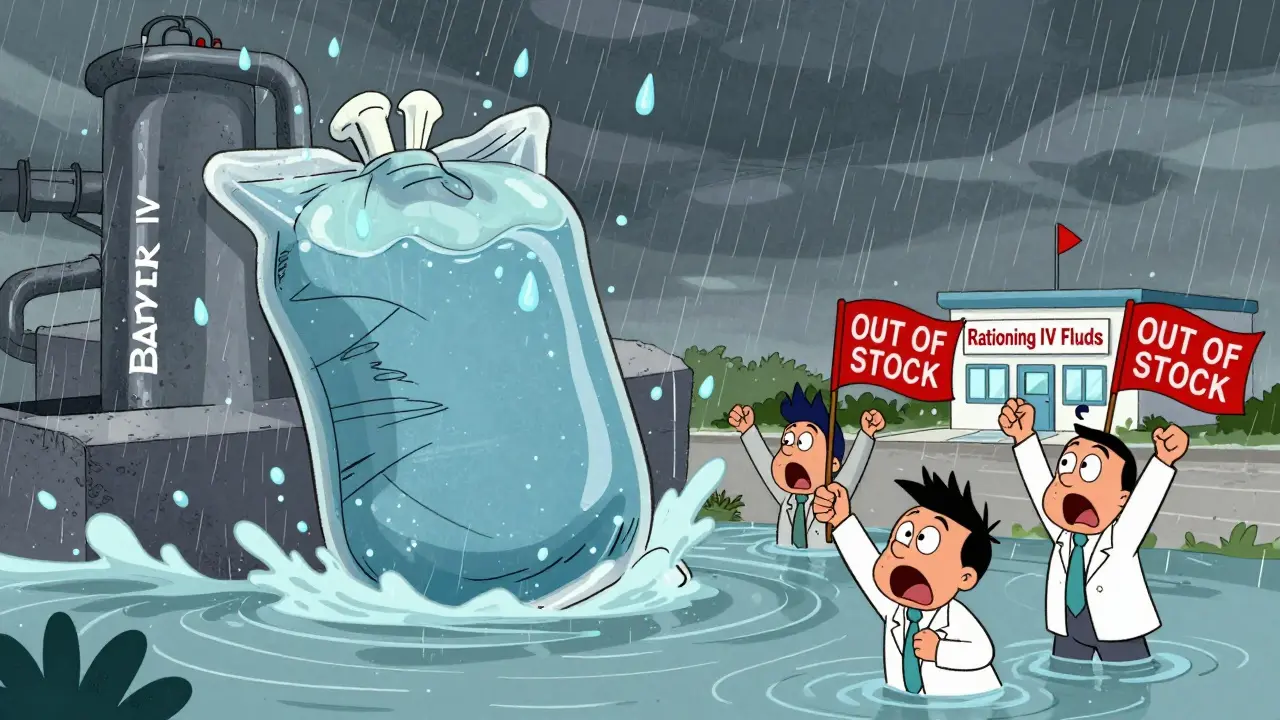
When Hurricane Helene hit North Carolina in September 2024, most people focused on the flooded homes and downed power lines. But behind the scenes, a quieter crisis was unfolding: hospitals across the U.S. ran out of IV fluids. Not just a few bags. Thousands. The Baxter plant in North Cove, which made 60% of the nation’s saline and other IV solutions, was knocked offline. Within 72 hours, emergency rooms were rationing fluids. Elective surgeries were canceled. Cancer patients had to wait for chemo because their drips couldn’t be filled.
This wasn’t an accident. It was a predictable failure.
For years, experts have warned that the U.S. pharmaceutical supply chain is dangerously fragile. And now, climate change is turning that fragility into a public health emergency. Natural disasters aren’t just destroying homes-they’re cutting off access to life-saving medicines.
Why Puerto Rico Still Matters
Most Americans don’t realize that a single island produces nearly half of the sterile injectables used in U.S. hospitals. Before Hurricane Maria in 2017, Puerto Rico was home to 55 FDA-approved drug manufacturing sites. That included facilities making insulin, antibiotics, chemotherapy drugs, and saline bags. When the storm knocked out power for months, the supply of insulin dropped by 80%. Patients went without. Some died.
The FDA later confirmed: 14 critical drugs were in short supply for over a year. Hospitals had to choose who got treatment and who didn’t. It wasn’t just a medical problem-it was an ethical crisis.
Even today, Puerto Rico still produces 10% of all FDA-approved drugs. And the island remains vulnerable. Power grids are still unreliable. Flood zones have expanded. Yet, little has changed in how drugs are made or where they’re made.
The Hidden Geography of Drug Risk
It’s not just Puerto Rico. The U.S. drug supply chain is concentrated in a few high-risk zones.
Western North Carolina is one of them. The town of Marion houses Baxter’s main IV fluid plant. Spruce Pine, just 40 miles away, supplies 90% of the high-purity quartz used in medical devices like heart monitors and dialysis machines. Both areas are now in the top 5% of U.S. counties most likely to face a major weather disaster.
According to a 2024 JAMA study, 65.7% of all U.S. pharmaceutical manufacturing facilities are located in counties that have declared a weather emergency since 2018. Hurricanes are the biggest threat-responsible for nearly half of all climate-related drug disruptions. But floods, wildfires, and even extreme heat are catching up.
When a tornado hit Pfizer’s plant in Rocky Mount, North Carolina in 2023, 27 specific medicines vanished from shelves. It took nine months to restore production. When flooding hit Abbott’s infant formula plant in Michigan in 2022, the shortage lasted eight extra weeks. Each disaster exposed the same flaw: too few factories, too much dependence on single locations.
Why There’s No Backup Plan
You’d think drugmakers would have backups. They don’t.
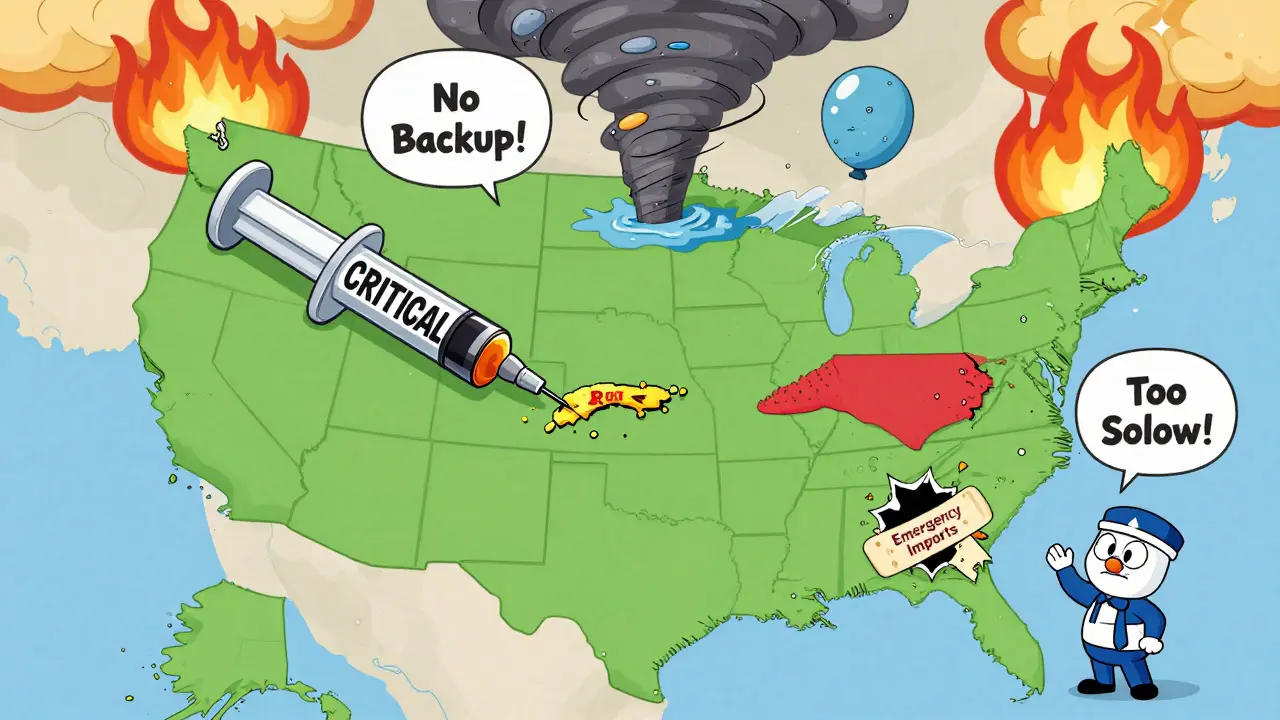
For 78% of sterile injectable drugs in the U.S., there are only one or two factories that make them. If one goes down, there’s no Plan B. Why? Because making drugs is expensive, slow, and tightly regulated. It takes six to twelve months to start up a new facility. Getting specialized equipment-like clean-room machines or sterile fill lines-can take two to three years.
On top of that, the industry runs on a just-in-time model. That means companies keep minimal inventory. They make drugs as they’re needed, not before. It saves money. But it leaves zero buffer when disaster strikes.
After Hurricane Maria, it took 11 months to restore power to Puerto Rico’s factories. Insulin shortages lasted 18 months. That’s not a glitch-it’s the system working as designed. And it’s not sustainable.
What’s Being Done? Not Enough
The FDA now officially lists natural disasters as a top cause of drug shortages. In 2024, climate-related disruptions accounted for 32% of all shortages. That’s up from 18% in 2017.
Some steps are being taken. The FDA created an Emergency Declaration pathway after Maria to fast-track imports of drugs from overseas. But it took 28 days to approve saline from Europe during the last shortage. In a crisis, that’s too slow.
A new pilot program in the Strategic National Stockpile started storing emergency IV fluid reserves in hurricane-prone states. During Helene, it cut shortage duration by 40% compared to Maria. That’s progress. But the stockpile only holds enough for 10 days of national demand.
Meanwhile, companies like Sensos.io are using AI to predict weather impacts on supply chains. One system flagged Helene’s threat to IV fluid production 14 days in advance. A few hospitals used that warning to stockpile extra bags. Most didn’t.
The Cost of Doing Nothing
The financial cost is rising fast. The market for pharmaceutical supply chain resilience is expected to hit $9.7 billion by 2029. But most of that money is going to consultants and software-not to building new factories or diversifying production.
Only 31% of top pharmaceutical companies have actually implemented real resilience strategies. Sixty-eight percent now assess climate risks, but that’s just the first step. Turning risk assessments into action? That’s where most fall short.
The FDA is pushing a new rule for 2025: drugmakers must keep 90-day emergency inventories of critical medicines and submit climate risk plans. If passed, this could prevent 60% of future climate-related shortages. But it would also raise drug prices by 4-7%.
Some argue that’s too expensive. Others say it’s the price of survival.
Who Gets Left Behind?
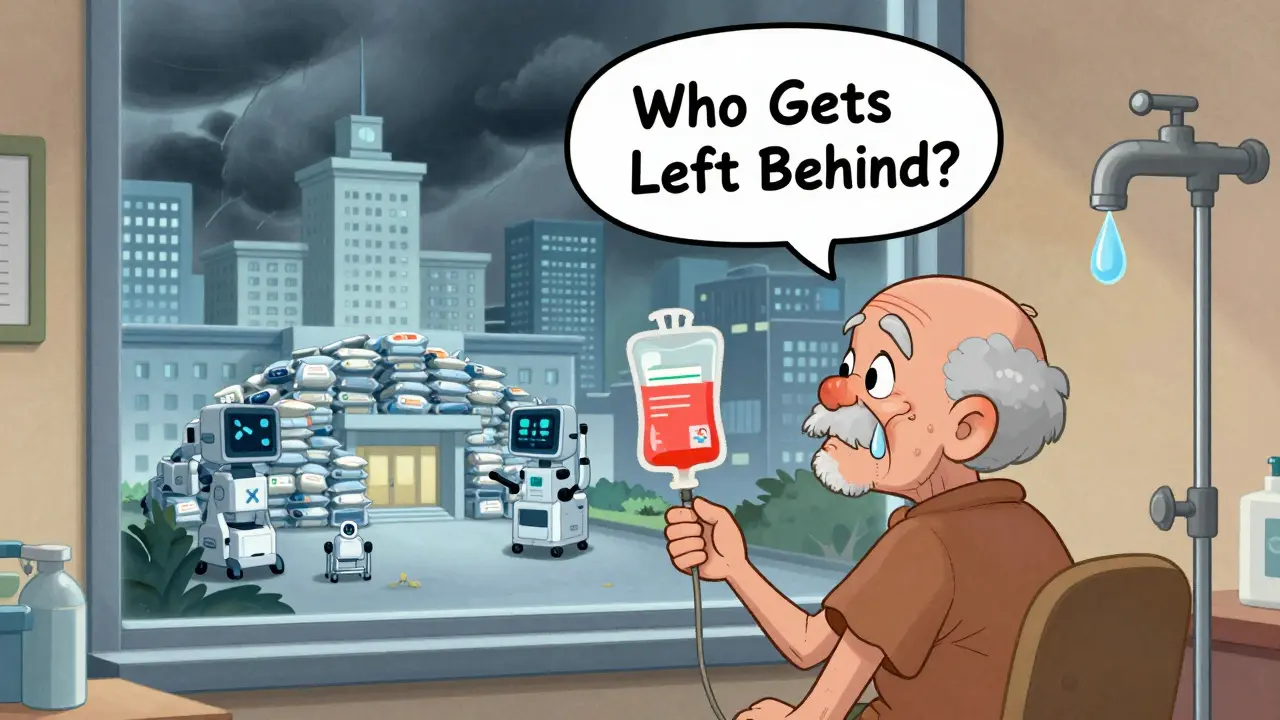
Large hospitals with 500+ beds are over three times more likely to map their supply chains than small clinics. That means rural hospitals, community health centers, and safety-net providers are the first to run out of medicine during a disaster.
When IV fluids disappeared in 2024, urban hospitals had backup systems. Rural ones didn’t. Cancer patients in Appalachia waited longer for chemo. Diabetics in the Gulf Coast rationed insulin. These aren’t abstract risks-they’re daily realities for millions.
And it’s only going to get worse. NOAA predicts a 25-30% increase in Category 4 and 5 hurricanes by 2030. That means more storms hitting the same fragile manufacturing zones.
The American Society of Clinical Oncology warns that by 2027, cancer patients could face treatment delays during 8 to 10 major climate disasters every year. That’s not speculation. That’s a projection based on current trends.
What Needs to Change
There are no easy fixes. But here’s what’s needed:
- Diversify manufacturing. Move production out of high-risk zones. Build new facilities in geographically dispersed, climate-resilient areas.
- Build strategic reserves. Stockpile essential drugs like insulin, saline, antibiotics, and chemo agents-not just for days, but for weeks.
- Speed up approvals. Create faster pathways for emergency production during disasters. Don’t wait 28 days to import救命药.
- Require climate plans. Make it mandatory for all drugmakers to submit resilience plans as part of FDA approval.
- Invest in local resilience. Help small hospitals and clinics get access to backup supplies and mapping tools.
The industry talks about innovation. But innovation shouldn’t mean faster pills-it should mean safer access. When a storm hits, you shouldn’t have to choose between your home and your medicine.
Climate change isn’t a future threat to the drug supply. It’s happening now. And the people paying the price aren’t CEOs or investors. They’re the ones lying in hospital beds, waiting for a bag of saline to arrive.
Why do natural disasters cause drug shortages?
Natural disasters damage manufacturing plants, disrupt transportation, and knock out power grids that drug factories rely on. Many critical drugs are made in just one or two facilities-often in areas prone to hurricanes, floods, or wildfires. When those sites go offline, there’s no quick replacement. The industry’s just-in-time inventory system means there’s little to no backup stock, so shortages happen fast.
Which drugs are most at risk during climate disasters?
Sterile injectables are the most vulnerable: IV fluids, insulin, antibiotics, chemotherapy drugs, and anesthetics. These require clean-room manufacturing and can’t be easily substituted. Many are generics with low profit margins, so companies don’t invest in backup production. During Hurricane Maria, saline, insulin, and chemotherapy drugs were among the hardest to get. After Hurricane Helene, IV fluids became the top concern.
Is the U.S. government doing enough to prevent these shortages?
Not yet. While the FDA now tracks climate-related disruptions and has created emergency pathways for imports, these responses are slow and reactive. The proposed 2025 rule requiring 90-day emergency stockpiles is a step forward, but it’s not mandatory yet. Most drugmakers still don’t have climate resilience plans. And funding for infrastructure upgrades is minimal compared to the scale of the problem.
Can we make drug manufacturing more resilient without raising prices?
It’s possible, but it requires investment. Building redundant factories, stockpiling key drugs, and using AI to predict disruptions all cost money. Some experts argue that the 4-7% price increase from new safety rules is worth it-because the cost of a shortage, in lives and emergency care, is far higher. The real issue isn’t cost-it’s prioritization. Right now, profit margins come before patient safety.
What can hospitals and patients do right now?
Hospitals can start mapping their supply chains-knowing where their drugs come from and who their backup suppliers are. Some, like Mayo Clinic, have cut response times by 65% just by doing this. Patients on critical medications should talk to their doctors about having a small emergency supply on hand, if possible. Stay informed about FDA shortage alerts. And advocate for policy changes: demand that elected officials support drug supply resilience as a public health priority.



Coral Bosley
January 20, 2026 AT 22:47The IV fluid shortage during Helene wasn't just a logistics failure-it was a moral collapse. People died because corporations chose profit over preparedness. And now we're supposed to be impressed that a 10-day stockpile is 'progress'? That's like handing out bandages after a grenade goes off. They knew this was coming. They just didn't care enough to act until the bodies started piling up.
Steve Hesketh
January 21, 2026 AT 15:46I come from Nigeria, where we've been managing medicine shortages for decades-but not because we're strong, because we're desperate. What happened in Puerto Rico and North Carolina? That's not a first-world problem. That's a human problem. We don't have fancy AI or FDA pathways. We have mothers boiling water to clean syringes. If the U.S. can't protect its own people from climate-driven drug shortages, what hope do the rest of us have? This isn't about politics. It's about dignity.
Kevin Narvaes
January 22, 2026 AT 02:18so like... the whole pharma system is just one big domino thing? one storm knocks out one plant and suddenly no one can get insulin? and theyre like 'oops' and then wait 11 months? lmao. why do we even have a government if the only thing it does is approve 28 day import delays? i mean, if my toaster breaks i can get a new one in 2 days. why does my life depend on a factory in a hurricane zone? someone explain this to me like im 5. or better yet, like im dying in a hospital bed.
Dee Monroe
January 24, 2026 AT 02:17There’s a deeper layer here that nobody wants to talk about: we’ve outsourced not just manufacturing, but moral responsibility. We’ve turned medicine into a commodity-something to be optimized, streamlined, and maximized for ROI. But medicine isn’t a product. It’s a lifeline. And when you treat a lifeline like a spreadsheet cell, you don’t get efficiency-you get corpses. The real tragedy isn’t that the plants are in risky areas. It’s that we’ve normalized the idea that some lives are disposable if the cost of saving them is too high. We’ve built a system that values efficiency over ethics, and now the bill is coming due-in hospital beds, in quiet homes, in the silence after a child’s last breath.
Alex Carletti Gouvea
January 24, 2026 AT 02:42Why are we letting foreign disasters dictate our medicine supply? Puerto Rico’s not even a state. And now we’re supposed to rebuild factories there? No. We need to bring this back to America. Make it here. Employ Americans. Stop outsourcing our healthcare to islands with broken power grids. This isn’t globalization-it’s surrender. If we want real resilience, we stop begging for imports and start building here. Made in USA isn’t a slogan-it’s a survival strategy.
Philip Williams
January 25, 2026 AT 11:45The data presented here is both compelling and deeply concerning. The concentration of pharmaceutical manufacturing in climate-vulnerable regions represents a systemic risk of unprecedented scale. The fact that 65.7% of facilities are located in counties that have declared weather emergencies since 2018 is not a coincidence-it is a failure of risk modeling and regulatory foresight. The proposed 90-day inventory requirement, if implemented with enforceable penalties and federal subsidies, could mitigate up to 60% of future disruptions. However, without mandatory geographic diversification and public investment in redundant infrastructure, even this measure will remain insufficient. We must treat pharmaceutical supply chains as critical national infrastructure, on par with power grids and water systems.
Yuri Hyuga
January 25, 2026 AT 22:33This is the quiet emergency no one talks about 🌪️💉. I’ve worked in public health across three continents. What happened in Puerto Rico? That’s not a natural disaster-it’s a manufactured one. We knew the risks. We ignored them. Now we’re pretending AI predictions and 10-day stockpiles are solutions. They’re bandaids on a hemorrhage. We need to stop treating medicine like a luxury item and start treating it like oxygen. If you can’t breathe, nothing else matters. Let’s stop debating cost and start saving lives. The tools are here. The will? Not so much. But we can still change that. 🙏
shubham rathee
January 26, 2026 AT 13:18Ben McKibbin
January 28, 2026 AT 01:19Let’s be honest-the real villain here isn’t climate change. It’s corporate consolidation. We used to have dozens of small manufacturers making critical drugs across the country. Now it’s three companies, three plants, one supply chain. And when those plants go dark? Poof. No more insulin. No more saline. No more chemo. The answer isn’t just stockpiles or AI-it’s antitrust action. Break up the monopolies. Encourage regional manufacturing. Let communities build local resilience. We don’t need more consultants. We need more factories. And we need them spread out-not clustered like eggs in one basket during a tornado.
Jerry Rodrigues
January 29, 2026 AT 14:08