
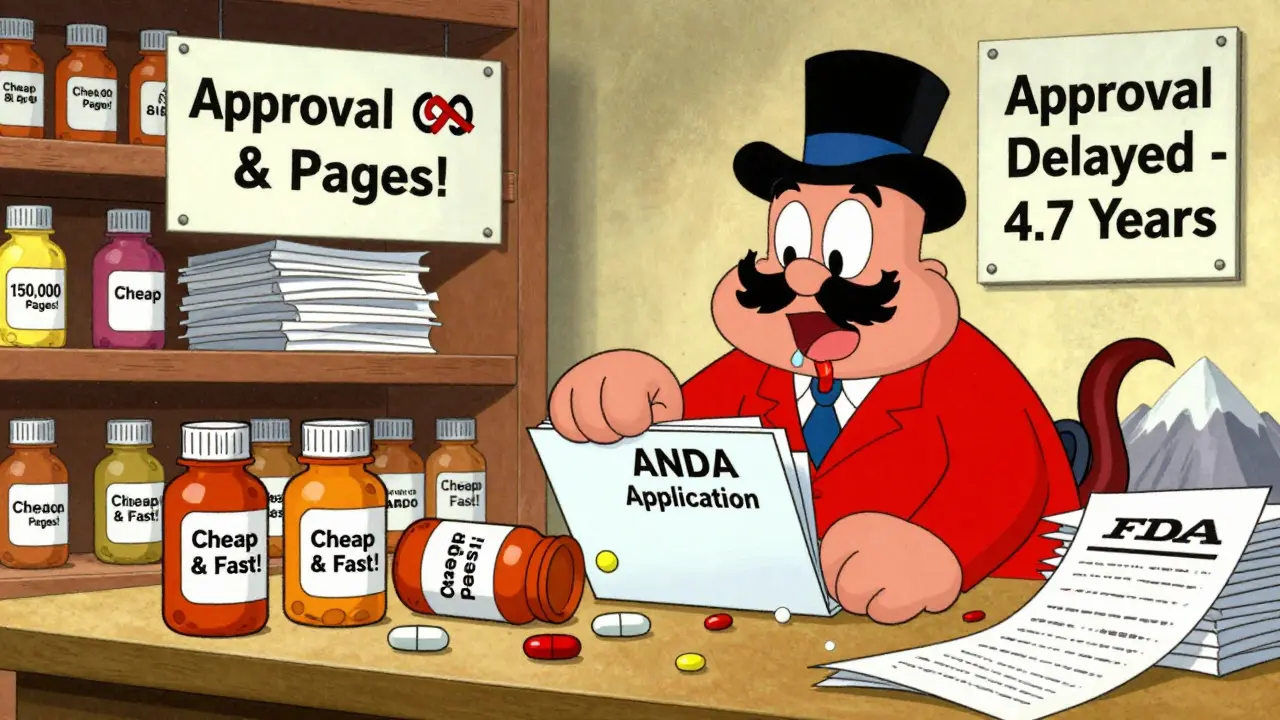
When you pick up a generic pill at the pharmacy, you’re paying a fraction of what you’d pay for the brand-name version. But have you ever wondered why some generics take years to hit the shelf - or why they still cost more than they should? The answer lies in the FDA approval process and the hidden costs buried in its bureaucracy.
Generic drugs make up 90% of all prescriptions filled in the U.S., yet they account for only 12% of total drug spending. In 2024 alone, generics saved the healthcare system $467 billion. That’s not a small number - it’s the equivalent of cutting the annual cost of Medicare Part D by nearly half. But behind those savings is a system that’s become slower, more expensive, and increasingly unfair for manufacturers trying to bring affordable drugs to market.
The Hidden Price Tag of Getting a Generic Drug Approved
It’s easy to assume that because generics are copies of brand-name drugs, the approval process should be simple. But that’s not how it works. The FDA requires every generic drug to submit an Abbreviated New Drug Application (ANDA). While it’s called “abbreviated,” the paperwork is anything but. A typical ANDA submission today averages 150,000 to 200,000 pages. That’s three times the size of what it was in 2013.
And then there’s the cost. For a single generic drug application, manufacturers pay:
- $136,485 in product fees
- $238,055 in facility fees (if they operate a manufacturing site)
- Plus additional application review fees
That adds up to roughly $375,000 just to get the FDA to look at your drug. Compare that to a brand-name drug, which costs over $3.6 million to approve under the Prescription Drug User Fee Act (PDUFA). On paper, generics look cheaper. But here’s the catch: brand-name companies get detailed feedback during development. Generic manufacturers don’t - not anymore.
The 2015 Policy That Broke the System
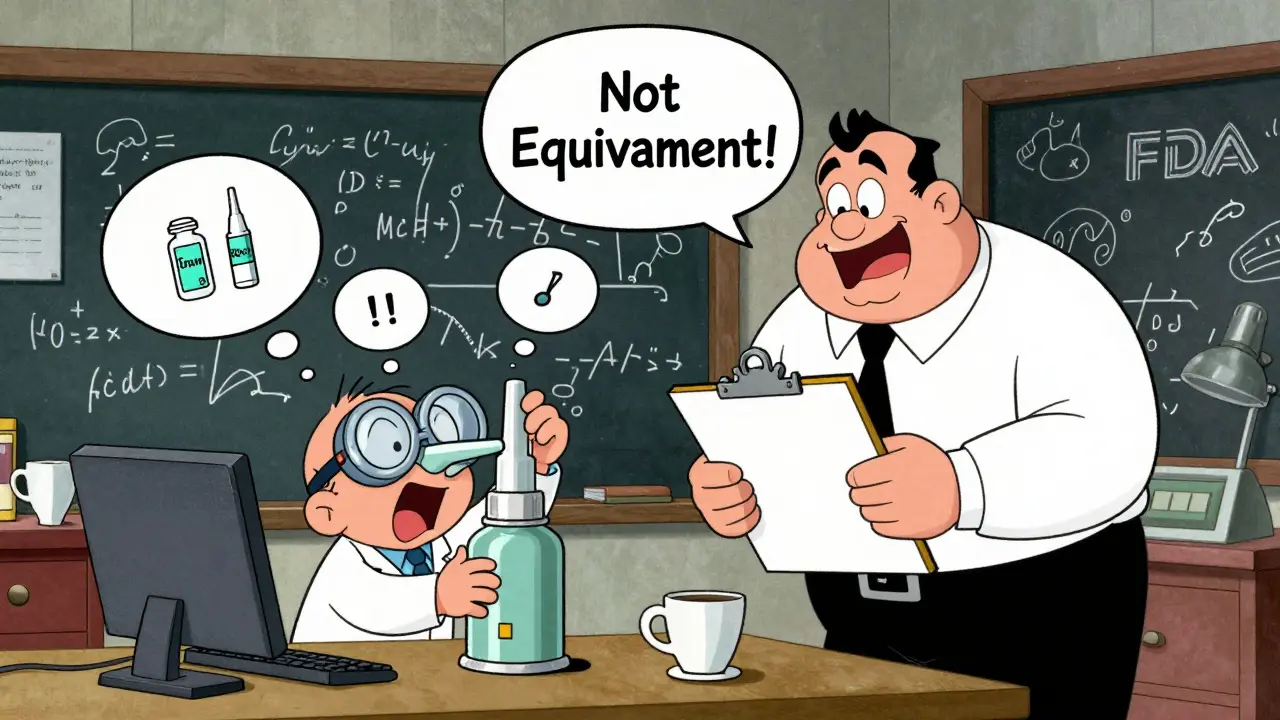
In 2015, the FDA stopped giving specific feedback on formulation details for complex generics. What does that mean? Let’s say you’re making a generic version of a nasal spray. The active ingredient might be the same, but how it’s delivered - the spray pattern, viscosity, particle size - matters. These are called Q1/Q2 sameness requirements.
Before 2015, the FDA would tell manufacturers: “Your spray droplets are too large. Adjust the pressure.” Now, they just say: “Not equivalent.” No specifics. No guidance. Just a rejection.
One mid-sized generic company told RAPS in 2024 they spent $8.7 million and tried three different formulations of a single nasal spray over seven years - all because the FDA wouldn’t tell them what was wrong. That’s not innovation. That’s guesswork.
As a result, complex generics - things like inhalers, injectables, and topical creams - now face approval delays of 2 to 3 years longer than simple pills. And those are the drugs many patients rely on for chronic conditions.
Why Some Generics Take Forever - And What It Costs Patients
It’s not just about money for manufacturers. It’s about people.
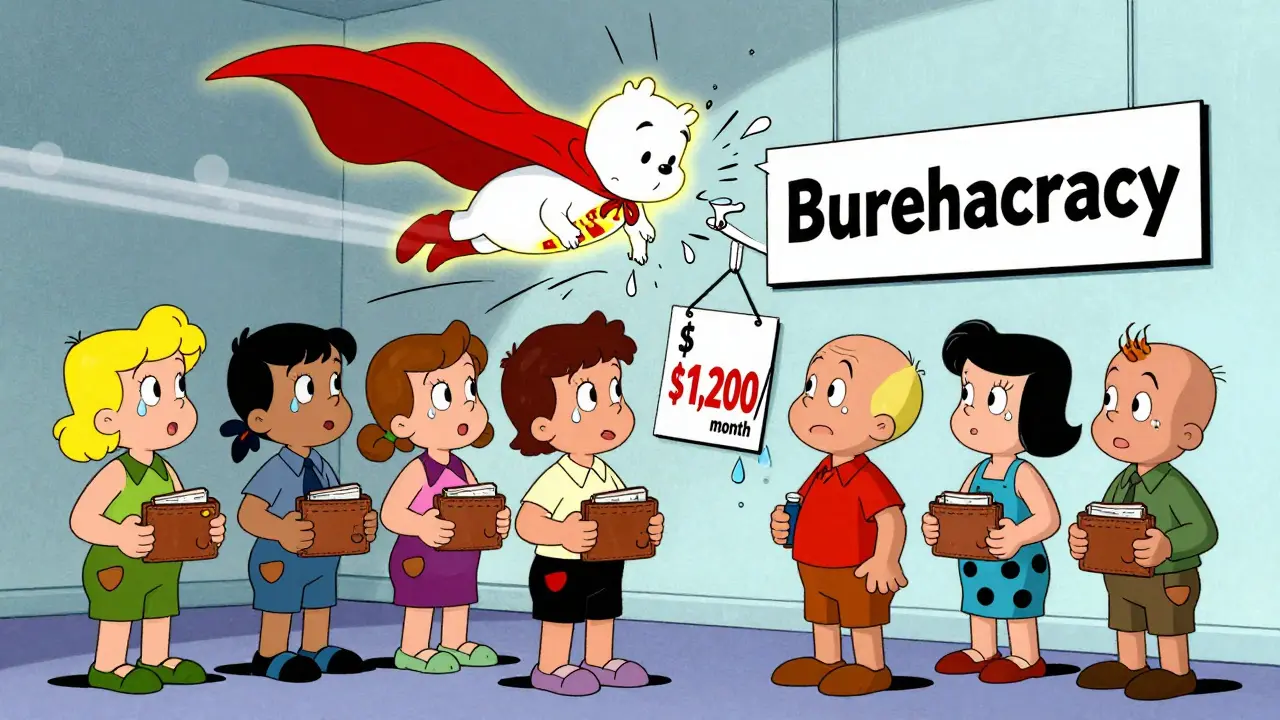
Between 2016 and 2020, generic versions of testosterone replacement therapy were delayed by 4.7 years. During that time, patients paid 300% more for the brand-name version. One Reddit user wrote: “I’ve been paying $1,200 a month for my generic glipizide because the FDA won’t approve the cheaper version. I’m on a fixed income. This isn’t a choice.” That thread had 147 comments - all from people in the same boat.
Complete Response Letters (CRLs) - the FDA’s formal rejection notices - now cost generic companies $2 to $5 million to fix. And they’re more common than ever. For standard generics, only 35% of submissions get rejected on the first try. For complex ones? It’s 58%. That means most companies have to go back, rework, resubmit, and wait again.
And while the FDA says its goal is to approve 90% of priority applications in the first cycle by 2027, their own 2023 data shows average review times are 11.2 months - longer than the promised 10 months. For complex drugs? It’s closer to 18 months.
The Bureaucracy vs. Public Health Tug-of-War
Some argue the FDA’s strictness keeps dangerous drugs off the market. They point to the 2022 valsartan recall, which affected 22 million people because of contamination. “The extra scrutiny saves lives,” said a pharmacist on Pharmacy Times in October 2025.
But here’s the contradiction: the same FDA that rejected detailed feedback on formulation is now approving biosimilars - complex biologic drugs - faster than ever. Why? Because they’re funded differently. The agency has more resources, clearer guidelines, and direct communication channels with manufacturers.
Generic drugmakers don’t get that luxury. They’re stuck in a system that treats them like second-class applicants. Terry Wilcox from Patients Rising put it bluntly: “A decade ago, the FDA created new bureaucratic hurdles that slow down the approval process for generic medications - and patients are paying the price.”
FDA Commissioner Robert Califf admitted in July 2024 that resource constraints impact feedback on complex applications. But he also defended the current system. The truth? The FDA is caught between two goals: speed and safety. And right now, safety is winning - at the cost of access.
What’s Changing - And What Could Save Billions
There’s hope. In September 2025, Congress introduced H.R. 1843 - the Increasing Transparency in Generic Drug Applications Act. It’s bipartisan. It has 72 co-sponsors. And it demands the FDA return to giving specific feedback on formulation.
The Congressional Budget Office estimates this single change could cut approval times for complex generics by 18 to 24 months. That means 12 to 15 more generic drugs hit the market every year. And according to their analysis, that would generate $1.8 billion to $2.3 billion in annual savings - just from those drugs.
Over five years, that adds up to $18 billion to $23 billion in total savings. That’s enough to cover free insulin for millions of Americans for over a decade.
Meanwhile, the FDA is preparing for GDUFA IV - the next round of user fee negotiations starting in 2028. Industry groups are pushing for a 3-5% annual fee increase to hire more reviewers. But if they don’t fix the feedback problem, more money won’t help. You can’t speed up a process that’s built on guesswork.
What This Means for You
If you take a generic drug - and most people do - you’re benefiting from a system that’s broken. The savings you see at the pharmacy counter are real. But they’re also fragile. Every delay in approval means a brand-name drug stays on the market longer. Every rejection without feedback means more time, more money, and more pain for manufacturers - and ultimately, for patients.
The solution isn’t to remove oversight. It’s to make it smarter. Give generic manufacturers the same clarity brand-name companies get. Restore specific feedback. Reduce guesswork. Cut the red tape - not the safety standards.
Because in the end, a generic drug isn’t just a cheaper version. It’s the only version millions can afford. And if we keep treating its approval like a maze with no map, we’re not just slowing down supply - we’re denying care.
How much does it cost to get a generic drug approved by the FDA?
The total cost to submit a single generic drug application (ANDA) is roughly $375,000. This includes $136,485 in product fees, $238,055 in facility fees (for manufacturers), and additional application review fees. This doesn’t include the cost of R&D, clinical testing, or fixing rejected applications, which can add millions more.
Why are generic drug approvals taking longer than they used to?
Since 2015, the FDA stopped providing specific feedback on formulation details for complex generics - like nasal sprays or injectables. Without knowing exactly what’s wrong, manufacturers must guess and reformulate, often multiple times. This has added 2-3 years to approval timelines for these drugs. Review times have also increased due to larger, more complex submissions - now averaging 150,000-200,000 pages per application.
Do brand-name drugs cost more to approve than generics?
Yes. Brand-name drugs require a New Drug Application (NDA), which costs $3.685 million per application in FY 2025. Generics pay about $375,000. But brand-name companies get detailed, ongoing feedback during development. Generics get minimal guidance - especially for complex drugs - which leads to higher failure rates and longer timelines despite lower fees.
What is GDUFA, and how does it affect generic drug costs?
GDUFA stands for the Generic Drug User Fee Amendments. It’s a program created in 2012 that lets the FDA collect fees from generic drugmakers to fund the review process. The current version, GDUFA III, runs until 2027 and generates about $613 million annually. While it was meant to speed up approvals, it’s also created a rigid, costly system that favors simple drugs over complex ones.
How does FDA approval delay affect patient costs?
Delays mean brand-name drugs stay on the market longer without competition. For example, between 2016 and 2020, patients paid 300% more for brand-name testosterone therapy because generic versions were delayed. One study found that 83% of brand-name drugs face no generic competition five years after patent expiration - largely due to approval bottlenecks.
Is there legislation to fix this problem?
Yes. H.R. 1843, introduced in September 2025, requires the FDA to restore detailed formulation feedback for complex generics. The Congressional Budget Office estimates it could reduce approval times by 18-24 months and generate $1.8-$2.3 billion in annual savings. The bill has bipartisan support and is expected to move through committee in late 2025.
What Comes Next
The next five years will decide whether generic drugs remain a pillar of affordable care - or become a casualty of bureaucracy. The FDA’s upcoming GDUFA IV negotiations will set the tone for the next decade. Will they invest in more reviewers? Will they restore transparency? Or will they double down on a system that’s broken?
Patients aren’t asking for miracles. They’re asking for fairness. If a drug is bioequivalent, why should it take longer - and cost more - to approve than the original? The answer should be simple: it shouldn’t.

Angel Wolfe
February 27, 2026 AT 19:27Vikas Meshram
March 1, 2026 AT 11:53Ben Estella
March 1, 2026 AT 21:19Miranda Anderson
March 3, 2026 AT 06:16Gigi Valdez
March 3, 2026 AT 17:32bill cook
March 5, 2026 AT 13:56Katherine Farmer
March 7, 2026 AT 11:20Jimmy Quilty
March 8, 2026 AT 18:11Sneha Mahapatra
March 10, 2026 AT 14:24Brandon Vasquez
March 12, 2026 AT 13:09Brandie Bradshaw
March 12, 2026 AT 19:46Ajay Krishna
March 13, 2026 AT 13:32Noah Cline
March 14, 2026 AT 04:40Lisa Fremder
March 14, 2026 AT 06:33