
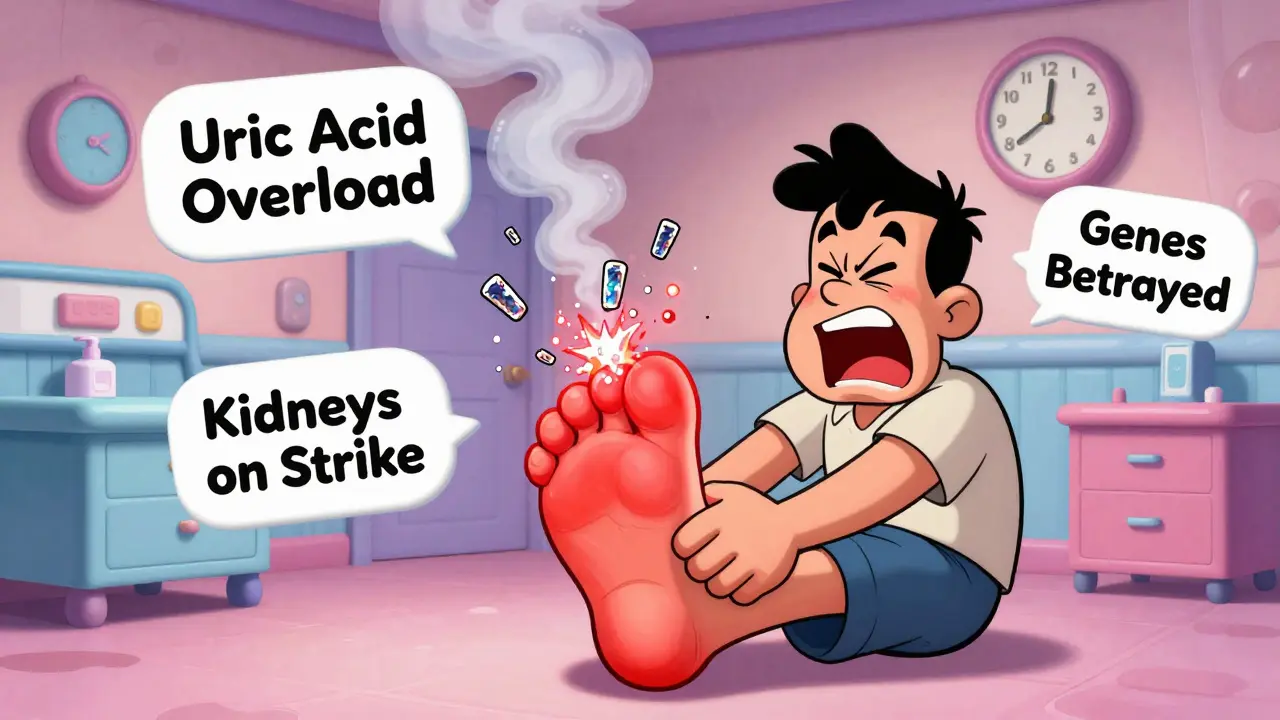
When your big toe suddenly feels like it’s been hit by a hammer-red, swollen, burning hot-you’re not imagining it. You’re having a gout attack. It doesn’t come out of nowhere. It’s the result of a slow buildup of uric acid in your blood, crystallizing in your joints like tiny shards of glass. And if you’ve ever had one, you know: this isn’t just discomfort. It’s a full-body alarm system screaming that something’s seriously off.
Most people think gout is just about eating too much steak or drinking too much beer. But the real story is deeper. It’s about your kidneys, your genes, and how your immune system reacts to crystals that shouldn’t be there. And if you’re on medication, you need to know why stopping it during a flare might make things worse-not better.
Why Uric Acid Turns Into a Weapon
Uric acid isn’t poison. It’s a natural waste product from breaking down purines-substances found in food and your own cells. But when it builds up past 6.8 mg/dL, it hits a tipping point. At that level, it starts forming sharp, needle-like crystals called monosodium urate. These aren’t just sitting there quietly. They’re like landmines in your joints.
Here’s the twist: humans are one of the only mammals that can’t break down uric acid. Most animals have an enzyme called uricase that turns it into allantoin, which is easy to flush out. We lost that gene millions of years ago. So we’re stuck with what we’ve got. And for about 90% of people with gout, the problem isn’t that they make too much uric acid. It’s that their kidneys won’t let it out.
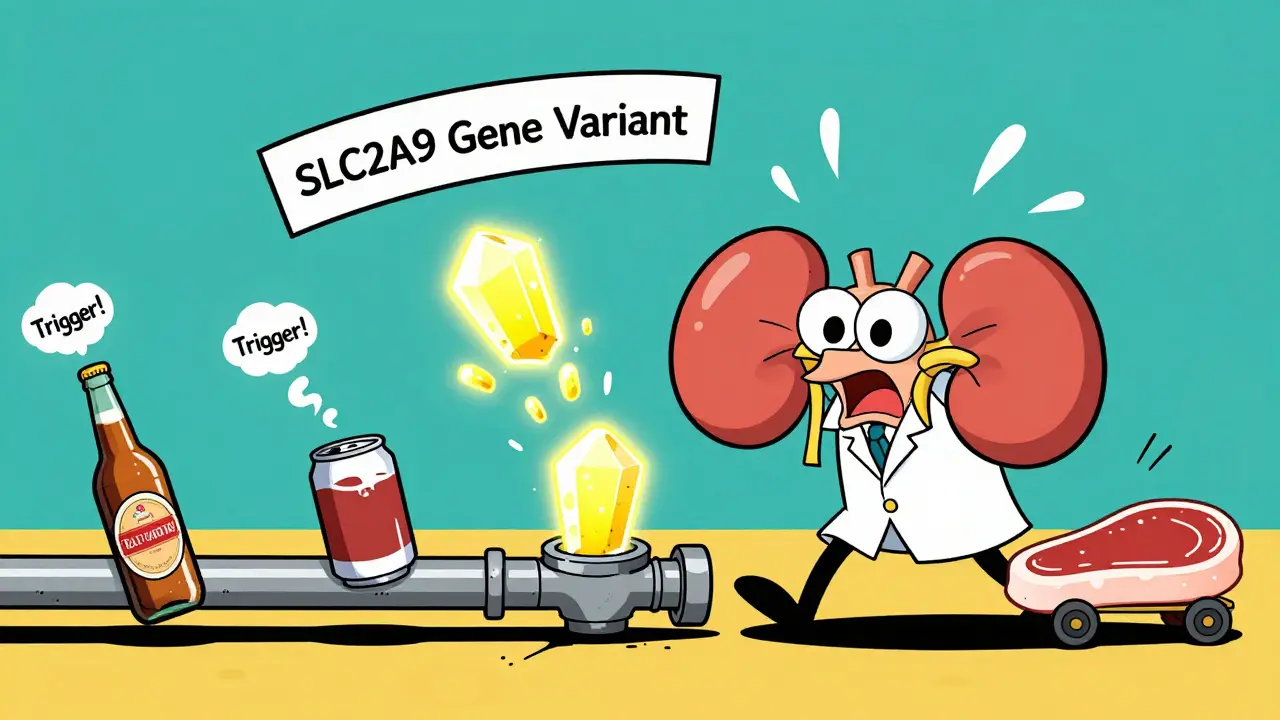
Genes play a huge role. Variants in SLC2A9, SLC22A12, and ABCG2 control how well your kidneys filter uric acid. If you’ve got a family history of gout, chances are you inherited a version of these genes that holds onto too much urate. That’s why gout runs in families-not because of diet alone, but because of biology.
What Actually Triggers an Attack
You might think a big steak or a six-pack of beer causes a flare. But triggers don’t always mean direct cause. They’re more like lighting a match next to gasoline.
- Dehydration: If you’re not drinking enough water, your urine output drops below 1.5 liters a day. That means uric acid gets concentrated and more likely to crystallize. A simple change-drinking 2+ liters of water daily-can cut your risk significantly.
- Alcohol: Beer is the worst offender. Each 12-ounce serving raises your gout risk by nearly 50%. That’s because beer contains high levels of purines and also blocks uric acid excretion. Spirits? Less risky. Wine? Barely any effect.
- Fructose: Soda, energy drinks, sweetened juices-these aren’t just empty calories. Fructose triggers your liver to produce more uric acid. One study showed a 20-30% spike after drinking just one sugary drink.
- Sudden changes in uric acid levels: This is the most misunderstood trigger. Starting or changing urate-lowering meds like allopurinol? You might think you’re fixing things. But if you don’t take anti-inflammatory meds alongside it, you’re almost guaranteed a flare. Why? Because any shift-up or down-in uric acid concentration makes crystals shift and break loose. Your immune system sees that as an attack and responds violently.
- Joint injury: Even a minor bump or twist can trigger a flare. That’s why gout often hits the big toe-it’s the most vulnerable joint.
And here’s the thing: a flare doesn’t mean you did something wrong yesterday. It could be triggered by stress, surgery, or even a cold. The crystal is already there. You just gave it a nudge.
How Medication Works-And Why People Get It Wrong
There are two phases of gout treatment: stopping the flare, and preventing the next one. Most people only focus on the first. That’s where things fall apart.
During an acute attack:
- NSAIDs (like indomethacin) are first-line. They block the inflammation pathway. A typical dose: 50 mg three times a day for 3-5 days.
- Colchicine works by calming down the immune cells that attack the crystals. Dose? 0.6 mg three times a day, but cut it back if you have kidney issues. Side effect? Diarrhea. About 1 in 5 people can’t tolerate it.
- Corticosteroids (like prednisone) are used when NSAIDs or colchicine aren’t an option. A 5-day course, starting at 30-40 mg, then tapering off.
These don’t fix the root problem. They just put out the fire. If you stop taking your long-term meds because you’re in pain? You’re setting yourself up for more flares.
For long-term control:
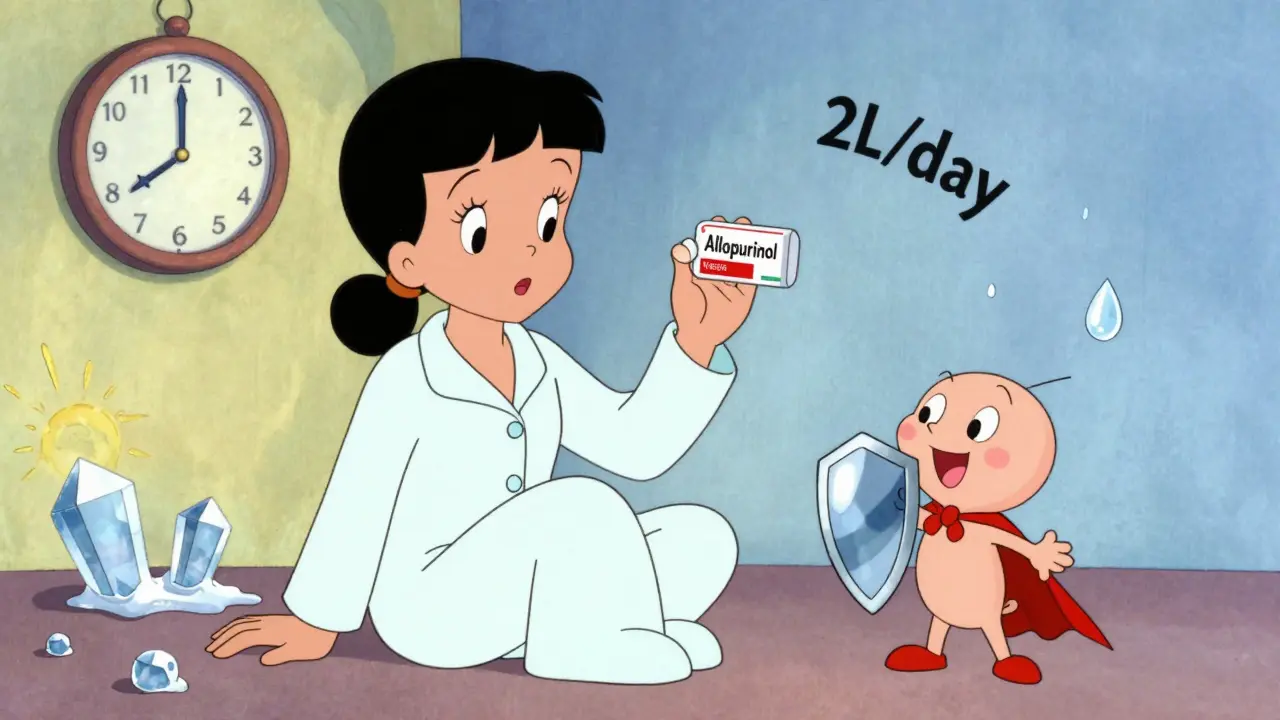
- Allopurinol is the go-to. It blocks uric acid production. Start at 100 mg daily. Increase by 100 mg every few weeks until your blood level hits below 6 mg/dL. For severe cases with tophi (those lumpy deposits under the skin), aim for 5 mg/dL or lower.
- Febuxostat is the alternative if allopurinol gives you a rash or doesn’t work. It’s stronger but comes with a higher cost and slightly higher heart risk in some patients.
- Probenecid helps your kidneys flush out more uric acid. But it only works if your kidneys are still functioning well (GFR above 50 mL/min). If you have kidney disease, this isn’t an option.
Here’s the critical part: you need to take these meds every day, even when you feel fine. Stopping for a week? Your uric acid climbs back to where it was in 2-4 weeks. The crystals reform. The flares come back.
The Secret Weapon: Prophylaxis During Treatment
When you start allopurinol or febuxostat, your body doesn’t know what’s coming. The crystals start dissolving. That’s good-but your immune system doesn’t see it that way. It sees it as chaos. So it fires off another flare.
That’s why the American College of Rheumatology says: always start prophylaxis with low-dose colchicine when beginning urate-lowering therapy.
Just 0.6 mg once or twice a day for 6 months cuts flare risk by 50-75%. That’s not optional. It’s essential. And it’s not just for the first few weeks-it’s for the full six months. Many patients stop too soon. They think, “I haven’t had a flare in a month,” so they quit the colchicine. Big mistake. The crystals are still dissolving. The risk stays high.
Diet Isn’t the Enemy-But It Matters
You don’t need to become a vegan to manage gout. But you do need to make smart swaps.
- Avoid: Organ meats (liver, kidneys), shellfish (shrimp, mussels), and sugary drinks. These are the big three triggers.
- Embrace: Low-fat dairy. One serving a day (like a cup of milk or yogurt) cuts your risk by 43%. Why? It helps your kidneys excrete uric acid.
- Hydrate: Water isn’t just for flushing out toxins. It dilutes uric acid in your blood and urine. Aim for 2-3 liters daily, especially if you’re on urate-lowering meds.
- Weight matters: Losing even 5-10% of your body weight can drop uric acid by 1-2 mg/dL. That’s like getting a free dose of medication.
And no, cherry juice or apple cider vinegar won’t cure gout. They might help a little, but they’re not replacements for proven treatment.
What Happens If You Don’t Treat It Long-Term
Gout isn’t just painful joints. Left unchecked, it turns into something worse.
- Tophi: These are visible lumps of uric acid crystals under the skin-on fingers, elbows, ears. They can destroy cartilage and bone.
- Joint damage: Repeated flares erode the joint surface. You’ll start losing mobility.
- Chronic kidney disease: Uric acid crystals can form in the kidneys, leading to stones or long-term damage.
But here’s the good news: if you keep your uric acid below 5 mg/dL for a full year, research shows that 70% of people with tophi see them completely disappear. That’s not a guess. That’s from the 2023 American College of Rheumatology meeting. It’s possible. But only if you stay consistent.
Common Mistakes (And How to Avoid Them)
- Mistake: Stopping allopurinol during a flare. Fix: Keep taking it. Add colchicine or NSAIDs for the flare.
- Mistake: Thinking “no pain, no gout.” Fix: Uric acid levels don’t care how you feel. Get tested every 2-5 weeks when adjusting meds, then every 6 months after.
- Mistake: Blaming every flare on food. Fix: Track your triggers-but remember, genetics and kidney function matter more than your last meal.
- Mistake: Skipping follow-ups. Fix: Your doctor needs your blood work. Without it, you’re flying blind.
And one more thing: if you’ve had a gout attack and your doctor didn’t mention long-term treatment? Ask for it. Most people don’t get the full picture until it’s too late.
What’s Next? New Hope on the Horizon
Researchers are now testing drugs that block the NLRP3 inflammasome-the exact immune switch that turns gout crystals into inflammation. Early trials show dapansutrile can cut flare duration by 40%. That’s huge. It’s not here yet, but it’s coming.
Another area? Gut health. Early studies suggest certain probiotics may help your body break down purines better. Not a cure, but a possible sidekick to traditional meds.
For now, the best strategy hasn’t changed: control the number, not just the pain. Lower uric acid. Stay hydrated. Take your meds. And don’t stop-even when you feel fine.
Can gout be cured permanently?
Gout can’t be “cured” in the traditional sense, but it can be completely controlled. If you maintain your serum uric acid below 5 mg/dL for 12+ months, tophi can dissolve, flares can stop, and joint damage can halt. This requires lifelong medication adherence and lifestyle management-not just during flares.
Why does gout often happen at night?
Body temperature drops slightly during sleep, especially in the extremities like the big toe. Lower temperature reduces uric acid solubility, making crystals more likely to form. Also, overnight dehydration and lower cortisol levels (which help control inflammation) can contribute to nighttime flares.
Is it safe to take NSAIDs long-term for gout?
NSAIDs are meant for short-term use during flares, not daily prevention. Long-term use increases risk of stomach ulcers, kidney damage, and high blood pressure. For ongoing prevention, focus on urate-lowering drugs like allopurinol-not repeated NSAID cycles.
Can I drink alcohol if I have gout?
Beer and spirits significantly increase gout risk. Wine has minimal effect. If you drink, limit beer to one 12-ounce serving per week or less. Avoid binge drinking entirely. Complete abstinence is safest, especially if you’ve had multiple flares.
How often should I get my uric acid levels checked?
When starting or adjusting urate-lowering medication, check every 2-5 weeks until you hit target (below 6 mg/dL). Once stable, check every 6 months. If you miss a dose or change your diet, retest within 4-6 weeks. Levels don’t lie-symptoms do.
Next Steps
If you’ve had one gout attack, your next step isn’t to wait for the next one. It’s to get your uric acid tested. Ask your doctor for a serum uric acid blood test. If it’s above 6 mg/dL, ask about starting allopurinol or another urate-lowering drug-and don’t forget to ask about colchicine prophylaxis.
If you’re already on medication and still getting flares, your dose may be too low. Or you might not be taking it daily. Or you’re still drinking beer. Or you’re dehydrated. Pick one thing to fix this week. That’s how you take back control.
Gout isn’t a punishment. It’s a signal. Listen to it. Act on it. And don’t let it define your life.


David McKie
February 24, 2026 AT 03:42This post is the most accurate thing I’ve read on gout in years-finally someone gets it. It’s not about steak, it’s about your kidneys being lazy. I’ve had three flares in two years, and guess what? I was drinking 3 liters of water daily and still got hit. Why? Because I stopped my allopurinol for a week after a flare. Stupid. Now I know: you don’t stop meds because you feel better. You stop when the crystals are gone. And they don’t vanish until your uric acid is below 5 for a full year. I’m on it now. No more excuses.
Southern Indiana Paleontology Institute
February 24, 2026 AT 18:58frickin’ hell. i read this whole thing. i thought gout was just from beer and steak. turns out my body’s just broken. no wonder i keep getting nailed in my toe. i’m gonna start chugging water like it’s my job. also, colchicine? sounds like a drug from a sci-fi movie. but if it stops the pain, i’m in. no more beer. ever. (well, maybe once a year on my birthday.)
Anil bhardwaj
February 25, 2026 AT 04:35honestly, this made me rethink everything. i’ve had gout for 8 years, never thought it was genetic. my dad had it too. now it makes sense. i started taking allopurinol last month, didn’t know i needed colchicine with it. i stopped the colchicine after 2 weeks because i felt fine. oops. gonna restart it. and yeah, i’m cutting out soda. it’s not just sugar-it’s poison for my joints. thanks for the clarity.
lela izzani
February 25, 2026 AT 15:58I’m a nurse who’s seen dozens of gout patients, and this is spot-on. So many people think if they avoid shrimp, they’re fine. Nope. The real issue is kidney excretion, and most don’t even get tested. I always tell my patients: treat the number, not the pain. If your uric acid is 8.5 and you’re symptom-free, you’re still damaging your joints. And yes-prophylaxis with colchicine isn’t optional. It’s the difference between a manageable condition and a nightmare. Please, if you’re on urate-lowering meds, don’t skip the anti-inflammatory cover. It saves you months of agony.
Nick Hamby
February 25, 2026 AT 20:42There’s a profound philosophical shift here: gout is not an event, it’s a process. We live in a culture of reactive medicine-we treat pain, not pathology. But gout reveals a deeper truth: the body doesn’t lie. The crystals are real. The genes are real. The kidneys are doing exactly what they’ve been coded to do-hold onto what they can’t process. And we, as humans, are stuck with an evolutionary glitch. We lost uricase. We became vulnerable. This isn’t punishment. It’s biology asking for cooperation. To manage gout is to enter into a quiet, daily pact with your own physiology. Take the pill. Drink the water. Don’t wait for pain to act. Act before pain arrives. That’s wisdom. That’s discipline. That’s the path to freedom from the hammer.
kirti juneja
February 26, 2026 AT 17:53OMG this is FIRE. i’ve been living with gout for 5 years and nobody ever told me about the colchicine prophylaxis thing. i thought it was just for flares. now i get why i kept getting hit even after starting allopurinol. i was basically throwing gasoline on a fire. also, low-fat yogurt? yes please. i’ve been eating it daily since reading this and my toe hasn’t screamed in 3 weeks. i’m not a vegan, but i’m definitely a gout warrior now. and no more energy drinks. my liver is gonna thank me. seriously, thank you for writing this. it’s like a gift wrapped in science.
Shalini Gautam
February 28, 2026 AT 05:26As an Indian woman who’s seen her mom suffer from gout for decades, I’m so glad someone finally explained why it runs in families. We thought it was because we ate too much dal and paneer. Nope. It’s our genes. My dad had it, my uncle had it, and now I’m on allopurinol. I didn’t know about the 6-month colchicine rule-I stopped after 2 weeks. Big mistake. Now I’m back on it. And I drink 3 liters of water every day. No more soda. My knees are happier. This isn’t just medical advice-it’s family legacy healing.
Natanya Green
February 28, 2026 AT 16:35WHY IS NO ONE TALKING ABOUT THIS?!?!?!?!?!?! I had my first gout attack last month and thought I was being punished for eating tacos. Turns out? My kidneys are lazy. My genes are faulty. And I’ve been taking my allopurinol… inconsistently. Like, “I feel fine, so I’ll skip it” inconsistent. NO MORE. I’m restarting colchicine. I’m drinking water like it’s my job. I’m avoiding beer like it’s an ex who cheated on me. And I’m getting my uric acid tested next week. I’m not just managing gout-I’m overthrowing it. With water. And science. And discipline. And maybe a little rage.
Steven Pam
March 1, 2026 AT 05:42This is the kind of post that changes lives. I’ve had gout for 12 years. I used to think it was just ‘bad luck.’ Now I know it’s a system failure-and I’m the one who can fix it. I started allopurinol, stopped the colchicine too soon, and paid for it with three flares. This time? I’m doing it right. Water? 3 liters. Colchicine? Daily for 6 months. No beer. No soda. No excuses. I’ve lost 15 pounds. My toe hasn’t flared in 90 days. And I’m not done. This isn’t about avoiding pain-it’s about reclaiming your life. You don’t have to suffer. You just have to show up. Every day. One pill. One glass of water. One choice. That’s how you win.