
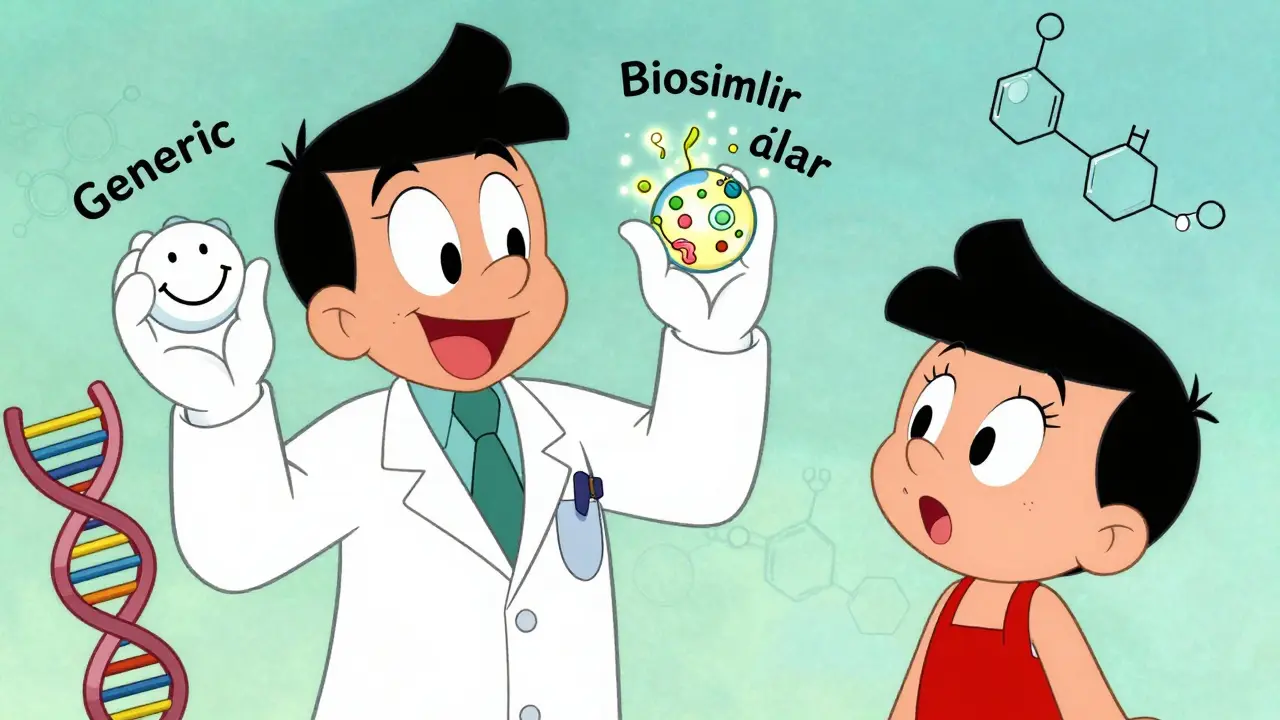
When you’re prescribed a new medication, you might hear your doctor or pharmacist mention biosimilar or generic as a cheaper alternative to the brand-name drug. At first glance, they sound the same-both save money. But they’re not interchangeable. Choosing the wrong one-or misunderstanding the difference-could affect how your treatment works, how often you refill, and even how much you pay out of pocket.
What’s the Real Difference Between Biosimilars and Generics?
Think of generics like copying a simple recipe. If the original drug is aspirin, the generic version has the exact same chemical formula, the same active ingredient, and works the same way in your body. It’s made in a lab using precise chemical reactions. That’s why the FDA can approve generics based on bioequivalence studies-showing they behave identically in your bloodstream. Biosimilars are more like trying to recreate a complex cake made by a master baker. The original is a biologic drug-something like Humira or Enbrel-made from living cells, not chemicals. These drugs are huge, intricate proteins. Even tiny changes in how the cells are grown, how they’re purified, or how they’re stored can alter the final product. So a biosimilar isn’t an exact copy. It’s highly similar. And that’s not a loophole-it’s science. The FDA requires biosimilars to undergo more than 100 analytical tests using tools like mass spectrometry and chromatography to prove they match the original in structure, function, and purity. Then they test them in animals and in small clinical trials. The goal isn’t perfection-it’s no clinically meaningful difference in safety or effectiveness.Cost Savings: Generics Cut Prices by 80%. Biosimilars Cut by 15-20%.
If you’re looking to save money, generics are the clear winner. For drugs like atorvastatin (Lipitor) or metformin, you’re often paying 80-85% less than the brand name. That’s hundreds of dollars a month saved. Biosimilars? They’re more modest. You’ll typically save 15-20% compared to the original biologic. That’s still meaningful-especially when the original costs $10,000 a year. A $2,000 savings on a cancer or autoimmune drug adds up fast. But it’s not the same as switching from a $200 brand to a $30 generic. Why the gap? Making a generic is cheap-$2 to $3 million and a few years. Making a biosimilar? That’s $100 to $250 million and 8 to 10 years. The manufacturing is complex. The equipment is specialized. The quality control is extreme. That cost doesn’t vanish-it just gets shared.When Can You Switch? It Depends on Your State and Drug Type
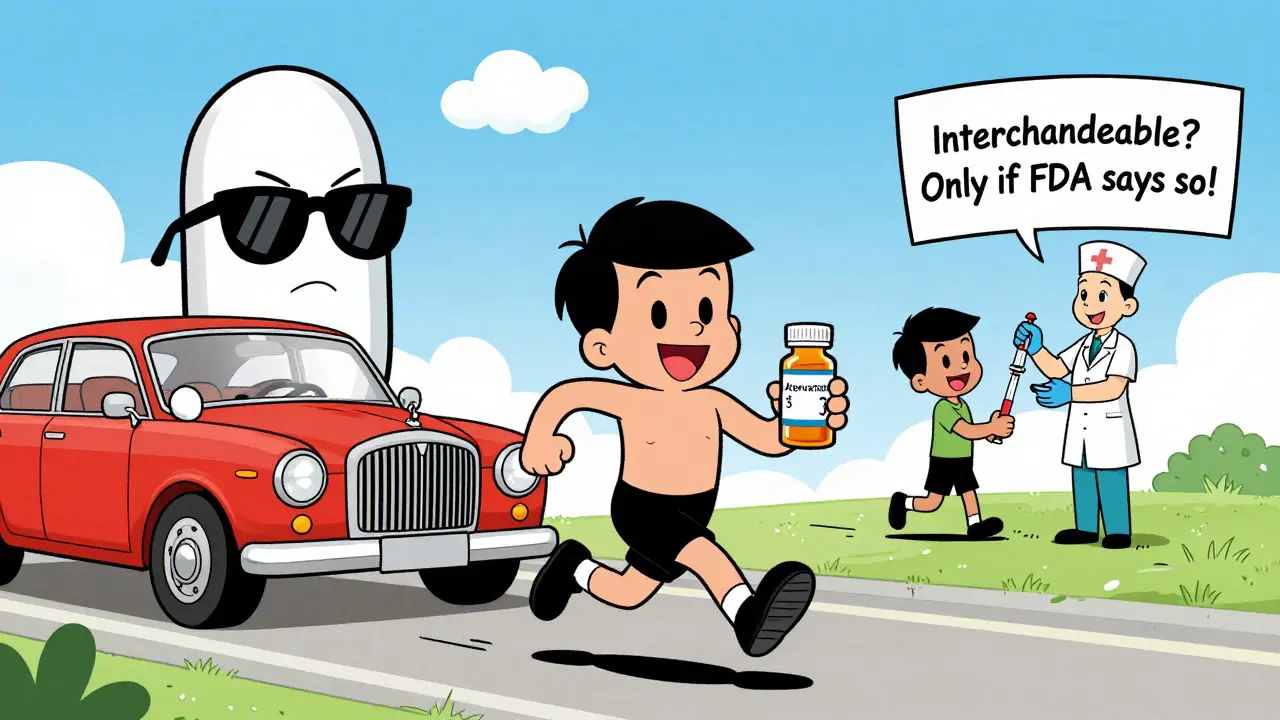
With generics, switching is easy. In 49 states, your pharmacist can swap a brand-name drug for a generic without asking you or your doctor-unless the doctor specifically says "dispense as written." Biosimilars? Not so simple. Only those labeled "interchangeable" by the FDA can be switched at the pharmacy without a new prescription. As of 2025, only a handful of biosimilars have that status-like Semglee (insulin glargine) and Cyltezo (adalimumab). Even then, 28 states require the pharmacist to notify your doctor within 72 hours of the switch. And if your drug isn’t interchangeable? Your doctor has to prescribe the biosimilar directly. No automatic swap. That means more paperwork, more calls, and sometimes delays.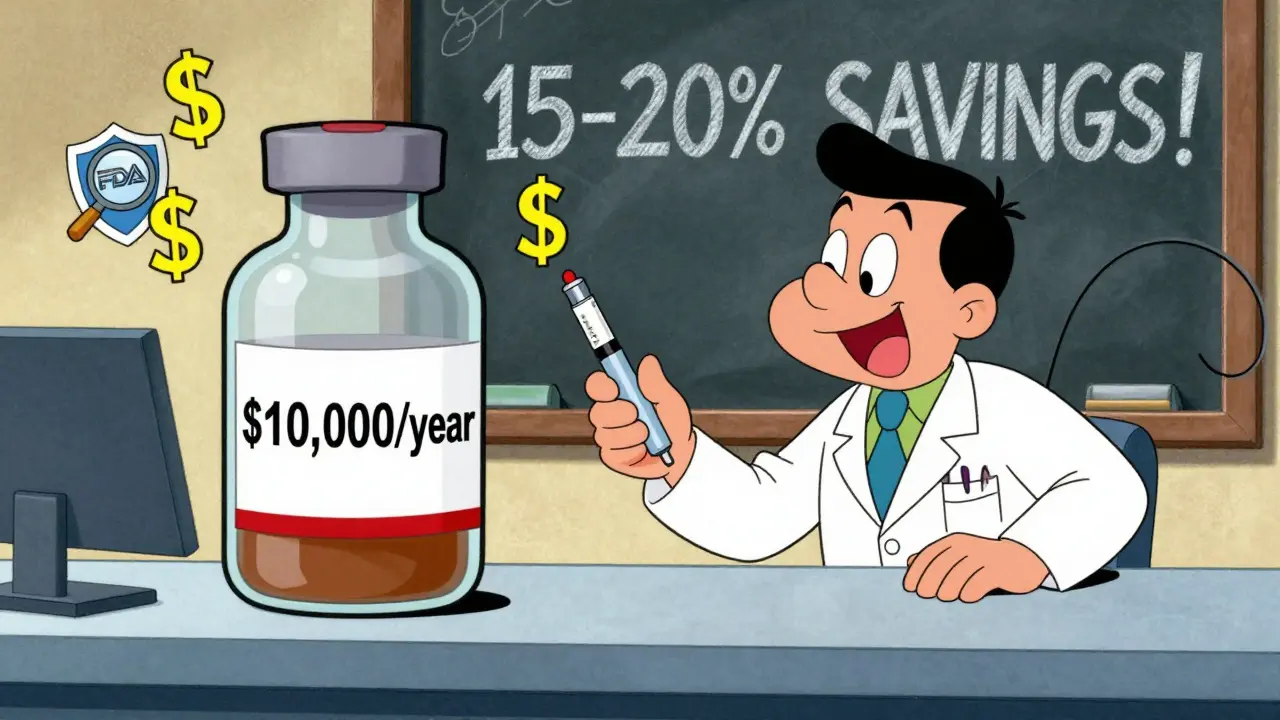
Which Conditions Use Which Type?
Generics cover the basics: high blood pressure, cholesterol, diabetes, thyroid issues, infections. If it’s a small molecule you swallow or inject once a day, there’s probably a generic. Biosimilars? They’re for the big guns. Drugs used to treat:- Rheumatoid arthritis (adalimumab, etanercept)
- Crohn’s disease and ulcerative colitis (infliximab, vedolizumab)
- Psoriasis and psoriatic arthritis
- Breast cancer (trastuzumab)
- Colorectal cancer (bevacizumab)
- Diabetes (insulin glargine)
Are They Safe? Real-World Evidence Says Yes
A lot of patients worry: "If it’s not identical, is it safe?" The answer is backed by data. A 2022 review of 128 studies involving over 38,000 patients with rheumatoid arthritis found no difference in effectiveness or side effects between biosimilar and brand-name infliximab. Another study in JAMA in 2019 looked at 47 trials comparing generics to brand-name heart drugs. The results? No difference in heart attacks, strokes, or deaths. Even the FDA’s own adverse event tracking shows biosimilars have nearly identical safety profiles. For example, biosimilar infliximab had 0.12 adverse events per 100 patient-years. The original? 0.15. The difference isn’t statistically meaningful. Real patient stories back this up. One woman in Brisbane switched from Humira to its biosimilar and saved $8,000 a year. Her joint pain didn’t return. A man with colon cancer switched to a bevacizumab biosimilar-his out-of-pocket cost dropped from $450 to $75 per infusion. His tumor markers stayed stable. Still, some people feel uneasy. A 2022 survey found 42% of psoriasis patients were hesitant to switch to a biosimilar. Anxiety isn’t about science-it’s about trust. That’s why education matters.What You Need to Know Before Switching
If your doctor suggests switching:- Ask which type you’re switching to. Is it a generic? A biosimilar? An interchangeable biosimilar? Don’t assume.
- Check your insurance. Some plans push biosimilars because they’re cheaper. Others still favor the brand. Ask about formulary rules.
- Know your state’s rules. If you’re in Queensland, New South Wales, or Victoria, the rules about pharmacist substitution for biosimilars may differ slightly from U.S. law-but the same principles apply: only interchangeable products can be swapped without a new script.
- Ask about support programs. Many biosimilar manufacturers offer patient assistance-co-pay cards, nurse hotlines, even delivery services. Amgen, Pfizer, and Sandoz all have them.
- Monitor your symptoms. If you switch and feel worse, don’t assume it’s the drug. But don’t ignore it either. Talk to your doctor. It could be a reaction, a dosing issue, or just stress.
Why Don’t More People Use Biosimilars?
Despite the savings, only 35% of eligible patients in the U.S. get prescribed a biosimilar, according to a 2023 JAMA Internal Medicine study. Why?- Doctors don’t know enough. Only 58% of non-specialist physicians feel confident prescribing them.
- Patent fights delay entry. Biologic companies file dozens of patents to block competition. On average, biosimilars enter the market 4.7 years later than they could.
- Pharmacies aren’t set up. Biosimilars often come in different pens or injection devices. Pharmacists need training. Patients get confused.
- Insurance doesn’t always help. Some plans still require step therapy-try the brand first, even if it costs more.
Bottom Line: Don’t Fear the Alternative-Understand It
Generics and biosimilars aren’t "second-rate" drugs. They’re the result of decades of science, regulation, and cost-saving innovation. Generics are your go-to for common conditions. Biosimilars are your lifeline for expensive, life-changing biologics. The key isn’t choosing one over the other. It’s knowing which one you’re getting-and why. If your doctor recommends a biosimilar, ask: "Is this interchangeable?" "What’s the evidence?" "Will my insurance cover it?" You’re not just saving money. You’re gaining access to treatments that were once out of reach. That’s not a compromise. That’s progress.Are biosimilars as safe as the original biologic drugs?
Yes. The FDA requires biosimilars to undergo extensive testing-including analytical studies, animal trials, and clinical trials-to prove they have no clinically meaningful differences in safety, purity, or effectiveness compared to the original. Real-world data from over 38,000 patients shows no increase in side effects or treatment failure when switching to a biosimilar. The FDA’s own adverse event reports show nearly identical safety profiles.
Can my pharmacist switch my brand-name drug to a biosimilar without asking me?
Only if the biosimilar is FDA-approved as "interchangeable" and your state allows pharmacy-level substitution. Even then, many states require the pharmacist to notify your doctor within 72 hours. If the biosimilar isn’t interchangeable, your doctor must prescribe it directly. You cannot be switched without your knowledge or consent unless the drug is labeled interchangeable and your state permits automatic substitution.
Why are biosimilars cheaper than the original but not as cheap as generics?
Because they’re far more complex to make. Generics are small molecules made with chemical synthesis-relatively simple and inexpensive. Biosimilars are large proteins made from living cells. Manufacturing requires specialized facilities, strict temperature controls, and years of development. The cost to bring one to market is $100-250 million, compared to $2-3 million for a generic. That’s why savings are 15-20%, not 80%.
Do I need to get blood tests after switching to a biosimilar?
Not because of the switch itself. If you were already getting regular blood tests to monitor your condition-like for rheumatoid arthritis or Crohn’s disease-you’ll likely keep doing them. But that’s because your disease requires monitoring, not because the biosimilar is riskier. Studies show no change in lab markers after switching. Your doctor will track your symptoms and disease activity, not your drug’s molecular structure.
What if I switch to a biosimilar and my symptoms get worse?
It’s unlikely the biosimilar caused it. Clinical trials and real-world data show no increase in treatment failure after switching. But if you notice new or worsening symptoms, talk to your doctor. It could be disease flare, stress, lifestyle changes, or even a different reaction to the injection device. Don’t assume it’s the drug. But don’t ignore it either. Your doctor can help determine if you need to switch back or adjust your treatment plan.
Are biosimilars approved in Australia?
Yes. The Therapeutic Goods Administration (TGA) in Australia approves biosimilars using standards similar to the FDA and EMA. Several biosimilars, including those for adalimumab, infliximab, and insulin glargine, are available in Australia. They’re listed on the Pharmaceutical Benefits Scheme (PBS), meaning they’re subsidized for patients. Access varies by prescription and condition, but they’re widely used in public hospitals and specialist clinics.
dean du plessis
December 28, 2025 AT 19:19Interesting read but honestly i’ve been on a biosimilar for my arthritis for two years now and my body didn’t even notice the switch
Elizabeth Alvarez
December 29, 2025 AT 11:14Let me tell you something they don’t want you to know about biosimilars. The FDA doesn’t actually test them in real human populations for more than six months. That’s right. Six months. Meanwhile the original biologics have been tracked for over a decade. What if the long-term immune response is different? What if the impurities accumulate silently over time? I’ve seen patients on these things develop autoimmune flares years later that doctors just chalk up to "natural progression." And don’t get me started on the manufacturing facilities-some are in countries with zero transparency. The same companies that made the original biologics often own the biosimilar subsidiaries. It’s a shell game. The price drop is real but so is the risk. I’ve filed FOIA requests on three different biosimilar manufacturers. Their internal emails show engineers arguing over cell line stability. That’s not science-that’s gambling with people’s lives. And the FDA approves it because they’re under pressure from Congress to "reduce drug costs." But who pays the price when the tumor comes back? Not the executives. Not the pharmacists. It’s the person who trusted the system.
Andrew Gurung
December 29, 2025 AT 14:24OMG I just read this and my soul screamed 😭😭😭 Biosimilars are basically the pharmaceutical equivalent of a knockoff Gucci bag that falls apart after two wears. I mean come on. You’re telling me a protein that’s 150,000 times bigger than aspirin can be "highly similar" and we’re just supposed to shrug? I’m not a scientist but I know MY BODY IS NOT A LAB RAT. And why do I have to beg my doctor to prescribe the real thing? This is capitalism at its most grotesque. I’m switching back to Humira even if I have to sell a kidney. 💔💊
Paula Alencar
December 30, 2025 AT 22:33It is imperative that we approach this subject with both scientific rigor and profound compassion. The distinction between generics and biosimilars is not merely a regulatory nuance-it is a fundamental reflection of the complexity inherent in biological systems. While generics replicate molecular structures with precision, biosimilars navigate the intricate dance of cellular expression, post-translational modification, and protein folding-all of which are influenced by environmental variables beyond human control. The FDA’s approval pathway, though stringent, must be contextualized within the broader ethical imperative to ensure equitable access to life-sustaining therapies. For patients living with chronic autoimmune conditions, the cost barrier is not abstract-it is existential. The 15-20% reduction in price may seem modest, yet for many, it is the difference between dignity and despair. We must not conflate affordability with compromise. Instead, we must advocate for transparency, education, and systemic support that empowers patients to make informed decisions without fear. The data is clear: biosimilars are safe. But safety is not merely statistical-it is relational. It is built through trust, communication, and the unwavering commitment of clinicians to honor patient autonomy.
Nikki Thames
January 1, 2026 AT 20:40There’s a deeper philosophical question here that no one is addressing. If a biosimilar is not identical, but functionally equivalent, then what does identity even mean in medicine? Is the self not also a collection of emergent biological processes? If we accept that a biosimilar can replace a biologic without clinical consequence, are we not implicitly accepting that human biology is reducible to measurable outputs? And if so, what happens when we apply that logic to mental health, to chronic pain, to aging? The fear of biosimilars isn’t about science-it’s about the erosion of the sacredness of the individual biological narrative. We are not data points. We are not cost centers. We are complex, unique, irreplaceable systems. And yet we are being asked to trade our uniqueness for a discount. That is not progress. That is alienation dressed in white coats.
Liz MENDOZA
January 2, 2026 AT 20:38I want to say thank you to everyone who shared their stories-it means a lot to see people being honest about this. I switched to a biosimilar for my Crohn’s last year and honestly, I was terrified. I kept checking my stool count, my energy levels, even my sleep patterns. But nothing changed. I still have bad days, but they’re my bad days-not the drug’s. I’m so glad I didn’t let fear stop me. To anyone nervous: your feelings are valid. Talk to your care team. Ask for support programs. You’re not alone in this. And if you’re worried about your insurance or your pharmacist switching you? Speak up. You have the right to know what’s in your body. We’re all just trying to survive this system. You’re doing better than you think.
Will Neitzer
January 3, 2026 AT 00:53While the preceding commentary has articulated a spectrum of emotional and philosophical responses to the adoption of biosimilars, it is essential to ground the discourse in empirical evidence and regulatory fidelity. The Food and Drug Administration’s biosimilar approval pathway, codified under the Biologics Price Competition and Innovation Act of 2009, mandates a totality-of-the-evidence approach, encompassing analytical characterization, pharmacokinetic and pharmacodynamic studies, immunogenicity assessments, and clinical safety and efficacy trials in at least one relevant indication. The cumulative data from over 128 peer-reviewed studies, involving more than 38,000 patients, demonstrate no clinically meaningful differences in safety, efficacy, or immunogenicity between reference biologics and their biosimilars. Furthermore, the adverse event profiles, as documented in the FDA’s FAERS database, exhibit statistical equivalence. The cost differential, while less pronounced than that of generics, remains substantively significant-particularly for high-cost therapies such as infliximab or trastuzumab. The barriers to adoption-namely physician unfamiliarity, pharmacy dispensing logistics, and insurance formulary inertia-are systemic, not scientific. The solution lies not in skepticism, but in structured education, standardized prescribing protocols, and patient-centered communication frameworks that reinforce trust through transparency. To equate biosimilarity with inferiority is to misunderstand the science. To resist adoption without evidence is to perpetuate inequity.
Janice Holmes
January 4, 2026 AT 15:23Okay so let’s get real for a second. Biosimilars are the pharmaceutical industry’s version of a "limited edition" remix that barely changes the beat. You’ve got these multi-billion-dollar biologics that are basically living organisms in a vial-engineered by cells that are basically tiny factories-and then you get some lab in Ohio or Singapore trying to clone the vibe? And we’re supposed to be okay with that? And don’t even get me started on the "interchangeable" label. That’s just corporate-speak for "we’ve paid enough lawyers to make this legally swapable." Meanwhile, the real issue is that Big Pharma is using patent thickets to block competition for 15+ years. Biosimilars are a band-aid on a bullet wound. We need real price controls. We need public manufacturing. We need to stop treating medicine like a luxury good. And until then? I’m sticking with the original. My immune system didn’t sign up for a beta test.