
When you buy a hearing aid, you’re not just buying a device-you’re investing in clearer conversations, reduced fatigue, and better quality of life. But here’s the hard truth: real ear measurement isn’t just a nice-to-have step in fitting. It’s the only way to know your hearing aid is actually working for your ears.
What Real-Ear Measurement Actually Does
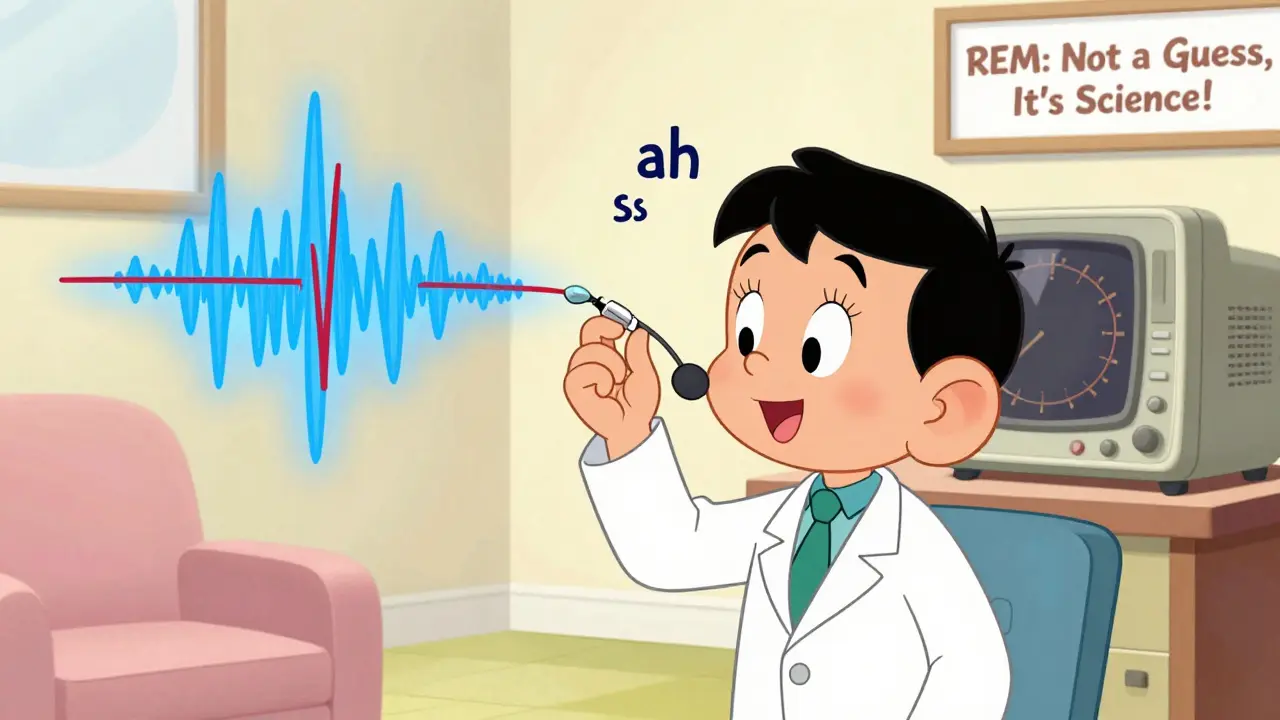
Real-ear measurement (REM) is a scientific process that checks exactly how much sound your hearing aid delivers inside your own ear canal. It’s not a guess. It’s not a simulation. It’s a direct measurement using a tiny probe microphone placed near your eardrum while you wear the hearing aid. Most people assume hearing aids are programmed based on their hearing test alone. That’s not enough. Every ear canal is different. The shape, length, and natural resonance of your ear can boost or dampen sound by up to 20 decibels. That’s like turning the volume up or down by half a room. Without REM, you’re fitting a hearing aid using data from an average ear-yours isn’t average. REM uses calibrated speakers to play speech sounds while the probe microphone records what your ear actually hears. The software then compares that to your prescribed target, like NAL-NL2 or DSL v5.0. These targets aren’t random-they’re based on decades of research into how people with hearing loss understand speech best.Why Manufacturer 'First Fit' Isn’t Enough
Hearing aid companies give you a starting point. That’s called the ‘first fit.’ It’s an algorithm based on your audiogram and the device’s specs. But here’s the problem: 78% of fittings rely on this alone, and only 52% of those match the target amplification. Why? Because those algorithms assume your ear canal behaves like a test box-a standardized 2cc coupler used in labs. Real ears aren’t test boxes. They’re curved, waxy, sometimes narrow, and full of natural acoustics that change how sound moves. A hearing aid that sounds perfect in a lab can be too quiet, too loud, or distorted in your ear. REM fixes that. Studies show it gets you to 92% accuracy against your target. That’s not a small improvement-it’s the difference between hearing someone in a noisy restaurant and missing half the conversation.The Science Behind the Numbers
The American Speech-Language-Hearing Association (ASHA), the American Academy of Audiology (AAA), and the American Medical Association all agree: REM is the gold standard. Why? Because the data doesn’t lie. A 2019 study in the Journal of the American Academy of Audiology found patients fitted with REM understood speech in noise 35% better than those without it. That’s not theoretical. That’s real-world results: better phone calls, clearer family dinners, less frustration. Even more telling: a 2022 survey of over 1,200 hearing aid users showed 87% of those who had REM rated their devices as “very effective.” Only 52% of those without it did. That’s a 35-point gap in satisfaction-just from one extra step. And it’s not just about loudness. REM ensures amplification is balanced across frequencies. If your hearing loss affects high-pitched sounds like “s” or “th,” REM makes sure those aren’t boosted too much (causing distortion) or too little (leaving you confused).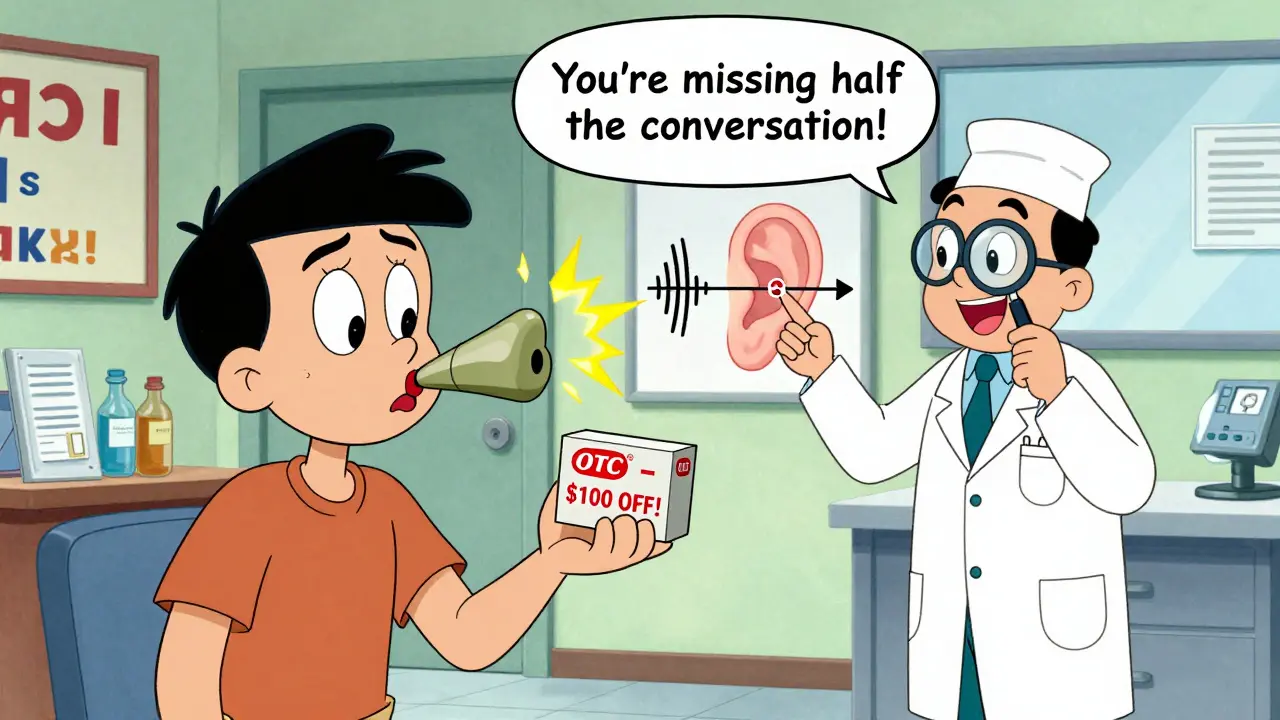
How the Process Works
The procedure takes 15 to 25 minutes. It’s not complicated, but it does require skill. First, your audiologist checks your ear canal with an otoscope to make sure there’s no wax blockage or damage. Then, they insert a thin, flexible probe tube-about the width of a human hair-into your ear canal, positioning it within 5 millimeters of your eardrum. The hearing aid goes in next, with the probe still in place. A speaker plays speech sounds at different volumes-usually 50 dB (soft), 65 dB (normal), and 80 dB (loud). The probe picks up what your ear actually hears, and the software shows a graph: the red line is your target, the blue line is what’s being delivered. If the blue line doesn’t match the red, the audiologist adjusts the hearing aid settings. This isn’t trial and error. It’s science. They tweak gain, compression, frequency response-until the match is within ±5 dB across all speech frequencies. That’s the standard for Medicare and most insurers.What Happens Without REM
Skip REM, and you’re gambling with your hearing investment. Many people buy hearing aids online or from retail chains without professional fitting. The FDA’s 2022 OTC rule explicitly says these devices can’t replace professional evaluation. Why? Because they lack verification. Users report whistling (feedback), muffled speech, or discomfort-not because the device is broken, but because it wasn’t calibrated to their ear. One Reddit user wrote: “Bought OTC aids online, saved $1,000 but they whistle constantly.” That’s not a defect. That’s a mismatch. The device was never measured in their ear. The feedback isn’t the device’s fault-it’s the fitting. Even worse: without REM, you might not realize your hearing aid isn’t working well. You might think, “This is just how it is now.” But with REM, you know exactly what to expect-and if it’s not right, you can fix it.Who Uses REM and Who Doesn’t
Here’s the divide: audiologists use REM. Most other providers don’t. According to a 2022 survey, 97% of board-certified audiologists use REM for every fitting. In hospital-based clinics, adoption is nearly 98%. But among hearing instrument specialists-who often work in retail settings-only 12% consistently use it. Why the gap? Time. REM adds 15-25 minutes to an appointment. Some providers skip it to see more patients. Others don’t have the equipment. But the cost of skipping it? Higher return rates, more follow-ups, and unhappy patients. The data shows REM cuts follow-up visits by 43%. That’s not just better outcomes-it’s better business. And better hearing.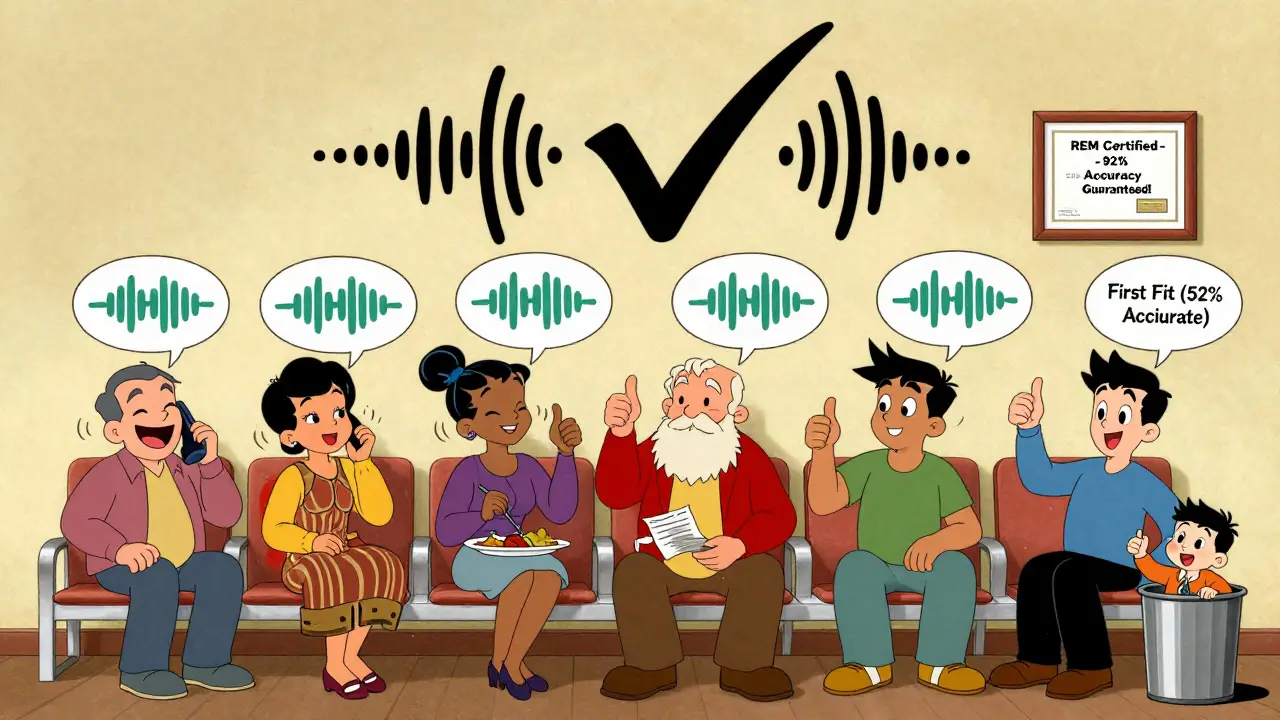




Doreen Pachificus
January 4, 2026 AT 23:17My audiologist skipped REM when I got my first pair. Thought I was being smart saving time. Turns out I was just being deaf in noisy rooms. Took me six months to realize it wasn’t me-it was the device. Finally went back, demanded REM, and now I hear my kid laughing in the next room. No joke. Changed everything.
Don’t let anyone tell you it’s optional. It’s the difference between hearing and understanding.
Vicki Yuan
January 5, 2026 AT 07:23As someone who works in audiology, I can’t stress this enough: REM isn’t a ‘bonus service.’ It’s the baseline. Every single fitting should include it. The fact that retail chains still skip it is a scandal. Patients pay thousands for these devices and get a factory preset like it’s a pair of earbuds.
And yes, Medicare covers it. If your provider says they don’t do it, they’re either under-equipped or cutting corners. Either way, walk out. Your ears deserve better.
Angie Rehe
January 5, 2026 AT 19:11Let me be blunt: if your provider doesn’t use REM, they’re not an audiologist-they’re a salesperson with a stethoscope. I’ve seen it too many times. ‘Oh, we use the manufacturer’s algorithm.’ Bullshit. That’s like saying your car’s GPS is fine because it uses Google Maps without checking if the road’s closed.
REM is non-negotiable. Period. If you’re not measuring real-ear output, you’re not fitting-you’re guessing. And guessing with hearing loss? That’s malpractice wrapped in a warranty.
Ethan Purser
January 7, 2026 AT 03:14Y’all are acting like this is some revolutionary breakthrough. Newsflash: I’ve had hearing aids since I was 12. REM didn’t exist back then. I survived. I thrived. I went to college, got married, raised kids.
Now you’re telling me I need a $500 probe mic to hear my wife say ‘pass the salt’? I’m sorry, but I’m tired of the medical-industrial complex turning every damn thing into a $200 procedure. If your hearing aid doesn’t work, just turn it up. Or buy better ones. Stop overcomplicating life.
Also, who even has time for 25-minute fittings? I work two jobs.
Aaron Mercado
January 9, 2026 AT 01:34EVERY SINGLE TIME. I went to this ‘hearing center’ near Walmart. Said they’d ‘optimize’ my aids. No REM. No probe. Just a laptop and a ‘first fit.’ Three weeks later, I’m screaming at my dog because I thought he was barking-and he was just breathing.
I went to a real audiologist. REM. Done in 20 minutes. Now I hear the microwave beep. The fridge hum. My daughter’s whisper. I cried. Not because I was sad. Because I realized I’d been living in a muffled hell for five years-and no one told me it could be fixed.
Don’t be the person who says ‘I didn’t know.’ You know now.
Uzoamaka Nwankpa
January 10, 2026 AT 05:42My uncle in Nigeria bought an OTC device from Amazon. He thought it was a miracle. It whistled. It made voices echo. He thought it was his brain. He stopped going to church because he couldn’t hear the pastor. He thought God was silent.
When we finally got him to a clinic, they did REM. Turned out the device was amplifying bass like a nightclub. He cried. Not because he was happy. Because he realized he’d been alone for months-and no one noticed.
Don’t let this be you.
Vikram Sujay
January 10, 2026 AT 20:59While the empirical evidence supporting real-ear measurement is robust and well-documented, it is also critical to acknowledge the structural inequities that prevent equitable access to such services. In underserved communities-both in the U.S. and globally-the cost, availability, and cultural awareness surrounding audiological verification remain significant barriers.
It is not enough to advocate for REM as a clinical standard if we do not simultaneously advocate for its inclusion in public health programs, tele-audiology frameworks, and subsidized care models. Science must be paired with justice. The data is clear; now we must ensure the delivery is just.
Akshaya Gandra _ Student - EastCaryMS
January 11, 2026 AT 22:56so i got my hearing aids from a place that said they do rem but i think they just fake it? like they put the probe in but then just clicked a button and said ‘all good’? i dont know how to tell if its real or not. also my ear felt weird after, like i had water in it. is that normal? idk maybe im dumb but i just wanna hear my mom when she talks to me without asking her to repeat everything 5 times lol
John Ross
January 13, 2026 AT 21:59Let’s be real-REM isn’t about fancy tech. It’s about accountability. In the U.S., we treat hearing aids like consumer electronics. But hearing isn’t a feature. It’s a function. And when you bypass verification, you’re not just wasting money-you’re eroding trust in the entire system.
Look at Europe. They mandated REM. Result? Fewer returns, higher satisfaction, lower long-term costs. We’re not innovating here. We’re catching up.
And for those saying ‘I survived without it’-congrats. But your kids deserve better than your compromise.