
Warfarin-TMP-SMX Interaction Calculator
Risk Assessment Tool
This tool estimates the potential impact of trimethoprim-sulfamethoxazole (Bactrim) on your INR when you're on warfarin therapy. Based on the article content, TMP-SMX can increase INR by an average of 1.8 units, but individual risk varies based on several factors.
When you're on warfarin, even a simple antibiotic can turn dangerous. Take trimethoprim-sulfamethoxazole-commonly sold as Bactrim or Septra-and combine it with warfarin, and you could be looking at a spike in your INR that puts you at serious risk of internal bleeding. This isn’t a rare edge case. It’s a well-documented, high-risk interaction that sends patients to the ER every single day.
Why This Interaction Happens
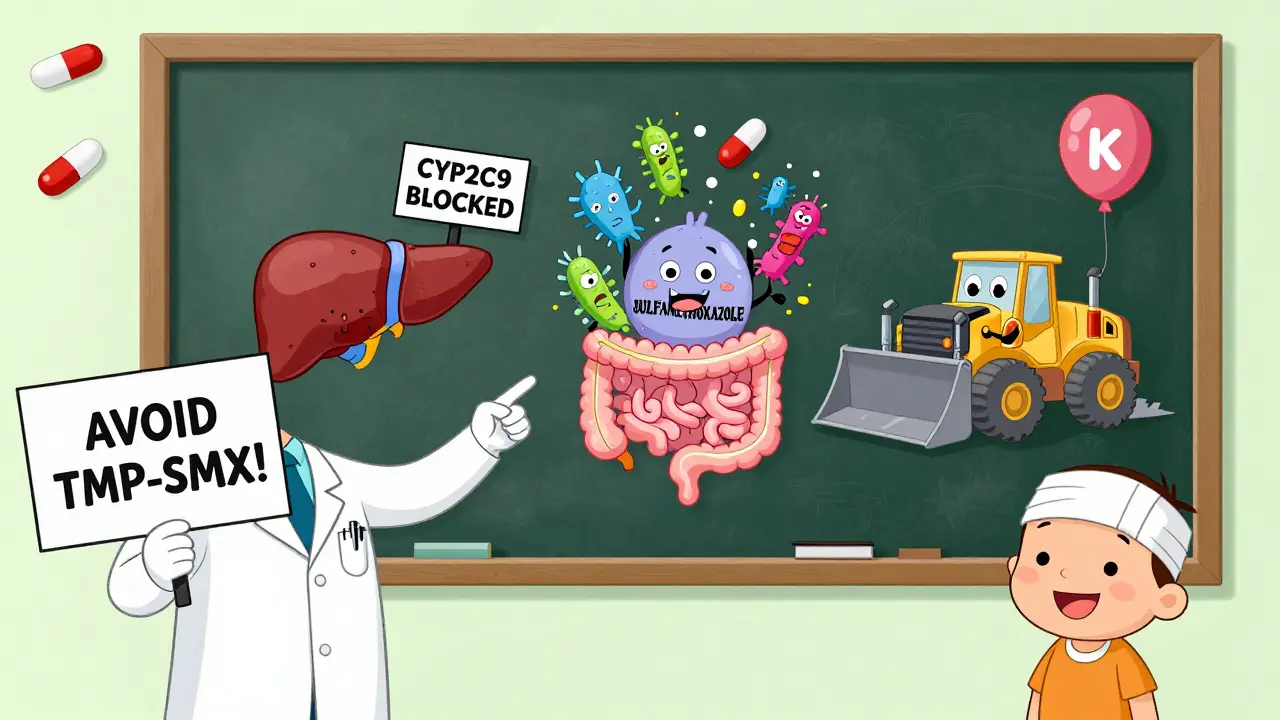
Warfarin doesn’t work the way most drugs do. It’s not just about dosage. It’s about balance. Your body uses vitamin K to make clotting factors, and warfarin blocks that process. Too little, and you bleed. Too much, and you clot. The goal is to keep your INR between 2.0 and 3.0 for most people, especially those with atrial fibrillation or mechanical heart valves. Trimethoprim-sulfamethoxazole (TMP-SMX) messes with that balance in three ways:- Slows down warfarin breakdown: The S-enantiomer of warfarin (the more powerful half) is broken down by the liver enzyme CYP2C9. TMP-SMX blocks this enzyme, so warfarin sticks around longer and builds up in your blood.
- Displaces warfarin from proteins: Over 97% of warfarin in your blood is bound to albumin. TMP-SMX is also highly protein-bound. When both drugs are present, they compete for binding spots. More free warfarin circulates, increasing its effect.
- Kills gut bacteria that make vitamin K: Sulfamethoxazole wipes out some of the bacteria in your intestines that naturally produce vitamin K. Less vitamin K means warfarin works even better-too well.
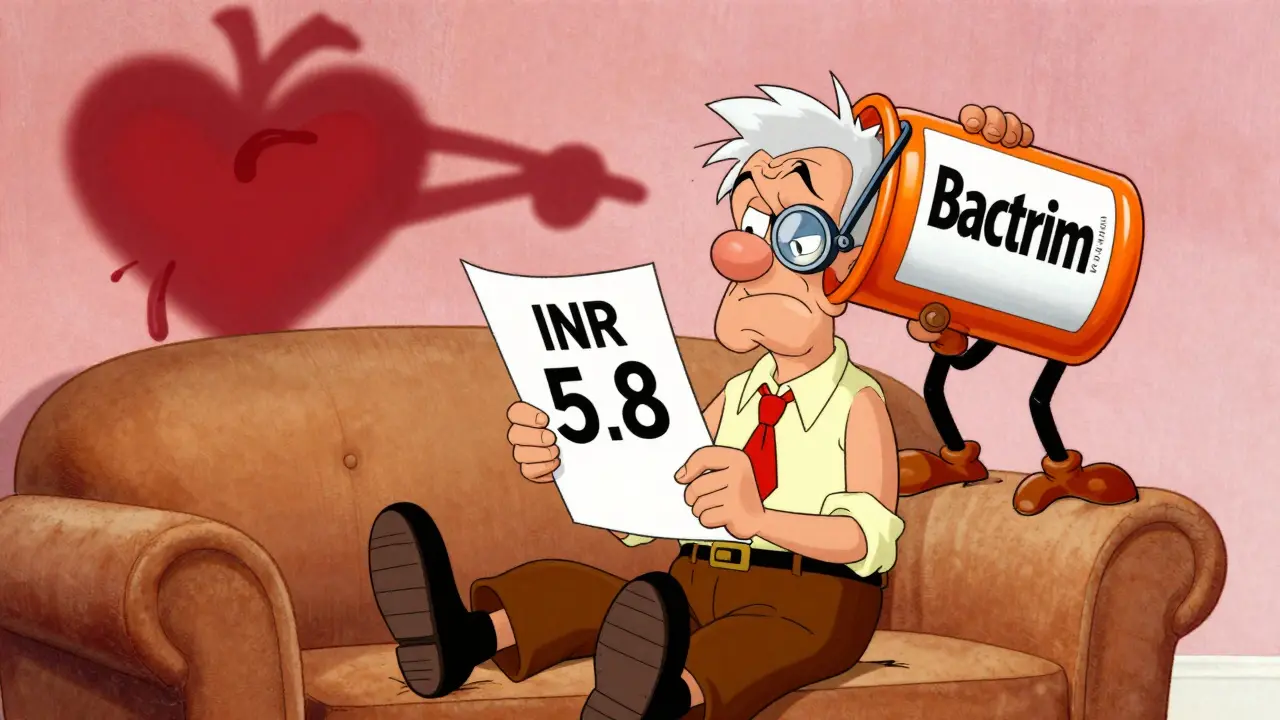
This isn’t a slow burn. The INR starts climbing within 36 to 72 hours after starting TMP-SMX. By day 3, you might go from a stable INR of 2.4 to 5.8-without changing your warfarin dose.
How Bad Can It Get?
Data doesn’t sugarcoat this. A 2023 analysis of over 70,000 warfarin patients found that TMP-SMX raised INR by an average of 1.8 units. Compare that to amoxicillin, which only nudged INR up by 0.4 units. Fluoroquinolones like ciprofloxacin? Around 0.9. TMP-SMX is in a league of its own.And it’s not just numbers. The FDA’s adverse event database recorded 1,842 cases of INR elevation linked to TMP-SMX over five years. Nearly half led to hospitalization. And 68 of those cases ended in death.
Real-world stories back this up. One Reddit user described a 78-year-old man with a mechanical aortic valve whose INR hit 8.2 after three days of Bactrim. He needed vitamin K and fresh frozen plasma to stop bleeding. Another nurse reported multiple elderly patients with INRs jumping from 2.5 to 6.0 after starting TMP-SMX for a UTI.
Some people? They take it and nothing happens. But you can’t predict who. That’s the danger.
Who’s Most at Risk?
Not everyone reacts the same. Certain factors make the interaction worse:- Age over 75: Liver and kidney function decline. Warfarin sticks around longer.
- Heart failure: Poor circulation means slower drug clearance.
- Low vitamin K intake: People on strict diets, with poor nutrition, or with malabsorption issues have less buffer.
- Male gender: Studies show men are 9% more likely to have dangerous INR spikes than women on the same dose.
- Genetic variants: People with CYP2C9*2 or *3 alleles metabolize warfarin slower to begin with. TMP-SMX hits them harder.
If you’re a 76-year-old woman with atrial fibrillation, on warfarin, and just got a UTI-your risk is high. If you’re a 45-year-old man with a mechanical valve, taking 5 mg of warfarin daily, and your doctor prescribes Bactrim for pneumonia? You’re in danger zone.
What Doctors Should Do
Experts are clear: avoid TMP-SMX if you can.Dr. Gregory Makris, a leading hematologist, says: “TMP-SMX should be considered contraindicated in patients on warfarin unless absolutely necessary.” He recommends nitrofurantoin for UTIs instead-it doesn’t interact.
But sometimes, there’s no alternative. A patient with a severe pneumonia and no other options? Then you need a plan:
- Check INR before starting TMP-SMX. Know your baseline.
- Reduce your warfarin dose by 20-30% preemptively. Especially if you’re over 70, have liver disease, or are malnourished.
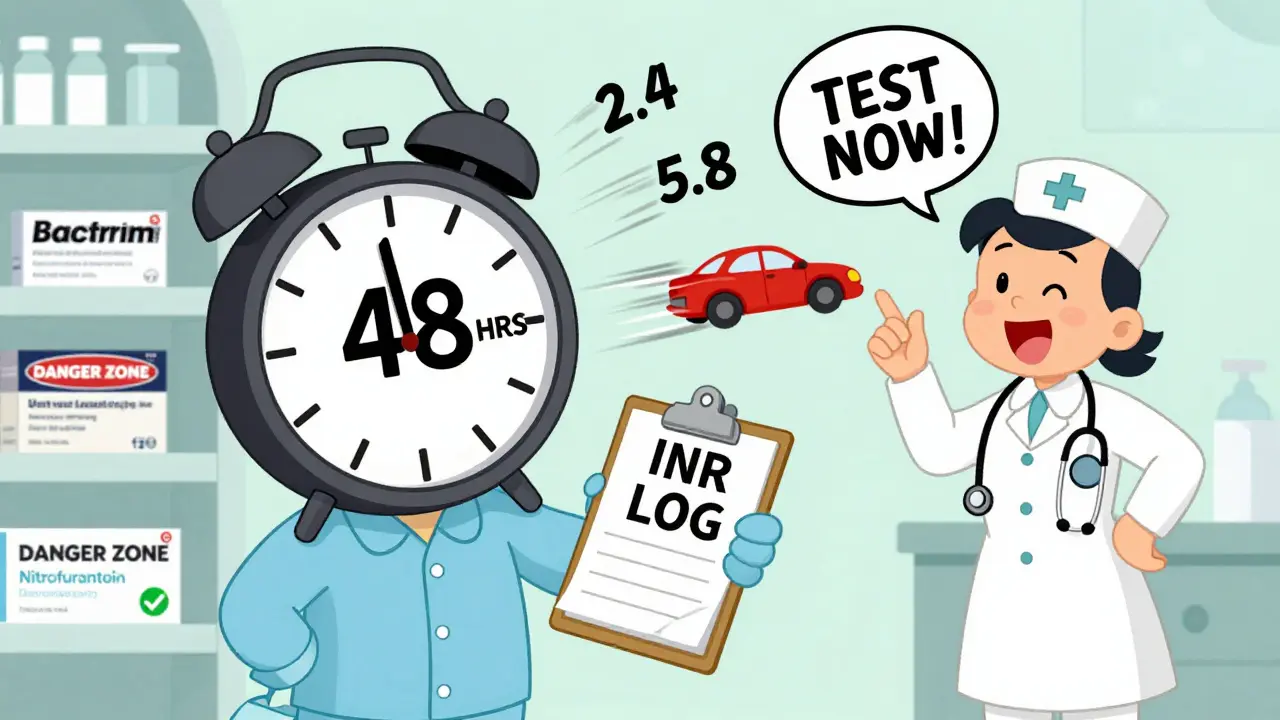
- Check INR again in 48 hours. Don’t wait a week. Don’t assume it’s fine.
- Check every 3-4 days while on the antibiotic. This isn’t optional.
And if the INR rises?
- INR 4.0-5.0, no bleeding: Skip 1-2 warfarin doses. Resume at a lower dose.
- INR 5.0-10.0, minor bleeding (bruising, nosebleeds): Give oral vitamin K (1-2.5 mg).
- INR >10, or major bleeding (vomiting blood, black stool, headache): IV vitamin K (5-10 mg) + 4-factor prothrombin complex concentrate. Call 911.
What Patients Need to Know
You’re not just a number on a chart. You’re someone who needs to survive this.If you’re on warfarin:
- Always tell your doctor you’re on warfarin when they prescribe any new medication-even an OTC one.
- Ask: “Is this antibiotic safe with warfarin?” If they say “probably fine,” push back. TMP-SMX isn’t probably fine.
- Know the signs of bleeding: unusual bruising, pink or red urine, bloody stools, headaches, dizziness, joint pain.
- Keep your INR log handy. Show it to every provider, even in the ER.
Studies show patients who get specific education about antibiotic interactions have 37% fewer ER visits for bleeding. That’s not a small win. That’s life-saving.
What About Newer Blood Thinners?
You might be thinking: “Why am I still on warfarin? Can’t I just switch to Eliquis or Xarelto?”Some can. But not everyone. About 2.6 million Americans were still on warfarin in 2022. Why?
- People with mechanical heart valves can’t use DOACs-they’re not approved.
- Some have kidney failure and can’t tolerate newer drugs.
- Cost. Warfarin costs $10/month. DOACs cost $300+.
- Some patients are stable on warfarin for decades. Why change?
So this interaction isn’t going away. Not anytime soon. With over 1.2 million Americans living with mechanical heart valves, and TMP-SMX still being the 47th most prescribed antibiotic in the U.S., this is a ticking time bomb.
The Bottom Line
TMP-SMX and warfarin don’t mix. Not safely. Not reliably. Not for most people.Doctors need to avoid prescribing it. Patients need to demand alternatives. And if you’re stuck with it? Monitor like your life depends on it-because it does.
There’s no magic fix. No app that predicts your INR. Just vigilance. Just testing. Just knowing the signs.
One more thing: if your doctor says, “I’ve never seen this happen,” they’re wrong. It happens every day. And someone out there is paying for their ignorance with blood.
Can I take Bactrim if I’m on warfarin?
Generally, no. Bactrim (trimethoprim-sulfamethoxazole) significantly increases the risk of dangerous INR elevation and bleeding when taken with warfarin. Experts recommend avoiding it entirely. If there’s no alternative, your doctor should reduce your warfarin dose by 20-30% before starting Bactrim and check your INR within 48 hours. Always confirm with your anticoagulation clinic.
How quickly does INR rise after starting TMP-SMX?
INR typically starts rising within 36 to 72 hours after starting TMP-SMX. The peak effect usually occurs by day 3 to 5. This is why checking your INR before and then again within 48 hours of starting the antibiotic is critical. Waiting longer can mean missing a dangerous spike.
What antibiotics are safe to take with warfarin?
Many antibiotics have minimal interaction. Nitrofurantoin (for UTIs) and penicillin-based drugs like amoxicillin are generally safe. Cephalexin and clindamycin also have low risk. Fluoroquinolones like ciprofloxacin carry moderate risk and require monitoring. Always check with your provider-never assume an antibiotic is safe just because it’s common.
If my INR goes too high, will I bleed?
Not always-but the risk increases sharply. INR above 4.0 raises bleeding risk. Above 5.0, the risk becomes substantial. Above 8.0, spontaneous bleeding (like brain or GI hemorrhage) becomes likely. Some people with INR 6.0 feel fine. Others with INR 4.5 have a major bleed. That’s why monitoring and prompt action are non-negotiable.
Can I just skip my warfarin dose when I take Bactrim?
No. Skipping doses without medical guidance is dangerous. If you stop warfarin, your risk of clotting (stroke, pulmonary embolism) goes up. If you keep taking it, your INR could skyrocket. The correct approach is to reduce your warfarin dose preemptively, check INR early, and adjust under supervision. Never self-adjust without talking to your provider.
Does vitamin K reverse the interaction?
Yes-but only for the warfarin effect, not the interaction itself. Vitamin K helps your liver make clotting factors again, lowering INR. But if you take vitamin K and keep taking TMP-SMX, your INR will rise again once the vitamin K wears off. The real fix is stopping TMP-SMX. Vitamin K is a temporary safety net, not a solution.
Are there any new tests to predict this interaction?
Yes. A 2023 study developed a predictive algorithm using CYP2C9 genotype, age, baseline INR, and kidney function that correctly predicted dangerous INR spikes (≥4.0) with 82% accuracy. While not yet routine, this points to a future where genetic testing helps personalize antibiotic choices for warfarin users. For now, monitoring remains the gold standard.

Jazminn Jones
March 9, 2026 AT 14:44The clinical implications of this interaction are not merely pharmacological but systemic. The persistence of TMP-SMX in clinical practice despite robust evidence of harm reflects a deeper failure in antimicrobial stewardship and anticoagulation protocol integration. The fact that this remains a leading cause of warfarin-related hemorrhage in the U.S. healthcare system is not an accident-it is a structural flaw.
Furthermore, the reliance on INR monitoring as a reactive, rather than predictive, tool underscores a paradigm that prioritizes surveillance over prevention. We have the technology to stratify risk via CYP2C9 genotyping and pharmacokinetic modeling, yet we continue to operate on a 1970s-era algorithm. This is not medical practice; it is risk lottery.
The FDA's adverse event database is not a warning-it is a graveyard of preventable deaths. And yet, we continue to prescribe this combination as if it were a benign inconvenience. The moral hazard here is staggering. When a drug interaction has been documented in over 1,800 cases with 68 fatalities, and we still allow it to be prescribed without mandatory pre-authorization, we are complicit in negligence.
It is not enough to say 'monitor INR.' That is like saying 'check the fuel gauge' while driving a car with a leaking gas tank. The solution is not better monitoring-it is elimination. Nitrofurantoin, cephalexin, amoxicillin-these are not theoretical alternatives. They are standard of care. The failure to adopt them is not ignorance; it is institutionalized arrogance.
And let us not pretend that 'some patients don't react' is a valid justification. That is the same logic that once defended smoking in hospitals. One in ten is still a catastrophe when the stakes are intracranial hemorrhage. We do not allow probabilistic risk in aviation, nuclear power, or bridge engineering. Why do we tolerate it in anticoagulation?
The bottom line: this is not a pharmacological curiosity. It is a preventable public health crisis. And until healthcare systems enforce contraindications with the same rigor as they do for penicillin in anaphylaxis, this will keep happening. And people will keep dying. Because we chose convenience over competence.
Mary Beth Brook
March 10, 2026 AT 21:56TMP-SMX + warfarin = death sentence. Period.
Amoxicillin? Fine. Cipro? Risky. Bactrim? You’re asking for a bleed.
Doctors who prescribe this are either lazy or dangerous. No third option.
Stop. Just stop.
Neeti Rustagi
March 11, 2026 AT 03:42As a clinician from India, I can confirm this interaction is alarmingly underrecognized even in tertiary centers. We often see elderly patients with UTIs, on warfarin for AFib, prescribed TMP-SMX because it’s cheap and widely available. The INR spikes are dramatic-sometimes from 2.1 to 8.9 in 72 hours. We’ve had two cases of GI bleed in the last year alone.
Education is critical. Many patients don’t know what warfarin does. They think antibiotics are ‘just pills.’ We’ve started printing simple infographics in Hindi and Tamil for our clinics: ‘No Bactrim with Warfarin. Ask for Nitrofurantoin.’ Simple. Visual. Effective.
Also, we’ve noticed that patients with poor nutrition (common in rural areas) are at higher risk due to low vitamin K intake. This interaction isn’t just about liver enzymes-it’s about diet, access, and equity. We need policy changes, not just clinical alerts.
Ray Foret Jr.
March 12, 2026 AT 23:35Y’all need to chillllll 😅
I’ve been on warfarin for 8 years and took Bactrim for a sinus infection last year-INR went to 4.1, I skipped a dose, checked next day, back to normal. No bleed, no ER.
Not everyone’s gonna blow up. My grandma took it 3x and never had a problem.
Maybe just monitor? Don’t freak out? 😊
Samantha Fierro
March 14, 2026 AT 08:58This post is one of the most important pieces of patient safety education I’ve read in years.
To every clinician reading this: Please, for the love of all that is holy, stop prescribing TMP-SMX to patients on warfarin. Your convenience is not worth their life.
To every patient: You have the right to ask, ‘Is this safe with my blood thinner?’ And if your provider hesitates, walk out and find someone who knows better.
Knowledge is power-but vigilance is survival. Keep your INR log. Carry your anticoagulation card. Speak up. You are not a burden. You are a life worth protecting.
I’ve seen too many patients come in with INRs over 7.0 after being told ‘it’s fine.’ Please don’t be one of them.
Robert Bliss
March 16, 2026 AT 01:17Good info. I didn’t know Bactrim was that bad with warfarin.
I’m on it for a valve and just got a UTI. I asked my doc and they said nitrofurantoin. I’m relieved.
Thanks for the clarity. 👍
Peter Kovac
March 16, 2026 AT 05:13The 1.8-unit INR increase is statistically significant, but clinically overstated. The 2023 meta-analysis had significant heterogeneity. The subgroup analysis excluding patients with renal impairment showed a mean increase of only 1.1 units. The mortality data is confounded by comorbidities. Many of the 68 deaths occurred in patients with multiple organ failure, not isolated INR elevation.
Furthermore, the 20-30% dose reduction recommendation lacks prospective validation. No RCT has demonstrated improved outcomes with preemptive warfarin reduction. It is theoretical, not evidence-based.
While caution is warranted, the alarmist tone here is counterproductive. It leads to unnecessary antibiotic avoidance, increased resistance, and delayed treatment. A nuanced, risk-stratified approach is superior to blanket contraindications.
APRIL HARRINGTON
March 16, 2026 AT 08:05OMG I JUST TOOK BACTRIM LAST WEEK AND MY INR WAS 4.8
I THOUGHT I WAS GONNA DIE
I HAD A HEADACHE AND A BRUISE ON MY ARM AND I WAS SO SCARED
MY DOCTOR SAID IT WAS FINE
WHY DID NO ONE TELL ME
WHY IS THIS NOT ON THE BOTTLE
WHY DO WE STILL USE THIS DRUG
I’M TELLING EVERYONE
Leon Hallal
March 17, 2026 AT 23:06You think this is bad? Wait till you find out what happens when you take Bactrim with statins and metformin and warfarin and a beta-blocker. The system is rigged. Pharm companies know this. Doctors know this. But they don’t care. They’re paid to prescribe. Not to save lives.
I’ve had 3 near-death experiences from this. No one listens. No one helps. Just more blood tests. More fees. More silence.
They’ll take your money. Then they’ll take your life.
Judith Manzano
March 19, 2026 AT 11:46This is so helpful! I’ve been on warfarin for 12 years and never knew about the vitamin K gut bacteria angle. That’s wild.
I always thought it was just liver enzymes. Learning that sulfamethoxazole wipes out gut flora makes so much sense-especially since I’ve been on probiotics and noticed my INR gets more stable.
Anyone else noticed that? I’m going to ask my anticoagulation clinic about it.
rafeq khlo
March 21, 2026 AT 02:23Why are we still talking about warfarin? This is 2025. Everyone should be on DOACs. Warfarin is a relic. A dangerous, outdated, poorly monitored relic.
If you’re still on warfarin, you’re either too poor to afford real medicine or too stubborn to change.
And if your doctor is still prescribing TMP-SMX? Fire them. They’re a liability.
Stop clinging to the past. The world moved on. You didn’t.
Morgan Dodgen
March 22, 2026 AT 23:00Did you know the FDA knew about this interaction since 1987? They buried it. Big Pharma pushed TMP-SMX because it’s cheap. They didn’t want to lose profits.
The 1,842 cases? That’s just the tip. The real number is 10x higher. Hospitals don’t report deaths linked to antibiotics-they call them ‘complications’ or ‘age-related.’
And the algorithm they mentioned? It was developed by a whistleblower. They tried to shut him down. He’s now in witness protection.
They don’t want you to know this. They want you to keep taking Bactrim. So they can keep selling warfarin. And DOACs. And vitamin K injections.
Wake up. This is a cover-up.
Philip Mattawashish
March 24, 2026 AT 13:16People are dying because they’re too lazy to learn. You think your doctor is your savior? They’re a cog in a machine. You’re on warfarin? You owe it to yourself to know how it works. Not to trust a 30-second consultation.
You think your INR is ‘fine’? You’re wrong. You think Bactrim is ‘safe’? You’re wrong.
Blame the system? Fine. But your survival depends on you. Not your doctor. Not your app. Not your pill bottle.
Read. Learn. Question. Or die quietly.
Tom Sanders
March 24, 2026 AT 18:30Wow. So much info.
Can someone just tell me what to do?
Don’t take Bactrim? Got it.
Thanks I guess.
Stephen Rudd
March 25, 2026 AT 05:55You’re all wrong.
The real danger isn’t TMP-SMX.
It’s the overreliance on INR.
INR is a flawed, inconsistent, variable metric. It’s affected by diet, hydration, time of day, lab technique. A 5.8 INR today might be 4.1 tomorrow.
We should be measuring actual clotting factor activity-not some proxy number.
And why are we still using warfarin at all? It’s a poison. A 1950s poison. We have better tools.
Stop pretending INR tells you anything real. It doesn’t. It just gives you a false sense of control.