
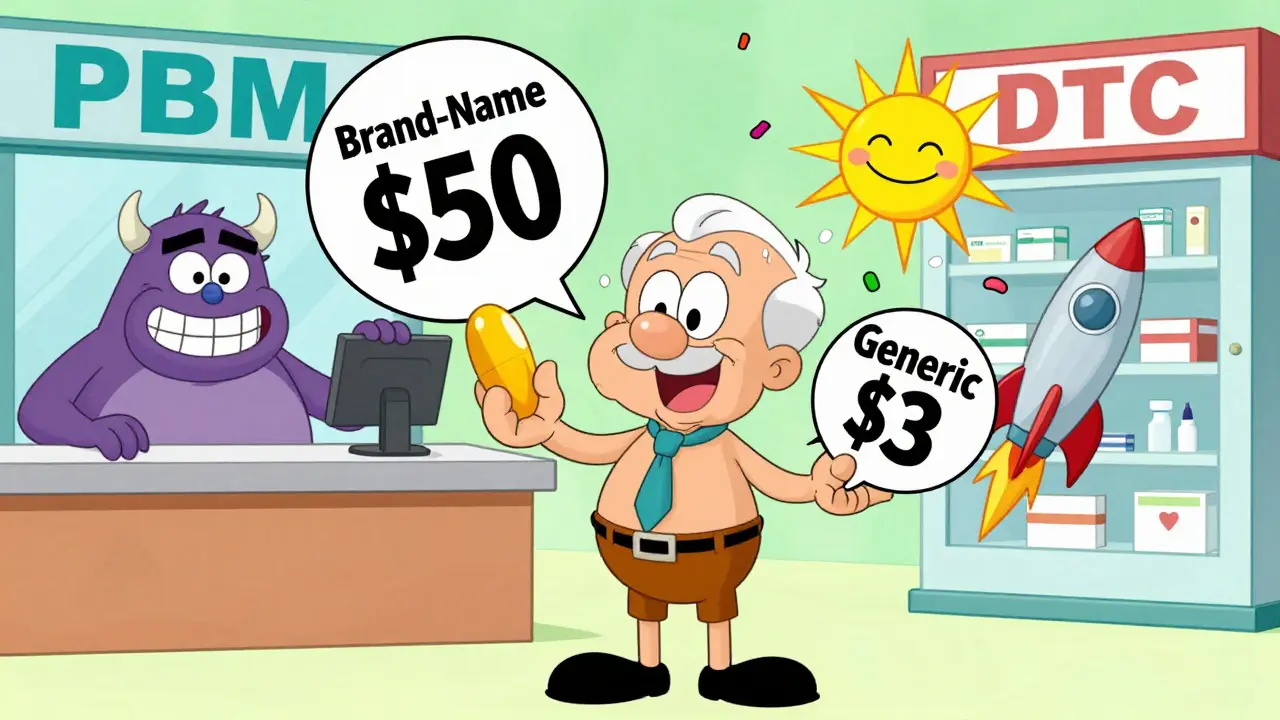
Imagine needing a pill every day to manage your blood pressure, diabetes, or cholesterol. Now imagine paying $50 for it. Then imagine finding the exact same pill for $3. That’s not a fantasy-it’s reality for millions of Americans who switch from brand-name drugs to generics. But here’s the catch: even when generics exist, many people still pay way too much. Why? Because the system isn’t built to help you save-it’s built to let middlemen profit.
Generics aren’t cheap copies. They’re identical drugs.
Generic drugs aren’t "weaker" or "inferior" versions of brand-name pills. They contain the same active ingredients, work the same way, and are held to the same safety standards by the FDA. The only differences? The color, shape, or filler ingredients-and the price. A 2023 report from the Association for Accessible Medicines showed that generics make up 90% of all prescriptions filled in the U.S., but only 13.1% of total drug spending. That’s because they cost a fraction of the brand-name version.
For example, the brand-name drug Sildenafil (Viagra) used to cost nearly $50 per pill. Once the patent expired and generics hit the market, the same drug dropped to $3.07. Emtricitabine/Tenofovir, used to treat HIV, fell from $20.46 to $2.13. That’s a 90%+ drop. These aren’t rare cases. They’re the norm. In 2023, the average out-of-pocket cost for a generic prescription was $7.05. For brand-name drugs? $27.10. Nearly four times more.
What happens when you don’t use generics?
If you stick with brand-name drugs when a generic is available, you’re paying extra-often unnecessarily. Take Pantoprazole, a common heartburn medication. At Albertsons, you’ll pay $44 for a 30-day supply. At a direct-to-consumer pharmacy, you can get the exact same tablet for $9.20. That’s $34.80 saved per month. Over a year? That’s over $400.
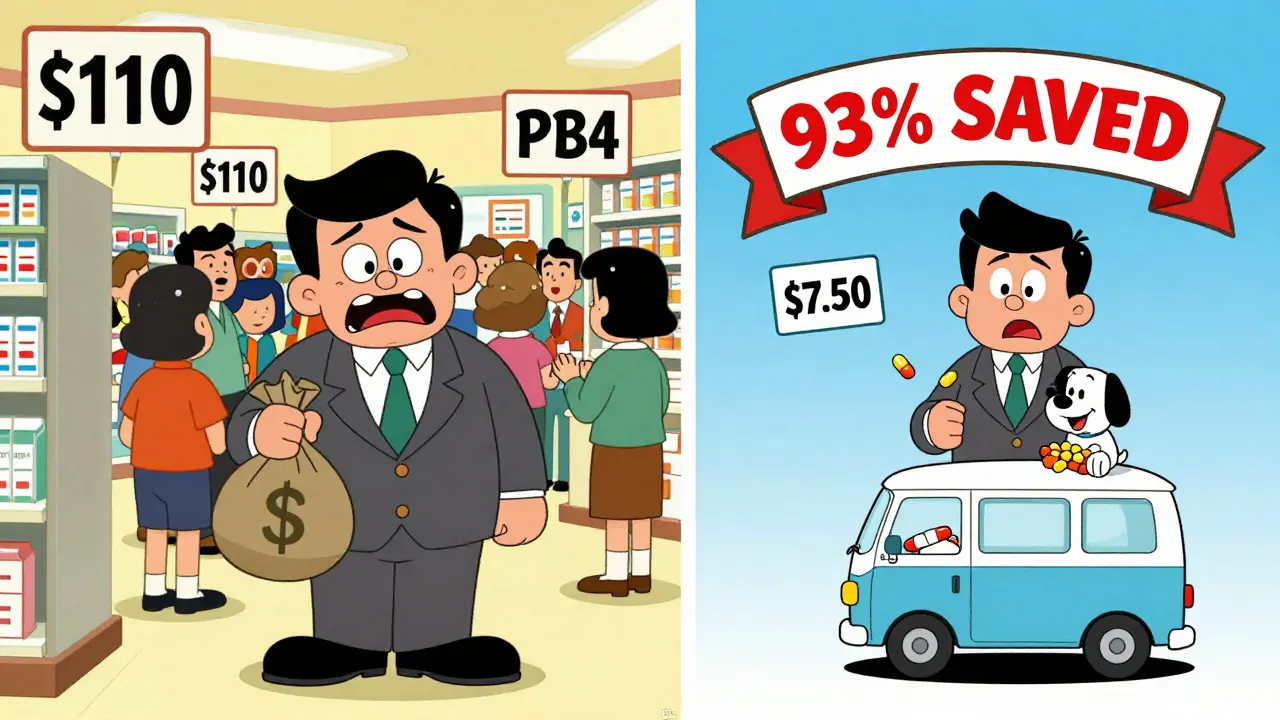
Same with Rosuvastatin (Crestor). At Walgreens, it’s $110. At Health Warehouse? $7.50. That’s 93% less. And these aren’t outliers. A 2021 analysis of 1.4 billion Medicare Part D claims found that 93% of all generic prescriptions cost $20 or less out-of-pocket. More than 82% cost under $20. Yet, many patients still pay $50, $70, or even $100 for the same drug because they don’t know where to look-or their insurance doesn’t guide them to the cheapest option.
Insurance plans make it harder to save
Here’s the twist: even when generics are available, your insurance plan might make you pay more. Some plans put generics in higher cost tiers-tiers usually reserved for expensive brand-name drugs. That means your copay jumps from $5 to $30, even though the drug hasn’t changed. Between 2011 and 2019, this practice increased patient spending by 135%, even as drug prices overall fell by 38%.
And it gets worse. Medicare Part D, the federal prescription program for seniors, often pays more than Costco. In 2018, Medicare overspent by $2.6 billion on 1.4 billion claims. Why? Because it didn’t negotiate prices effectively. In fact, 53% of 90-day generic fills cost more through Medicare than they would at Costco-even though Costco doesn’t have insurance. Some patients without insurance paid less than those with Medicare.
This isn’t about drug companies. It’s about pharmacy benefit managers (PBMs), middlemen who negotiate rebates between drugmakers and insurers. They get paid based on list prices, not actual costs. So if a drug’s list price stays high-even when the real price drops-the PBM keeps earning more. You end up paying more, even for a $7 generic.
Direct-to-consumer pharmacies are the secret weapon
Most people go to CVS, Walgreens, or their local pharmacy because it’s convenient. But convenience costs money. Direct-to-consumer (DTC) pharmacies like HealthWarehouse, MCCPDC, or Blink Health cut out the middlemen. They buy in bulk, skip the retail markup, and pass the savings directly to you.
A 2023 NIH study found DTC pharmacies save patients 76% on expensive generics and 75% on common ones. That’s not a small discount. It’s life-changing for people on fixed incomes. For example:
- Pantoprazole 20mg: $44 at Albertsons → $9.20 at MCCPDC (79% savings)
- Rosuvastatin 5mg: $110 at Walgreens → $7.50 at HealthWarehouse (93% savings)
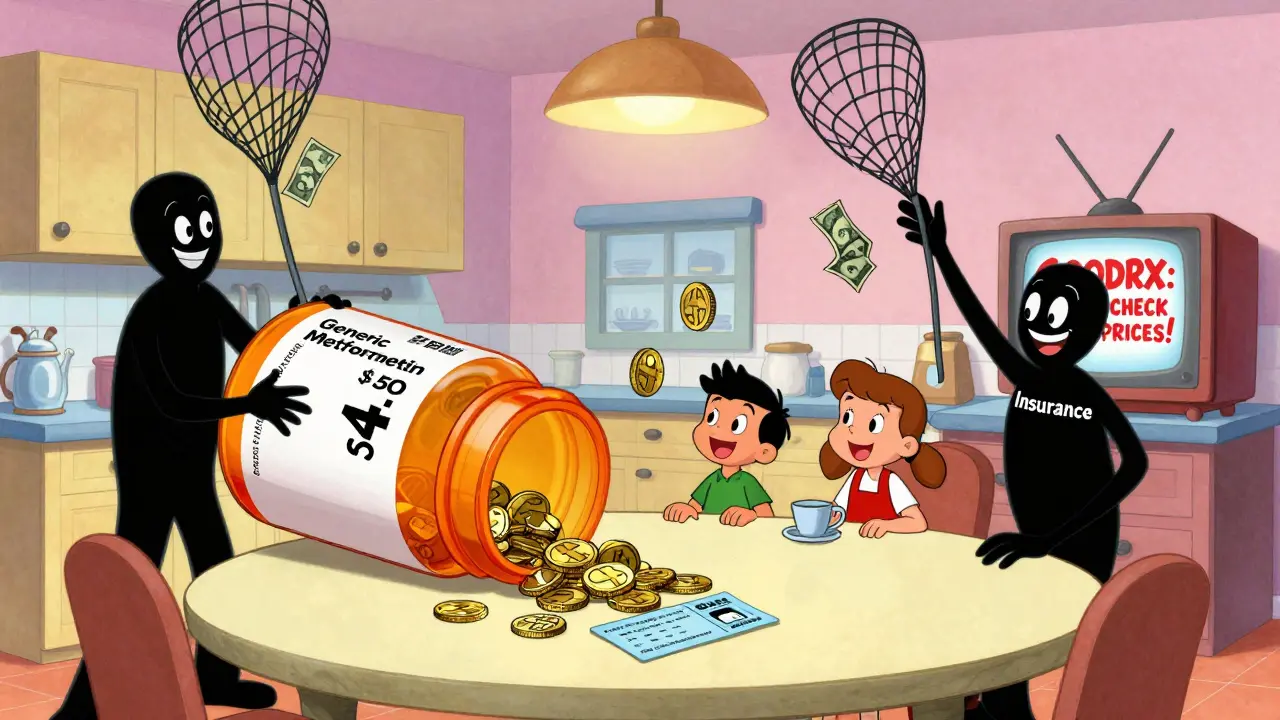
- Metformin 500mg: $35 at CVS → $4.50 at Blink Health (87% savings)
These aren’t gimmicks. These are identical medications, same FDA approval, same batch numbers, same expiration dates. The only difference? Where you buy them.
Why do generics cost so little?
Brand-name drug companies spend billions developing a new medicine. They need to recover that cost, plus make a profit. That’s why they charge $100, $500, or even $1,000 per month. Once the patent expires, other companies can make the same drug without paying for research. They don’t need to advertise. They don’t need to pay for clinical trials. They just make it-and sell it for $5.
That’s why the total value of U.S. generic sales has dropped by $6.4 billion since 2019-even as more people use them. The system is working: more generics = lower total spending. But that doesn’t mean you’re saving. If your pharmacy charges $40 for a $5 drug, you’re still paying the old price.
The bigger picture: 5 billion saved in 10 years
Between 2013 and 2023, generic and biosimilar drugs saved the U.S. healthcare system $445 billion. That’s more than the GDP of many countries. Every year, dozens of blockbuster drugs lose patent protection. In 2024, drugs like Humira, Eylea, and Dupixent started seeing generic competition. That means even more savings coming.
But here’s the problem: those savings aren’t reaching patients. They’re going to insurers, PBMs, and pharmacy chains. You’re still paying more than you should-even for a $7 pill.
What you can do right now
You don’t need to wait for policy changes. You can start saving today:
- Ask your doctor: "Is there a generic version of this?" If they say no, ask why. Sometimes, it’s just habit.
- Use a price comparison tool like GoodRx, Blink Health, or SingleCare. Enter your drug name and zip code. You’ll see prices from local pharmacies and online sellers.
- Switch to a direct-to-consumer pharmacy. Many ship for free. You can get 90-day supplies for less than a 30-day retail fill.
- Check if your Medicare Part D plan has a preferred pharmacy network. If Costco is cheaper, use it-even if you’re not a member.
- Call your pharmacy and ask: "What’s the cash price?" Sometimes, paying cash is cheaper than using insurance.
One woman in Ohio switched her cholesterol medication from Walgreens to a DTC pharmacy. Her monthly cost dropped from $110 to $7.50. She used the savings to pay for her grandson’s braces. That’s the power of knowing your options.
The bottom line
Generics aren’t a compromise. They’re the smart choice. The data is clear: 90% of prescriptions are generics. 93% cost under $20. And yet, most people still overpay. It’s not because they’re careless. It’s because the system is designed to confuse you.
You’re not alone. Millions of Americans are paying too much for the same pills their neighbors buy for pennies. The fix isn’t complicated. It’s just not obvious. Start by asking one question: "What’s the cash price?" Then shop around. You might be surprised how much you can save-without sacrificing quality, safety, or effectiveness.
Matthew Hekmatniaz
January 3, 2026 AT 07:20Just last month I switched my blood pressure med from the brand to generic through GoodRx. Went from $48 to $5.50. I didn’t even tell my doctor I was switching-just did it. No side effects, no issues. Why do people still pay full price when the science says it’s the same thing? It’s not about trust, it’s about inertia.
And honestly? The pharmacy staff never volunteers this info. They’re not trying to hide it, they just don’t know how to explain it. We need better public education, not just individual hustle.
Liam George
January 5, 2026 AT 01:19Let me tell you what they don’t want you to know. PBMs aren’t middlemen-they’re the *real* pharmaceutical cartel. They collude with insurers to inflate list prices so they can siphon rebates. The FDA? They’re just the window dressing. The real drug companies? They’ve been bought off since the 90s.
That’s why generics are legal. It’s a controlled release valve to keep the masses from revolting. The system is engineered to make you think you’re saving when you’re just being funneled into a different tier of exploitation. Wake up.
And don’t get me started on how Medicare pays more than Costco. That’s not incompetence. That’s policy by design.
sharad vyas
January 5, 2026 AT 17:44In India, generics are the only option. We don’t have brand-name drugs unless you’re rich. So we know-generic means the same medicine, just no fancy packaging. My father takes his diabetes pills from a local pharmacy for $0.20 a tablet. No insurance. No problem.
Here in the US, it’s strange to see people pay $50 for something that costs $3. Maybe it’s because you’re used to paying for branding, not medicine. But the science doesn’t care about logos.
Dusty Weeks
January 6, 2026 AT 07:39OMG I JUST SWITCHED TO BLINK HEALTH AND MY CHOLESTEROL MED IS NOW $4.50 😭😭😭 I WAS PAYING $110 AT CVS. I CRIED. MY DOG CRIED TOO. 🐶💔
Also I found out my insurance doesn’t cover it unless I use their ‘preferred’ pharmacy… which charges $70. WHAT IS THIS WORLD??
PS: I told my mom. She’s 72 and now she’s on it too. She says she’s gonna buy a new pair of shoes with the savings. 💃
Sally Denham-Vaughan
January 7, 2026 AT 00:52I used to think generics were sketchy until my mom got on them after her stroke. She was on Lipitor for $80 a month. Switched to generic at Walmart-$4. She didn’t even notice a difference. Now she calls them ‘the cheap miracle pills.’
And honestly? The biggest hurdle isn’t the price-it’s the shame. People feel like they’re taking a ‘second-class’ drug. But it’s not second-class. It’s just… unbranded. Same pill. Same science. Same life-saving effect.
Also-cash price > insurance price. Always ask. Seriously. Just say ‘what’s the cash price?’ and watch the pharmacist’s face drop.
Bill Medley
January 7, 2026 AT 18:53Generics are therapeutically equivalent. FDA bioequivalence standards are rigorous. Cost differentials stem from marketing, distribution, and PBM structures-not efficacy.
Patients should always compare cash prices. Insurance formularies are opaque and often misaligned with actual market value.
Direct-to-consumer channels reduce systemic inefficiencies. This is not anecdotal. It is data-driven.
Richard Thomas
January 8, 2026 AT 13:37There’s something deeply ironic about how we treat medicine in this country. We’re told to trust science, but we’re also told to trust brands. We’re told generics are just as good, but we’re conditioned to fear them-like they’re somehow morally inferior because they’re cheaper.
It’s not just about money. It’s about identity. We associate cost with value. We associate brand with quality. We associate suffering with deservingness. So when someone says, ‘I pay $50 for my pill because I believe in the brand,’ what they’re really saying is, ‘I believe I deserve to suffer more.’
The system doesn’t just overcharge us. It makes us feel guilty for wanting to stop.
I’ve watched friends choose brand-name drugs over generic ones because they didn’t want to ‘look poor.’ That’s not health. That’s trauma dressed in prescription bottles.
Paul Ong
January 9, 2026 AT 05:12Switched my metformin to Blink Health last year. $4.50 for 90 days. My old pharmacy charged $35. I didn’t even know I could do this. Why isn’t this on TV?
Also my mom got her blood pressure med for $2.50 at a warehouse pharmacy. She thought it was a scam. Turned out it was the same pills from the same factory.
People need to know this. Like right now. Not next year. Not after they get a bill. Now.
And stop letting insurance dictate your meds. Just say no to the middleman. Cash is king.
Also if you’re on Medicare-check Costco. Always. They’re cheaper than your plan. Seriously.
Andy Heinlein
January 11, 2026 AT 01:17Just got my husband’s heart med from HealthWarehouse for $7.50 instead of $110. I cried. I’m not even kidding. We’re on a fixed income and this is life-changing.
Also I found out the same pill is sold under a different name at Costco. Same exact thing. Just different label.
So if you’re reading this and you’re scared to switch-don’t be. It’s the same drug. The same science. The same results.
And if you’re a doctor-please just ask your patients if they know about GoodRx. That’s all it takes. One question. One minute. Could save someone’s rent.
PS: I told my neighbor. She’s gonna try it tomorrow. We’re all gonna be saving money now 💪❤️