
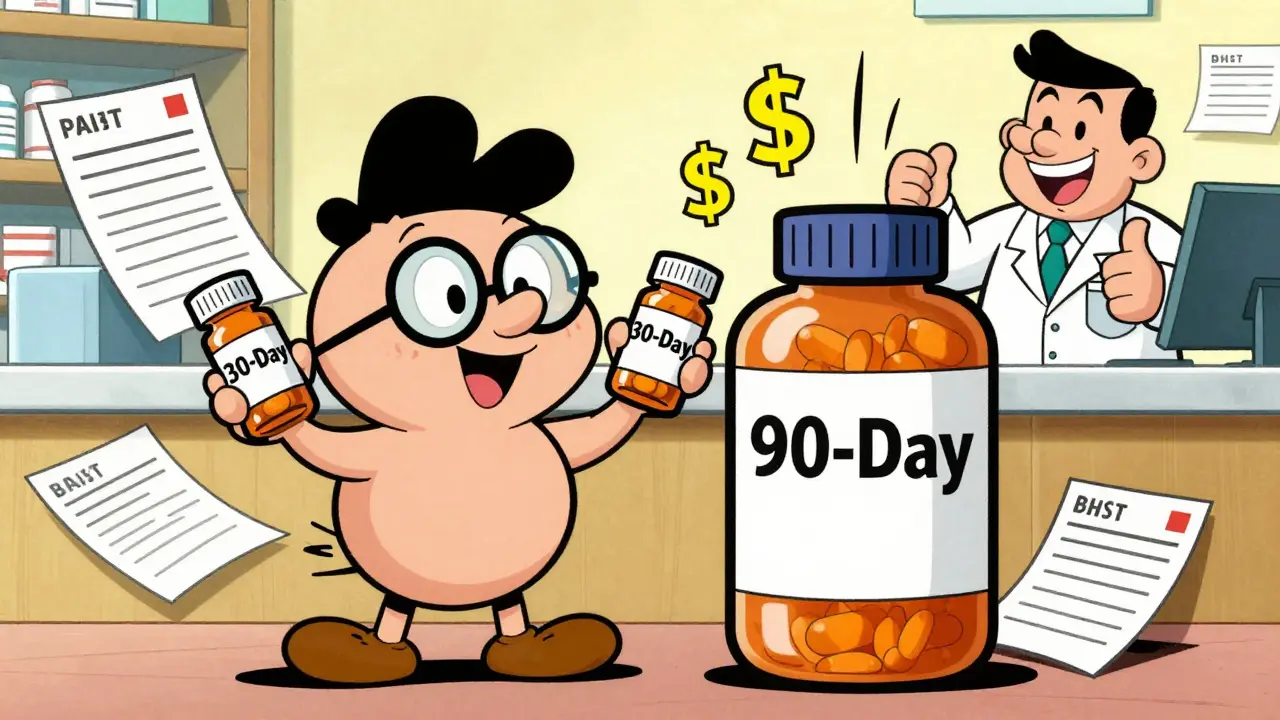
If you take medication every day for a long-term condition like high blood pressure, diabetes, or high cholesterol, you’re probably paying the same copay every month-no matter how much medicine you’re actually getting. What if you could get three months’ worth of pills for the same price as one month? That’s not a trick. It’s a 90-day prescription fill, and it’s one of the simplest ways to cut your medication costs without changing your treatment.
Why 90-Day Fills Save You Money
Most insurance plans charge you the same copay whether you pick up a 30-day or a 90-day supply. So if your copay is $4.90 for a 30-day prescription, you’re still paying $4.90 for 90 days. That means you’re getting two extra months of medication for free-no extra charge. Over a year, that’s $39.20 saved on just one medication. Multiply that by three or four prescriptions, and you’re talking hundreds of dollars a year.Some plans even offer lower copays for 90-day fills. For example, the LINZESS Savings Program lets eligible patients pay as little as $30 for either a 30-day or 90-day supply. That’s not a discount-it’s a flat rate. The math is simple: the more you get, the less you pay per day. A 90-day supply cuts your trips to the pharmacy from 12 times a year down to just 4. Fewer visits mean less time off work, less gas, and less stress.
Who Qualifies for a 90-Day Prescription
Not every medication qualifies. Insurance companies and pharmacy benefit managers (PBMs) only allow 90-day fills for maintenance medications-drugs you take daily for chronic conditions. Common examples include:- High blood pressure meds (like lisinopril or amlodipine)
- Cholesterol drugs (like atorvastatin or simvastatin)
- Diabetes medications (like metformin or glimepiride)
- Thyroid pills (like levothyroxine)
- Antidepressants and anti-anxiety meds (like sertraline or escitalopram)
You also need to have already taken the medication successfully for at least one cycle. You can’t get a 90-day supply the first time you’re prescribed something. Pharmacies and insurers want proof you’re not allergic, you’re tolerating it well, and you’re actually taking it.
How to Get a 90-Day Prescription
There are two main ways to get a 90-day supply, and neither requires a complicated process.Option 1: Ask your doctor
When you’re at your next appointment, say: “Can you write this prescription for a 90-day supply?” Most doctors are happy to do it-they know it helps patients stick to their treatment. You don’t need to argue or justify it. Just ask. If your doctor says they can’t, ask why. Sometimes it’s just a system setting. They can often override it with a quick click.Option 2: Ask your pharmacy
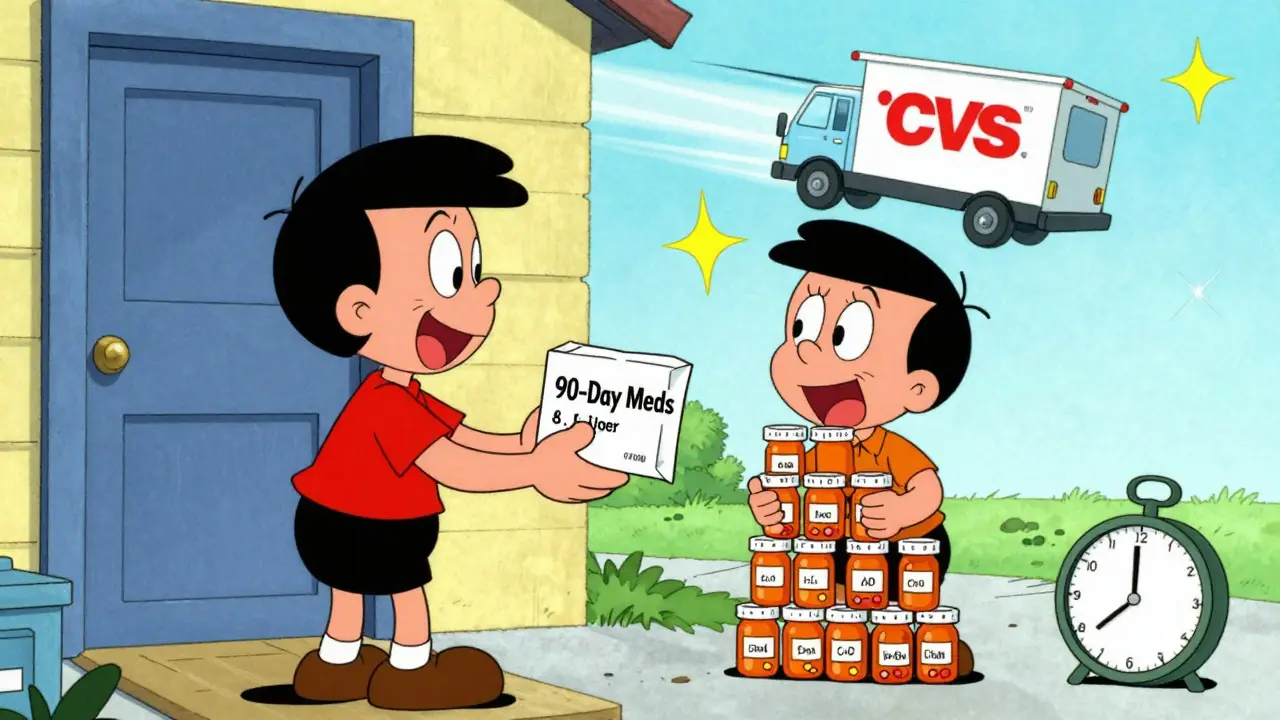
If your prescription already has refills on it, you can walk into your pharmacy and ask for a 90-day fill-even if the script says “30 days.” Many pharmacies can dispense a 90-day supply if you have at least three refills left. Just say: “I’d like to fill this for 90 days instead of 30.” They’ll check your insurance and let you know if it’s allowed.Some pharmacies, like CVS and Walgreens, now offer 90-day fills right at the counter. Others may refer you to their mail-order service. Either way, you’re still covered under your insurance plan.
Mail-Order vs. Retail Pharmacy
You’ve got two choices for getting your 90-day supply: pick it up at your local pharmacy or have it delivered to your door.Mail-order pharmacies (like CVS Caremark, Express Scripts, or HPSM’s Postal Prescription Services) specialize in 90-day fills. They’re often the cheapest option. Many offer free shipping, and some even send you a 90-day supply every month so you never run out. You’ll usually need to sign up through your insurer’s website or call their pharmacy line.
Retail pharmacies (like your neighborhood CVS, Walgreens, or Rite Aid) can now also fill 90-day prescriptions on the spot. This is great if you prefer picking up your meds in person or need to see a pharmacist right away. Some people worry retail pharmacies won’t support 90-day fills because they earn less per dispensing fee. But most major chains have adapted-they know patients want this option, and they’re making it work.
What to Do If Your Insurance Says No
Sometimes, your plan won’t cover a 90-day fill for a specific drug. That’s frustrating, but it’s not the end. Here’s what to do:- Call your insurance company. Ask: “Is there a prior authorization form for a 90-day fill of [medication name]?”
- Ask your doctor to submit the form. Many insurers require this for certain meds, especially newer or expensive ones.
- Check GoodRx or SingleCare. Even if your insurance won’t cover a 90-day fill, these discount cards can still give you a better price than retail. Sometimes, paying cash for a 90-day supply with a coupon is cheaper than your copay.
- Ask your pharmacy to check other plans. Some pharmacies can run your prescription through a different PBM network to find a better rate.
If your drug is on Medicare Part D or Medicaid, you’re more likely to get 90-day coverage. Commercial insurers are catching up fast. By 2025, over 12% of maintenance prescriptions in the U.S. are being filled as 90-day supplies-and that number is growing.
Real Benefits Beyond the Savings
It’s not just about money. People who take their meds consistently have fewer hospital visits, fewer emergency room trips, and better long-term health. A 2025 report from UnitedHealth Group found that patients on 90-day fills are significantly more likely to stick with their treatment than those refilling monthly. Why? Because life gets busy. Forgetting to refill your prescription because you’re sick, traveling, or just overwhelmed happens more often than you think.Getting a 90-day supply means you’re less likely to run out. No more last-minute pharmacy runs at 8 p.m. on a Sunday. No more calling your doctor’s office after hours to ask for a refill. You’re not just saving money-you’re saving time, stress, and potential health risks.
What You Should Watch Out For
There are a few small things to keep in mind:- Some meds can’t be split into 90-day supplies-like insulin or certain controlled substances. These usually stay at 30-day fills.
- Always check your copay amount before you fill. Sometimes, plans change their structure. What was $4.90 last year might be $7.50 this year.
- If you switch insurance, your new plan might not cover 90-day fills right away. Always verify when you change coverage.
- Don’t stockpile. If your doctor changes your dose or stops the medication, you could end up with unused pills. That’s why you need to keep your doctor updated.
Final Thoughts: It’s Easier Than You Think
Getting a 90-day prescription isn’t a complicated medical decision. It’s a practical, everyday way to save money and simplify your life. You don’t need to be a healthcare expert. You don’t need to fill out forms unless your insurer requires it. All you need to do is ask.Next time you refill your blood pressure or cholesterol med, say: “Can I get a 90-day supply?” If they say no, ask why. Then ask your doctor. If you’re paying for maintenance meds every month, you’re leaving money on the table. And with the average American taking at least one chronic condition medication, that adds up fast.
By the end of 2025, 90-day fills are expected to become the default for most maintenance prescriptions. The system is changing. You don’t have to wait for it to catch up. Just ask.
Can I get a 90-day prescription for any medication?
No, only maintenance medications for chronic conditions qualify. These include drugs for high blood pressure, diabetes, cholesterol, thyroid issues, and mental health conditions like depression or anxiety. You can’t get a 90-day supply for antibiotics, painkillers, or medications you only take occasionally.
Do I need a new prescription from my doctor for a 90-day supply?
Not always. If your current prescription has refills left, your pharmacy can often dispense a 90-day supply without a new script. But if your doctor wrote it for only 30 days with no refills, you’ll need to ask them to rewrite it for 90 days or add more refills.
Is mail-order better than picking up at the pharmacy?
Mail-order usually offers the lowest prices and free shipping, especially for long-term meds. But if you prefer seeing a pharmacist in person, need your meds right away, or want to ask questions face-to-face, retail pharmacies now offer 90-day fills too. Both options are covered by insurance-choose what works best for your routine.
Will my insurance cover a 90-day fill if I’m on Medicare?
Yes. Medicare Part D plans almost always cover 90-day fills for maintenance medications, especially through mail-order pharmacies. Many also offer lower copays for 90-day supplies. Check your plan’s formulary or call customer service to confirm your specific drug is covered.
What if my pharmacy says they can’t fill a 90-day supply?
Ask them to check your insurance plan’s benefit design. Sometimes, the pharmacy’s system is set to default to 30-day fills. Call your insurer directly and ask if 90-day fills are allowed for your medication. If they say yes, ask the pharmacy to try again with the correct code. You can also switch to mail-order or another pharmacy that supports it.
Can I use a discount card like GoodRx with a 90-day fill?
Yes. If your insurance doesn’t cover a 90-day fill or your copay is high, GoodRx and SingleCare often offer lower cash prices than your insurance copay. Always compare the cash price with your insurance price before filling. Sometimes, paying cash with a coupon saves more than using insurance.
How many fewer pharmacy visits will I make with a 90-day supply?
You’ll go from 12 visits per year to just 4. That’s 8 fewer trips to the pharmacy. For people with mobility issues, busy schedules, or long commutes, this saves time, energy, and transportation costs.
Are there any downsides to 90-day prescriptions?
The main downside is if your medication dose changes or you stop taking it-you could end up with unused pills. That’s why it’s important to stay in touch with your doctor. Also, some retail pharmacies may be less enthusiastic about filling 90-day scripts because they earn less per dispensing fee. But most major chains now support it.
If you’re paying for monthly refills on chronic meds, you’re likely overspending. A 90-day fill is one of the few healthcare decisions where the benefit is immediate, obvious, and completely under your control. Just ask.





Meina Taiwo
December 22, 2025 AT 02:30Just asked my pharmacist for a 90-day fill for my metformin. Took 2 minutes. Copay stayed the same. Saved $40 a year. Do it.
Cara C
December 23, 2025 AT 09:32I used to refill every month out of habit. Then I realized I was paying the same copay for three times the pills. Now I get everything 90-day. No more Sunday night panic runs. Life’s easier. Also, my pharmacist remembers my name now. That’s a win.
Michael Ochieng
December 23, 2025 AT 17:04As someone who’s lived in four countries, I can tell you this is one of the few American healthcare things that actually works. In Nigeria, you pay per pill. Here? You get bulk discounts just by asking. My mom’s on lisinopril and she saves $120 a year. She didn’t even know this was a thing until I told her. Tell your people.
Grace Rehman
December 23, 2025 AT 18:03So the system is designed so you have to be smart to save money on your own meds? Wow. Just wow. I guess if you’re not a medical consumer ninja you just keep paying extra so the pharmacy can afford their third espresso machine. I mean, it’s not like they’re losing money on you. They’re just collecting your ignorance like trading cards. Cool. Cool cool cool. No punctuation needed. I’m tired.
Jerry Peterson
December 25, 2025 AT 13:01My doc wrote me a 90-day script for my cholesterol med without me even asking. Said he’s been doing it for years. I thought it was a new thing. Turns out I was just late to the party. Also, mail-order saved me $60 last year. Free shipping? Yes please. No drama, no stress, no extra trips. Just meds showing up like magic.
Southern NH Pagan Pride
December 25, 2025 AT 23:30They want you on 90-day fills because it makes you dependent. Think about it. Less pharmacy visits means less human contact. Less human contact means less chance you’ll notice the surveillance tracking your med habits. The PBM’s are feeding your data to the AI that predicts when you’ll die. And they want you to take it in bulk so your body’s rhythm syncs with their algorithm. They even control the pill color now. I checked. Mine changed from blue to green last month. Coincidence? I think not.
Orlando Marquez Jr
December 27, 2025 AT 03:22It is an empirically verifiable fact that extended-supply dispensing for maintenance pharmacotherapy significantly enhances medication adherence metrics while concurrently reducing per-unit cost burdens on the insured population. The structural incentives embedded within pharmacy benefit manager formularies render this practice both economically rational and clinically optimal. Further, the reduction in dispensing frequency correlates with a statistically significant decrease in patient-reported stress associated with regimen management.
Jackie Be
December 28, 2025 AT 23:38I JUST GOT MY 90-DAY SCRIPT FOR ESCITALOPRAM AND I FEEL LIKE A GENIUS OMG I WAS PAYING $45 A MONTH NOW I PAY $4.90 FOR THREE MONTHS I COULD BUY A NEW PAIR OF SHOES WITH WHAT I SAVED AND I DIDNT EVEN HAVE TO SCREAM AT MY DOCTOR OR CRY IN THE PHARMACY LINE I JUST ASKED AND THEY SAID YES I LOVE AMERICA
John Hay
December 29, 2025 AT 12:28Stop acting like this is some secret hack. It’s basic math. If your insurance charges the same for 30 or 90, you’re an idiot if you don’t take the 90. I’ve been doing this for 7 years. I’ve had people argue with me about it like it’s a moral choice. It’s not. It’s money. Get your meds. Save your cash. Don’t overthink it.