

Reading a food or medicine label might seem like a quick glance-but for people with allergies, it’s the difference between staying safe and ending up in the emergency room. In 2023, over 147 food recalls in the U.S. were due to undeclared allergens. That’s not a small mistake. It’s a public health issue. And the problem doesn’t stop at food. Many prescription medications contain hidden allergens like lactose, soy, or peanut oil-none of which are required to be clearly labeled. If you or someone you care for has allergies, you need to know how to read labels the right way. Not just once. Every time.
What You Must Know About Food Allergen Labels
The U.S. Food and Drug Administration (FDA) requires nine major food allergens to be clearly labeled on packaged foods. These are: milk, eggs, fish, crustacean shellfish, tree nuts, peanuts, wheat, soy, and sesame. Sesame became the ninth allergen in January 2023, thanks to the FASTER Act. Before that, millions of people with sesame allergies had no protection. Now, if a product contains sesame-even as a tiny part of "natural flavors" or "spices"-it must say so.
There are two legal ways manufacturers can declare these allergens:
- Within the ingredient list: The allergen’s common name appears in parentheses right after the ingredient. For example: "lecithin (soy)" or "whey (milk)".
- A separate "Contains" statement: Right after the ingredient list, you’ll see something like: "Contains: Milk, Soy, Tree Nuts." This must be easy to find, with no other text in between.
Don’t assume "natural flavors," "spices," or "color added" are safe. These terms can hide allergens. If you see "natural flavor" and don’t know what’s in it, don’t take the risk. The same goes for "modified food starch"-it can come from wheat. Always look for the allergen in parentheses or the "Contains" line. And remember: even if you’ve bought the product before, check the label every time. Companies change ingredients without warning. In 2022, FARE reported that 28% of allergic reactions came from products people had used safely before.
What’s Missing: Medication Labels
Here’s the scary part: medications don’t have to list allergens. Unlike food, there’s no law requiring drug makers to say if their pills contain lactose (a milk derivative), peanut oil, soy lecithin, or gelatin from pork or beef. These are called "inactive ingredients"-they don’t treat your condition, but they can still trigger a reaction.
A 2023 study in the Journal of Allergy and Clinical Immunology found that 4% of American adults have allergies to medication ingredients. Many of those reactions come from hidden allergens in pills, capsules, or liquid suspensions. For example, a common generic version of a blood pressure pill might use lactose as a filler. Another brand might use corn starch. Same active ingredient. Different filler. Same risk.
So how do you know what’s in your medicine?
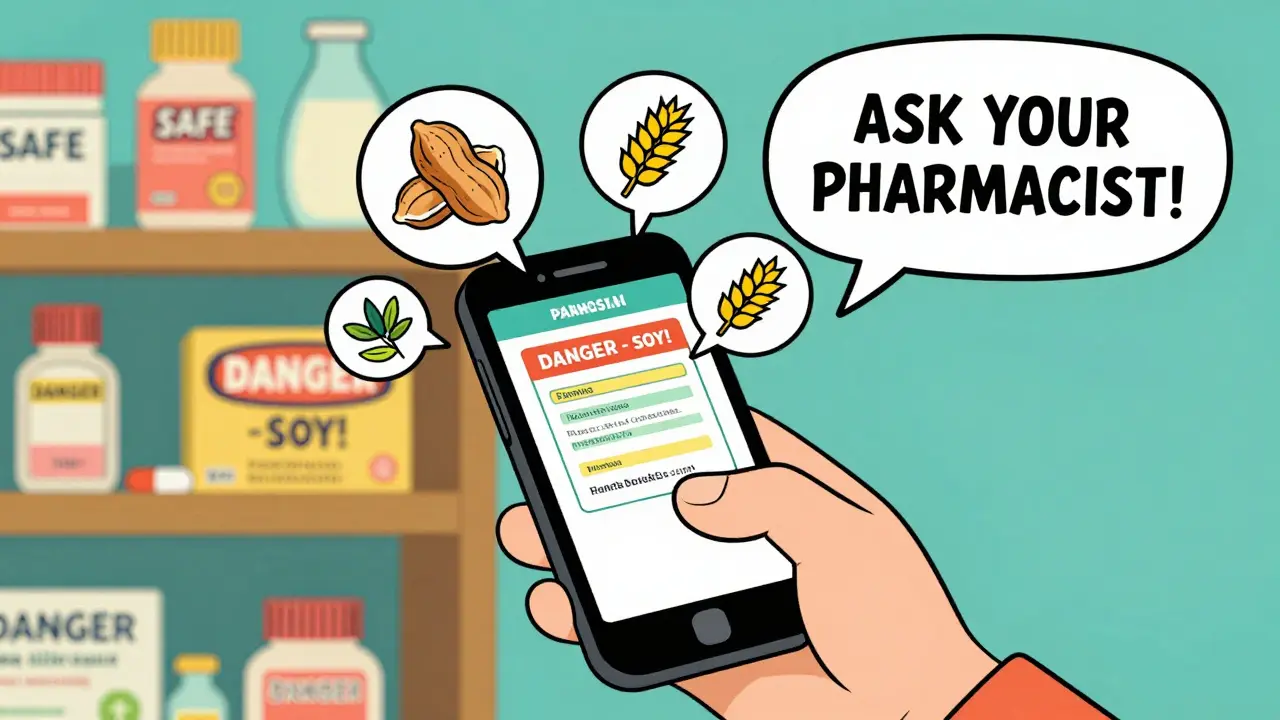
- Ask your pharmacist. Always. Say: "Can you give me the full list of inactive ingredients in this prescription?"
- Check the package insert (the small paper inside the box). Look for "Inactive Ingredients" or "Excipients."
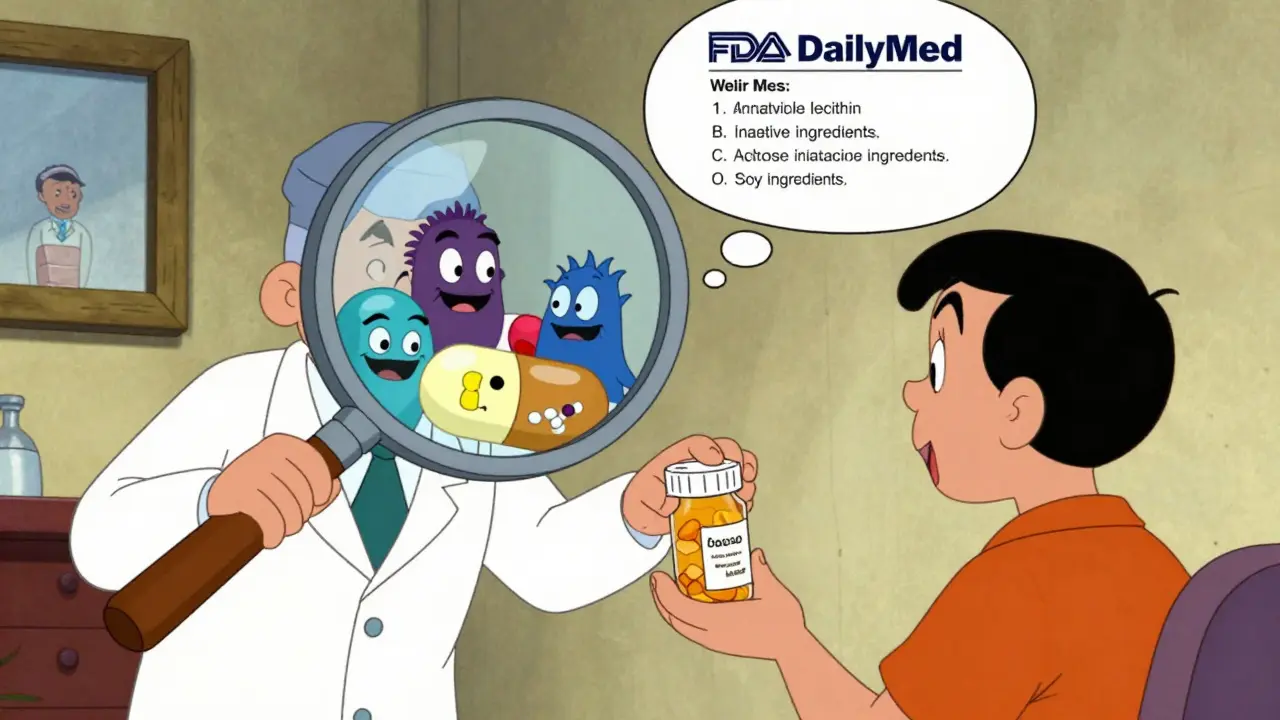
- Use the FDA’s DailyMed database online. Search your drug name, and scroll to the "Description" section.
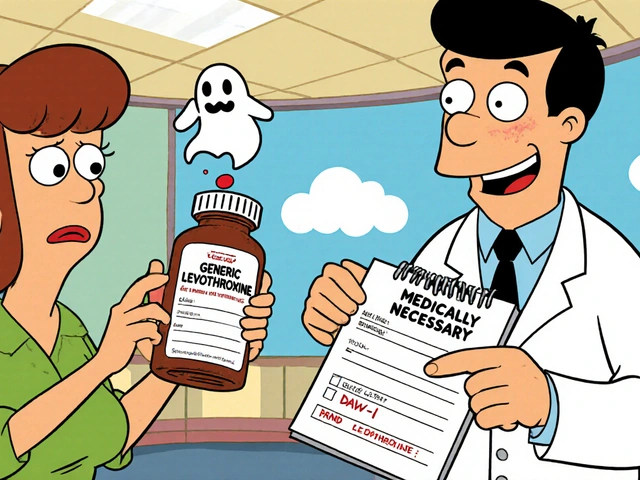
- Don’t assume generics are the same. Even two brands of the same generic drug can have different fillers.
One woman in Brisbane told me her son had a severe reaction to a generic antibiotic. The label didn’t say anything about soy. But the capsule shell contained soy lecithin. She’d never had a problem with the brand-name version-because it used a different filler. That’s why you can’t rely on past experience with medications.
How to Read Labels Like a Pro
Here’s a simple, step-by-step method that allergists recommend:
- Start with the "Contains" statement. If it’s there, read it first. It’s the fastest way to spot major allergens.
- Scan the ingredient list. Look for allergens in parentheses. Don’t skip over words you don’t recognize. "Casein" = milk. "Albumin" = egg. "Arachis oil" = peanut.
- Watch for "may contain" or "processed in a facility with". These are voluntary warnings. They mean cross-contact might have happened. They’re not required, so they’re not always reliable. But if you’re highly sensitive, treat them like a red flag.
- Check for hidden names. Soy can be listed as "textured vegetable protein," "hydrolyzed plant protein," or "vegetable gum." Wheat might be "modified starch," "maltodextrin," or "brewer’s yeast."
- For medicines: Always ask for the full inactive ingredient list. Write it down. Keep a note on your phone.
It takes 15 to 20 seconds per product. At first. After a few months, you’ll do it in 5. Practice makes safety.
What to Do When You’re Unsure
Here’s the truth: labels aren’t perfect. Even the best ones can miss something. If you’re ever unsure:
- Call the manufacturer’s customer service line. Most have it printed on the package. Ask: "Does this product contain [allergen]?" and "Is it made in a facility that processes [allergen]?"
- Use apps like AllergyEats Scan (launched in early 2024). It uses your phone’s camera to read ingredient lists and flags allergens. Beta testing showed 92% accuracy.
- Shop with brands that label clearly. FARE’s 2023 survey found that 79% of allergy sufferers prefer brands that use both the "Contains" statement AND parenthetical labeling. They’re more consistent.
- Keep a personal allergen log. Write down every product you’ve safely used-and every one that caused a reaction. Include the batch number if possible. This helps you spot patterns.
Why This Matters More Than You Think
Food allergen mislabeling causes 40% of all food recalls in the U.S. That’s not a glitch. It’s systemic. Smaller companies have only a 76% compliance rate. Big companies? 92%. But even big companies make mistakes. In 2023, 18% of sesame-related recalls happened because sesame was hidden in "spices" or "flavors."
And it’s not just about food. The global "free-from" food market hit $68.3 billion in 2023. People are spending billions to avoid allergens. But if you’re taking medication with hidden allergens, you’re still at risk-even if you eat perfectly clean.
For parents: 78% of allergic reactions in children happen from products their families thought were safe. That’s not negligence. It’s lack of information. The system isn’t designed to make you safe-it’s designed to avoid lawsuits. You have to be your own advocate.
What’s Changing in 2025 and Beyond
The FDA is working on new rules to standardize how "may contain" warnings appear. Right now, they say everything from "may contain peanuts" to "produced in a facility that also processes tree nuts." No consistency. No clarity. By late 2025, global standards from the Codex Alimentarius may bring more uniformity.
Some companies are adding QR codes to packages. Scan it, and you get a full allergen breakdown, including cross-contact risks. But older adults and people without smartphones can’t use them. So don’t rely on them alone.
The bottom line? Labels are improving-but they’re still not foolproof. The safest approach is simple: Read every label, every time. Ask questions. Don’t assume.
Are all food allergens required to be listed on labels?
Yes, the nine major food allergens-milk, eggs, fish, crustacean shellfish, tree nuts, peanuts, wheat, soy, and sesame-are legally required to be clearly labeled on packaged foods in the U.S. under FALCPA and the FASTER Act. They must appear either in the ingredient list (in parentheses) or in a separate "Contains" statement. However, other allergens like mustard or celery are not yet required to be labeled in the U.S., though they are in the EU and Canada.
Can medications contain allergens without saying so?
Yes. Unlike food, medications in the U.S. are not required to list allergens in their inactive ingredients. Common hidden allergens include lactose (from milk), soy lecithin, peanut oil, gelatin, and wheat starch. These can trigger reactions even in small amounts. Always ask your pharmacist for the full list of inactive ingredients, especially when switching brands or generics.
What should I do if I react to a product that doesn’t list my allergen?
Report it immediately. For food, file a report with the FDA through their Safety Reporting Portal. For medications, report to the FDA’s MedWatch program. Include the product name, batch number, and your reaction. These reports help the FDA track patterns and trigger recalls. Also, contact the manufacturer. Many will investigate and respond.
Is "gluten-free" the same as "wheat-free"?
No. Gluten is a protein found in wheat, barley, and rye. A product can be wheat-free but still contain barley or rye-both sources of gluten. Conversely, a product labeled "gluten-free" must contain less than 20 parts per million of gluten, but it could still contain wheat if the gluten has been removed (rare). Always check the ingredient list. If you’re allergic to wheat, don’t rely on "gluten-free" alone.
How can I find out if a generic drug has the same inactive ingredients as the brand name?
You can’t assume they’re the same. Generic drugs must have the same active ingredient, but not the same fillers. Use the FDA’s DailyMed website. Search the brand name and the generic name side by side, then compare the "Inactive Ingredients" sections. If they differ, ask your pharmacist if there’s a generic version with your preferred fillers.



Jake Moore
January 17, 2026 AT 14:37Just wanted to add that if you're on a tight budget, call your pharmacy and ask for the inactive ingredients list for your meds - most will print it for free. I keep a folder on my phone with every drug I take, the filler, and whether it triggered anything. Saved my life when I switched from one generic to another and ended up in hives. Don't trust the bottle. Trust your notes.
Joni O
January 19, 2026 AT 03:46thank you so much for this. i’ve been scared to try new meds for years bc i don’t know what’s in them. i just wrote down all the names of my meds and called my dr’s office. they sent me the inserts. this changed everything. 🙏
rachel bellet
January 20, 2026 AT 00:53Let’s be clear: the FDA’s labeling regime is a catastrophic failure of regulatory oversight. The fact that lactose, soy lecithin, and peanut oil - known anaphylactogens - are permitted as inert ingredients without disclosure is not an oversight, it’s a structural betrayal of public health. The 2023 JACI study you cited? It’s underreported. The real prevalence is likely 7-9% given underdiagnosis in low-income populations. And don’t get me started on the regulatory capture by Big Pharma lobbying against mandatory excipient disclosure. The FASTER Act was a performative gesture. Real reform requires codifying allergen thresholds for pharmaceuticals under 21 CFR Part 201, which the industry has blocked since 2018. You’re not just reading labels - you’re performing risk mitigation against a system designed to externalize harm.
Pat Dean
January 20, 2026 AT 21:35Why are we letting foreign companies get away with this? If you’re selling food or medicine in AMERICA, you follow AMERICAN rules. No more ‘natural flavors’ hiding soy. No more ‘excipients’ being a loophole. If you can’t spell out every ingredient in plain English, you don’t get to sell here. This isn’t ‘personal responsibility’ - it’s corporate cowardice, and it’s time we stopped rewarding it.
Jay Clarke
January 21, 2026 AT 08:59Look. I used to think labels were just a pain. Then my cousin’s kid went into anaphylaxis because a ‘gluten-free’ gummy vitamin had soy lecithin in the coating. The box said ‘allergen-free’ on the front. The back? Tiny print. ‘Contains: Soy.’ That’s not negligence. That’s a trap. And now I carry a laminated card in my wallet that says ‘I am allergic to soy, milk, peanuts, and sesame - please confirm inactive ingredients.’ People think I’m dramatic. I’m not. I’m alive. And you will be too - if you stop trusting the packaging and start asking questions. Every. Single. Time.
Selina Warren
January 23, 2026 AT 05:27YOU ARE NOT ALONE. I used to feel like a freak for reading every label like it was a CIA document. But here’s the truth: your life depends on this. I used to cry after every allergic reaction. Now I keep a log. I screenshot every package. I text my allergist before trying anything new. And guess what? I’m not just surviving - I’m thriving. This isn’t paranoia. It’s power. You have the right to know what’s in your body. Take it. Demand it. Document it. You’re not being difficult - you’re being smart. And if anyone tells you otherwise? Tell them to get off your back and read the damn label themselves.
Robert Davis
January 23, 2026 AT 11:41Interesting. I’ve been reading up on this for a while. The real issue isn’t labeling - it’s the lack of standardized nomenclature across manufacturers. One company calls it ‘hydrolyzed soy protein,’ another calls it ‘vegetable gum.’ The FDA doesn’t enforce naming consistency for excipients, which creates cognitive dissonance for consumers trying to track allergens. Also, QR codes? They’re a band-aid. Most elderly users can’t use them. And let’s not forget: 37% of all allergic reactions occur in children under 12 - who can’t read labels. The system is fundamentally flawed. We need mandatory allergen databases linked to product barcodes. Not ‘may contain.’ Not ‘processed in.’ Actual, verifiable, real-time data. But no one wants to pay for that infrastructure.
Eric Gebeke
January 24, 2026 AT 07:40Everyone’s acting like this is new. It’s not. I’ve had a peanut allergy since I was 5. In 2008, I had a reaction to a ‘nut-free’ granola bar. Turned out - peanut oil was used to polish the machinery. No one told me. No one had to. That’s the system. And now? They still hide it under ‘natural flavors.’ You think you’re safe because you’ve used the same brand for years? That’s the trap. Companies change suppliers every 18 months. Your ‘safe’ product? It’s not anymore. You’re not paranoid. You’re just late to the party. And now you’re gonna die because you trusted the brand instead of the label. I’ve been doing this for 30 years. You’re still learning. I’m not judging. I’m just saying - you’re behind.
Ryan Otto
January 25, 2026 AT 15:42It is not coincidental that the rise in food and pharmaceutical allergen-related incidents correlates precisely with the globalization of supply chains and the deregulation of excipient disclosure standards post-NAFTA. The U.S. regulatory apparatus has been systematically hollowed out by corporate lobbying, resulting in a biosecurity vacuum wherein allergenic agents - particularly those derived from genetically modified soy and dairy monocultures - are permitted to infiltrate the pharmacopeia under the euphemism of 'inert.' The FASTER Act, while symbolically laudable, is a performative gesture designed to appease middle-class consumers while permitting multinational conglomerates to continue outsourcing production to jurisdictions with no allergen transparency laws. The true solution lies not in individual vigilance - which is a burden imposed upon the vulnerable - but in the international codification of allergen disclosure standards under WHO oversight, enforced via trade sanctions. Until then, we are merely subjects in a biopolitical experiment conducted by the pharmaceutical-industrial complex.