
Metformin Formulation Decision Tool
1. What form of metformin are you currently taking?
2. What stomach issues are you experiencing?
3. How important is cost to your decision?
4. Any other relevant health factors?
Your Personalized Recommendation
Why this recommendation?
When you're first prescribed metformin for type 2 diabetes, most doctors don’t warn you about the stomach issues. But if you’ve taken it, you know-diarrhea, nausea, cramps. It’s not just annoying; it’s enough to make people quit the drug entirely. That’s why so many patients and doctors are asking: metformin extended-release vs immediate-release-does one actually sit better in your gut?
The short answer? Yes, for a lot of people, extended-release (XR) is easier on the stomach. But it’s not magic. And it doesn’t work for everyone. Let’s break down what the data says, what real patients experience, and how to decide which one’s right for you.
Why Does Metformin Even Cause Stomach Problems?
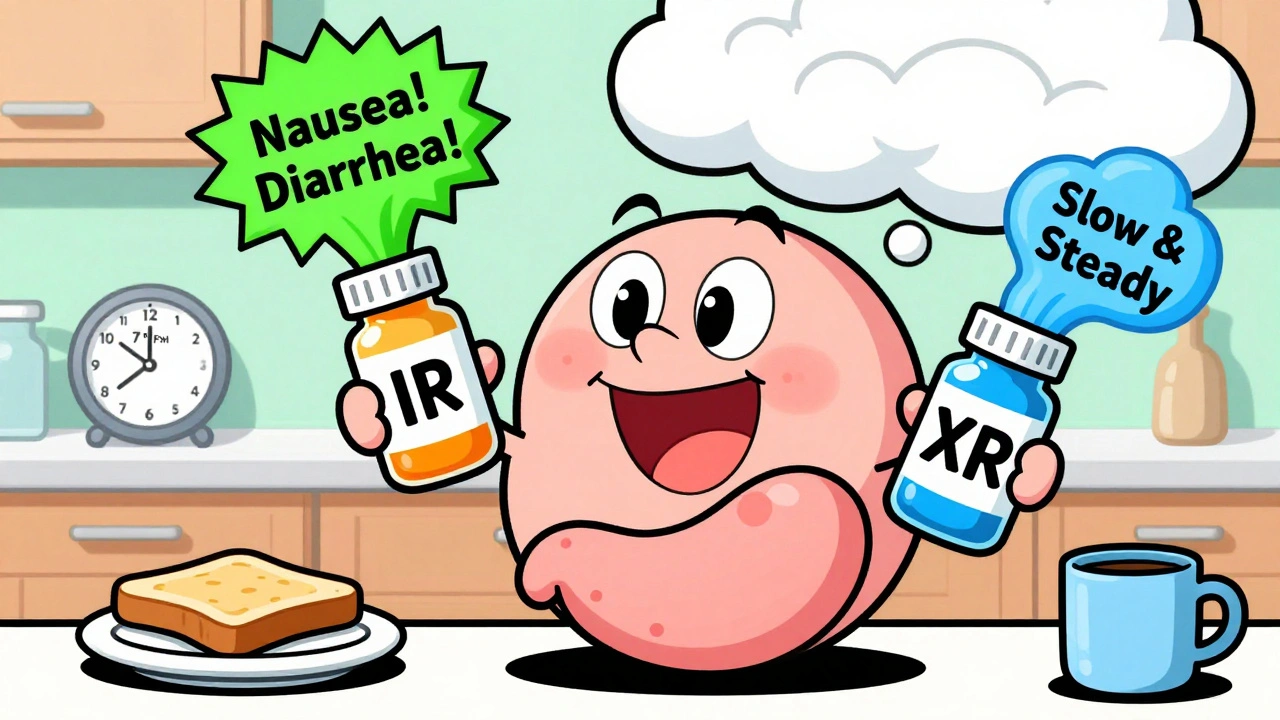
Metformin works by lowering blood sugar in the liver and improving how your body uses insulin. But it also acts directly on the lining of your intestines. That’s where the trouble starts. About 20-30% of people on immediate-release (IR) metformin get nausea, diarrhea, bloating, or gas. These side effects usually show up in the first few weeks and often fade as your body adjusts. But for some, they never go away.
Immediate-release metformin hits your system fast. If you take a 1000 mg tablet, your body absorbs most of it within 3-4 hours. That sudden surge of the drug in your upper gut irritates the lining. Think of it like dumping a handful of salt into a wound-quick, sharp, and uncomfortable.
How Extended-Release Metformin Works Differently
Extended-release metformin (XR) is designed to release the drug slowly over 8-12 hours. Instead of one big blast, you get a steady drip. This happens because XR tablets use special coatings or gel systems-like the GelShield Diffusion System-that control how quickly the medicine dissolves.
Here’s the key difference:
- Metformin IR: Peak concentration in blood at 3 hours after taking it.
- Metformin XR: Peak concentration at 7-8 hours.
That slower release means less drug is floating around your intestines at any one time. Less irritation. Fewer side effects.
The Data: How Much Better Is XR?
Multiple studies back this up. A 2021 meta-analysis of 2,347 patients across seven trials found that XR reduced overall gastrointestinal side effects by 15.3% compared to IR. That’s not a tiny difference-it’s meaningful.
One 2004 study tracked patients who switched from IR to XR. Diarrhea dropped from 28.6% to 17.5%. Nausea and cramping also fell sharply. In another study using the Gastrointestinal Symptom Rating Scale (GSRS), patients reported significantly lower symptom scores after switching.
But here’s the catch: Not all studies agree. A 2017 trial found that while diarrhea was lower with XR, nausea was slightly higher-4.6% vs 2.8%. Why? Maybe because the slow release keeps the drug in the stomach longer, which can trigger nausea in some people. So it’s not a perfect swap.

What Real Patients Say
Online forums like Reddit and TuDiabetes are full of stories. One user, u/MetforminSurvivor, wrote: “After years of daily diarrhea on IR, switching to XR cut my GI issues from 5-6 days a week to maybe 1-2 days a month. Life-changing.”
But another user, u/GlucophageProblems, said: “I switched to XR thinking it would help. Instead, I got new nausea I never had on IR. Went back to splitting my IR dose-better results.”
On Drugs.com, metformin XR has a 6.9/10 average rating. Metformin IR? Only 5.8/10. The negative reviews for IR are mostly about stomach problems. For XR, they’re about nausea or no difference.
So what’s the pattern? About 68% of people who switch from IR to XR report noticeable improvement. But 23% say it made no difference. And 8% actually feel worse. That’s why doctors don’t just push XR on everyone.
Cost and Accessibility
Generic metformin IR costs about $8-$10 for a 30-day supply. Generic XR? Around $10-$15. That 25-35% price difference adds up over time.
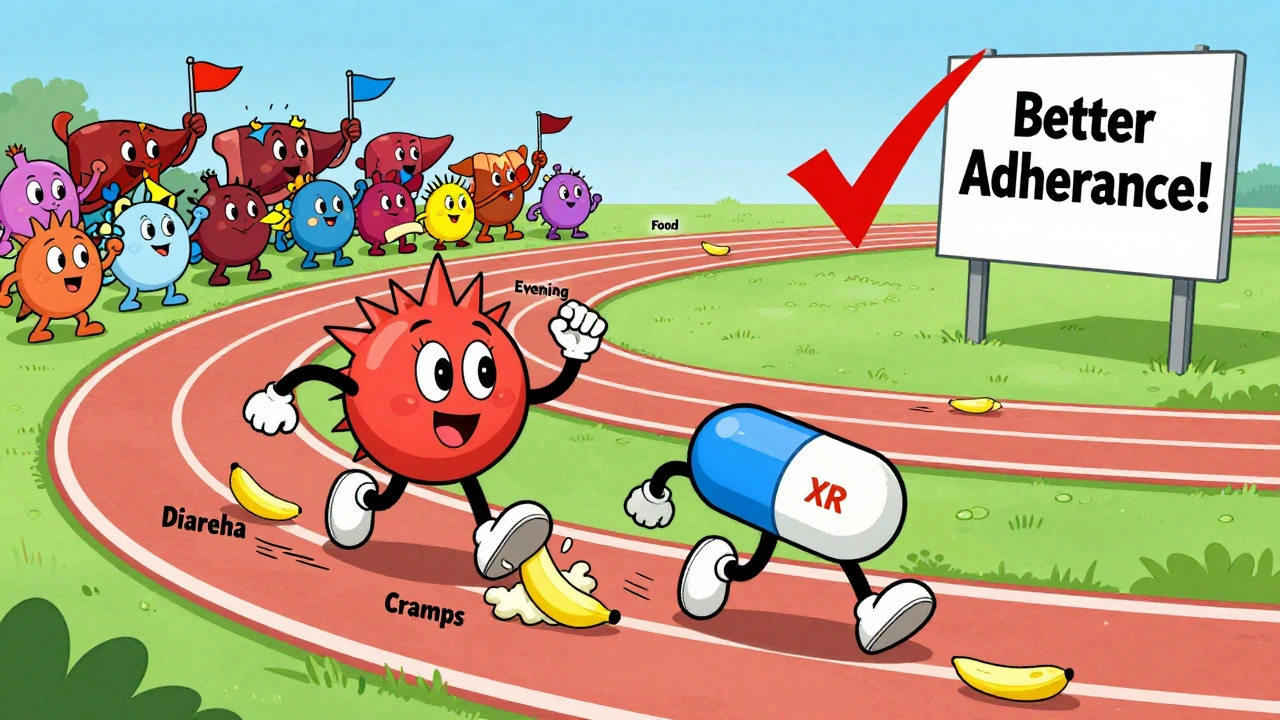
But here’s the twist: People on XR stick with it longer. A 2022 analysis of nearly 19,000 patients found that XR users had 18.3% higher adherence at 12 months. That means fewer missed doses, better blood sugar control, and less risk of complications down the road.
Cost-wise, it’s not just about the pill price-it’s about the cost of stopping the drug, going back to the doctor, trying something else, or ending up in the hospital because your diabetes isn’t controlled.
How to Start (and Stay) on Metformin Without the GI Pain
Whether you pick IR or XR, how you start matters just as much as what you take.
Here’s what works:
- Start low. Begin with 500 mg once a day. Don’t jump to 1000 mg right away.
- Take it with food. Always. Even if it’s just a snack. Food slows absorption and reduces irritation.
- Go slow with increases. Wait a full week before upping the dose. Your gut needs time to adapt.
- Consider timing. For IR, split the dose-take half with breakfast, half with dinner. For XR, one daily dose at dinner is often best.
A 2024 review showed that starting at 500 mg once daily and increasing weekly reduced GI side effects by 42% compared to faster titration.
Who Should Choose XR?
Extended-release metformin is a smart choice if:
- You had bad stomach issues on IR and couldn’t stay on it.
- You’re trying to stick with metformin long-term and don’t want to fight daily nausea.
- You prefer one pill a day over two or three.
- Your insurance covers XR with a low copay.
It’s less ideal if:
- You’re on a tight budget and IR is significantly cheaper.
- You’ve never had GI issues with IR-no need to switch.
- You’ve tried XR and got worse nausea. Some people just react differently.
What’s New in 2025?
Metformin XR isn’t standing still. In 2023, the FDA approved a new XR version called Metformax XR, which uses pH-dependent release technology. Early data suggests it cuts GI side effects another 12-15% compared to older XR formulations. It’s not widely available yet, but it’s a sign that drugmakers are still trying to make this drug easier to take.
The MET-XR trial, which started in 2021 and will wrap up in early 2024, is tracking 1,200 patients over two years. Its results could solidify XR as the default choice for new patients.
Bottom Line: It’s Personal
There’s no one-size-fits-all answer. Metformin XR reduces GI side effects for most people-but not all. Some do better on IR with a slow start and split doses. Others can’t tolerate IR at all, and XR is their only way to stay on the drug.
Doctors now recommend XR for patients who can’t handle IR. The American Diabetes Association and the American Association of Clinical Endocrinologists both say XR is preferred for tolerability. But they also say: start low, go slow, and take it with food-no matter which version you pick.
If you’re struggling with stomach issues on metformin, don’t just quit. Talk to your doctor. Try switching to XR. Or adjust your dosing schedule. Your gut-and your blood sugar-will thank you.
Is metformin extended-release better for your stomach than immediate-release?
Yes, for most people. Studies show metformin XR reduces overall gastrointestinal side effects like diarrhea and cramping by about 15% compared to immediate-release. The slower release means less irritation in the gut at any one time. However, some people report increased nausea with XR, so it’s not universally better-but it’s the preferred option for those who can’t tolerate IR.
Can you switch from metformin IR to XR safely?
Yes, and it’s often recommended if you’re having GI side effects. You can usually switch directly from the same total daily dose-for example, 1000 mg IR twice daily to 2000 mg XR once daily. But always consult your doctor first. They may recommend starting at a lower dose of XR and gradually increasing to avoid new side effects.
Does metformin XR cause more nausea than IR?
Some studies show a slight increase in nausea with XR-around 4.6% vs 2.8% in one trial. This may be because the drug stays in the stomach longer before being absorbed. If you’re prone to nausea, this could be a problem. But for most, the reduction in diarrhea and cramping outweighs this small risk.
Is metformin XR more expensive than IR?
Yes, typically by 25-35%. Generic metformin IR costs about $8-$10 for a 30-day supply. Generic XR runs $10-$15. But because people stick with XR longer, it can be more cost-effective overall-fewer doctor visits, better blood sugar control, and lower risk of complications.
Should I start with metformin XR or IR if I’ve never taken it before?
Many doctors now recommend starting with XR, especially if you’re overweight or have a history of stomach issues. It’s better tolerated from the start, and you’re more likely to stick with it. But if cost is a concern or you’re young and healthy, starting with IR at a low dose (500 mg) and increasing slowly can work just as well.
What’s the best time to take metformin XR?
Take metformin XR with your evening meal. This timing aligns with the drug’s slow release, helping to control overnight and morning blood sugar spikes. It also reduces the chance of nausea by ensuring the drug is released while food is in your stomach.





Juliet Morgan
December 4, 2025 AT 20:22I switched to XR last year after months of nasty diarrhea on IR. Like, I was literally avoiding social events because I didn't know when my gut would revolt. XR didn't make it disappear, but it cut it down to maybe once a week. I take it with my dinner and it's been life-changing. No more panic attacks before leaving the house.
Harry Nguyen
December 4, 2025 AT 23:28Of course XR is easier on your stomach. It's just the pharmaceutical industry's way of making you pay 30% more for the same drug. They didn't improve the medicine, they just slowed down the poison. Wake up people. Big Pharma is laughing all the way to the bank while you're still blaming your gut.
Deborah Jacobs
December 6, 2025 AT 02:01My grandma’s been on metformin since 2010. She tried IR, hated it, switched to XR, and now she’s the healthiest 78-year-old I know. She takes it with her scrambled eggs and a cup of chamomile tea. No drama. No drama at all. I wish I could say the same about my own stomach. Maybe I just need to go slower. Or eat more eggs.
Stephanie Bodde
December 7, 2025 AT 01:29YOU GOT THIS 💪 I was skeptical too, but I started at 500mg once a day with food and slowly crept up. Now I’m on 1000mg XR and feel like a new person. Your gut isn’t your enemy-it’s just confused. Be patient. It’ll catch up.
Ada Maklagina
December 7, 2025 AT 05:06XR works. I tried it. My stomach stopped screaming. Done.
Jimmy Jude
December 9, 2025 AT 00:20Let’s be real. This isn’t about metformin. This is about modern medicine’s obsession with packaging suffering in a prettier box. We’ve turned a simple, ancient remedy into a corporate product with a 25% markup and a fancy name. XR isn’t better-it’s just more expensive. And we’re all just complicit, swallowing pills and paying bills like good little consumers.
Meanwhile, people in developing countries are still taking plain metformin, no coating, no gel, no marketing-just pure science. And they’re fine. Maybe the problem isn’t the drug. Maybe it’s us. Maybe we’ve forgotten how to tolerate discomfort.
Do you know what’s really hard? Living with diabetes without access to any metformin at all. But we’re here arguing over whether the slow drip hurts less than the fast one. We’ve lost our way.
Don’t get me wrong-I’m glad XR helps some people. But don’t let the narrative fool you. This isn’t progress. It’s capitalism with a prescription pad.
Katie Allan
December 9, 2025 AT 20:53I’ve been a nurse for 18 years and I’ve seen so many patients give up on metformin because of the GI issues. The truth? Most of them just started too fast. I always tell them: start with 500mg, wait a week, then go up. Food. Always food. And if they still struggle? XR is a gift. Not magic. Just smarter delivery. And yes, the cost difference matters-but not as much as staying on the drug.
One patient told me, ‘I’d rather pay $15 and not feel like I’m dying every morning.’ That’s wisdom right there.
Philip Kristy Wijaya
December 11, 2025 AT 17:31It is imperative to acknowledge that the pharmaceutical industry has engineered a pseudo-scientific solution to a problem that is largely behavioral in nature. The fact that you require a delayed-release formulation suggests that you lack the discipline to take your medication with food or to titrate slowly. This is not a pharmacological advancement. This is a societal failure of personal responsibility.
My grandfather took metformin in the 1970s without any XR nonsense. He ate his meals on time. He did not complain. He lived to 94. What did you do today besides complain about your stomach?
James Moore
December 12, 2025 AT 07:32Let’s not forget the real issue here: the human body is not a machine that needs to be calibrated with fancy gel-coated tablets. The fact that we’ve gone from a simple, effective, cheap drug to a multi-billion-dollar extended-release product speaks volumes about how broken our healthcare system is. We’ve turned a lifestyle intervention into a pharmacological dependency. We’ve made people believe that their gut is broken, when in reality, they just need to eat slower, stop snacking, and maybe-just maybe-stop drinking soda with every meal. XR is a bandage on a bullet wound.
And don’t get me started on the FDA approving ‘Metformax XR’-like we need another branded version of a 70-year-old drug. What’s next? Metformin with Bluetooth? A smart pill that texts your doctor when you skip a dose?
The real breakthrough would be teaching people how to eat. But that doesn’t make money. So we sell pills.
Carole Nkosi
December 13, 2025 AT 22:43You all are missing the point. This isn’t about metformin. It’s about control. We’re so afraid of discomfort that we’ve created a whole industry to eliminate it. Pain is a signal. Diarrhea is your body saying ‘slow down.’ Instead of listening, we invent a pill that mutes the signal. That’s not healing. That’s suppression.
And yes, I’ve tried both. XR helped my diarrhea. But it made me feel like I was drugged. Like my body wasn’t mine anymore. I went back to IR. I take it with ginger tea. I eat at regular hours. I don’t eat after 7pm. And guess what? My blood sugar is better. My gut is quieter. And I didn’t pay extra for a placebo with a fancy name.
Annie Grajewski
December 14, 2025 AT 13:04XR my ass. I switched and got worse nausea. So I started splitting my IR into 250mg doses and taking them with every meal. Now I feel like a god. No drama. No extra cash. Just common sense. Why does everyone think they need a fancy pill? It’s not rocket science.
Kylee Gregory
December 16, 2025 AT 11:49I think the real takeaway here is that everyone’s body is different. Some people thrive on XR. Some need IR with split doses. Some need to eat more fiber. Some need to drink more water. There’s no universal answer-and that’s okay. The best thing a doctor can do is listen, not prescribe. And the best thing a patient can do is experiment, not quit.
Metformin isn’t the enemy. Fear of discomfort is. But so is the pressure to find the perfect pill. The truth is messy. And that’s beautiful.
Manish Shankar
December 17, 2025 AT 14:15As a physician who has managed diabetes for over two decades, I can confirm that extended-release metformin significantly improves gastrointestinal tolerability in approximately 70% of patients who previously discontinued immediate-release formulations due to adverse effects. However, the underlying principle remains unchanged: adherence is the most critical factor in long-term glycemic control. The pharmacokinetic advantages of XR are well-documented, but they are rendered meaningless if the patient does not take the medication consistently. Therefore, while XR is clinically preferable for intolerant patients, the cornerstone of success remains patient education, gradual titration, and dietary synchronization with dosing. The choice between IR and XR should be individualized-not standardized.