
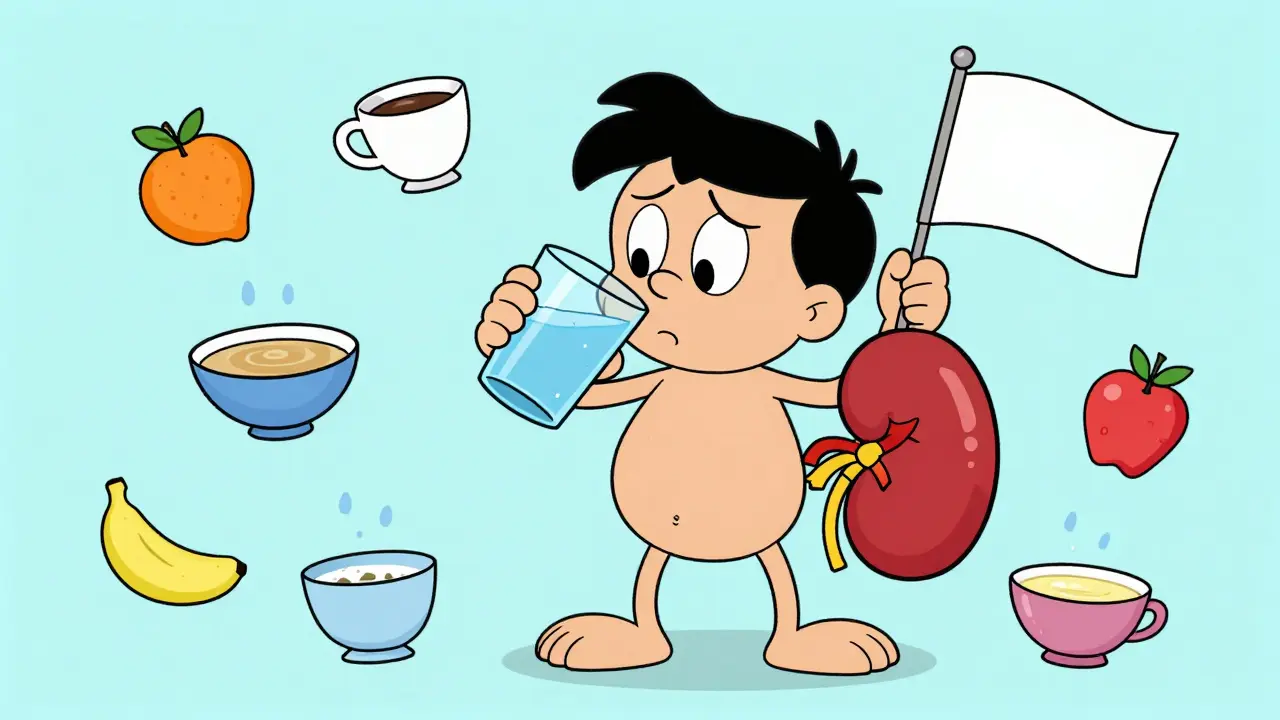
How many times have you heard that you need to drink eight glasses of water a day? Or that chewing gum stays in your stomach for seven years? What about the idea that we only use 10% of our brains? These aren’t just silly stories-they’re myths that shape how people make decisions about their health. And in healthcare, those myths can lead to real harm: missed diagnoses, unnecessary worry, or even avoiding proven treatments because of false beliefs.
Myth: You Need Eight Glasses of Water a Day
This one is everywhere. From school textbooks to fitness apps, it’s repeated like gospel. But here’s the truth: there’s no scientific basis for the number eight. Dr. Heinz Valtin from Dartmouth Medical School reviewed over 100 peer-reviewed studies in 2002 and found zero evidence supporting that specific recommendation. Your body doesn’t operate on a one-size-fits-all hydration schedule. Water needs vary based on climate, activity level, age, and even diet. If you eat fruits, vegetables, soups, or even coffee, you’re getting water. Thirst is your body’s natural signal-listen to it. For most healthy adults, drinking when you’re thirsty and letting your urine be pale yellow is all you need. Forcing down eight glasses daily? That’s not helping-it’s just filling your bladder.
Myth: You Lose 70-80% of Your Body Heat Through Your Head
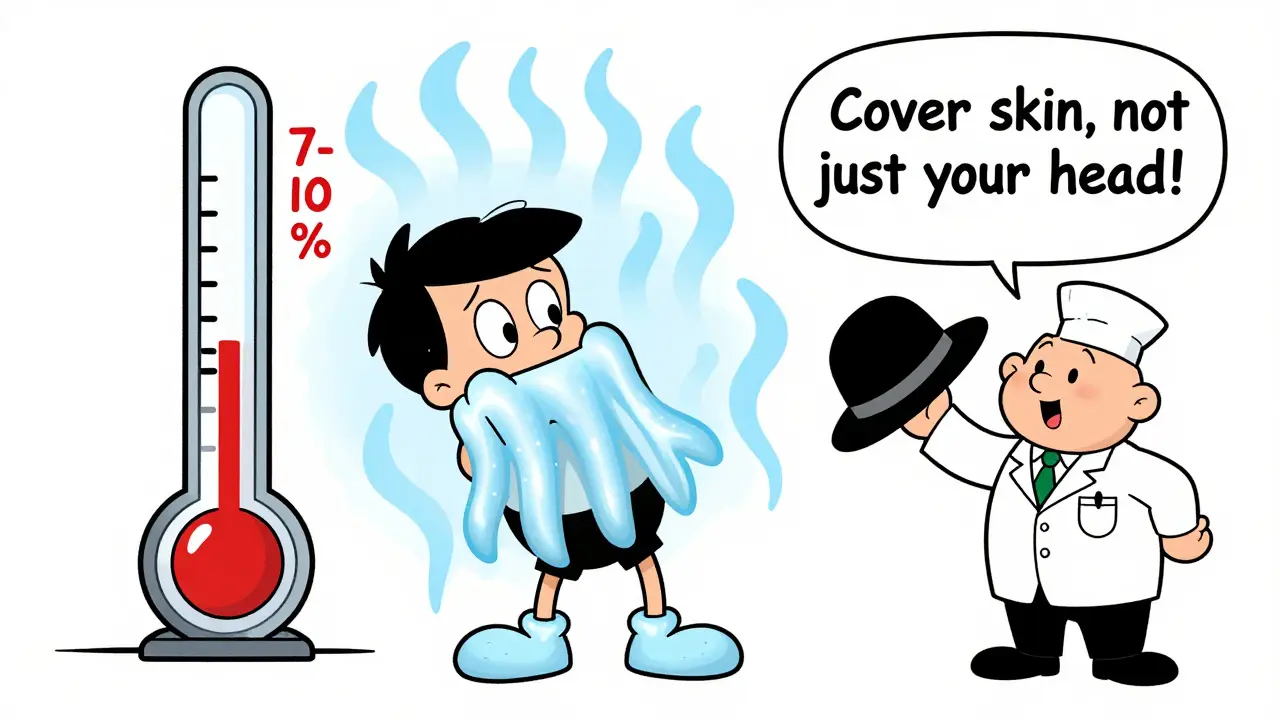
This myth probably started because people wear coats but forget hats. It sounds logical-if your head is uncovered, you’ll get cold fast. But here’s what actually happens: your head makes up about 7-10% of your total body surface area. So, if you’re cold and uncovered, your head will lose about that same percentage of heat. No more, no less. The same is true for your hands, feet, or any other exposed part. A 2023 study in BBC Science Focus Magazine confirmed this: if you leave your arm out in the cold, your arm loses just as much heat as your head. The key isn’t protecting your head above all else-it’s covering exposed skin. Wear a hat if it’s cold, sure. But don’t think it’s your only defense.
Myth: We Only Use 10% of Our Brains
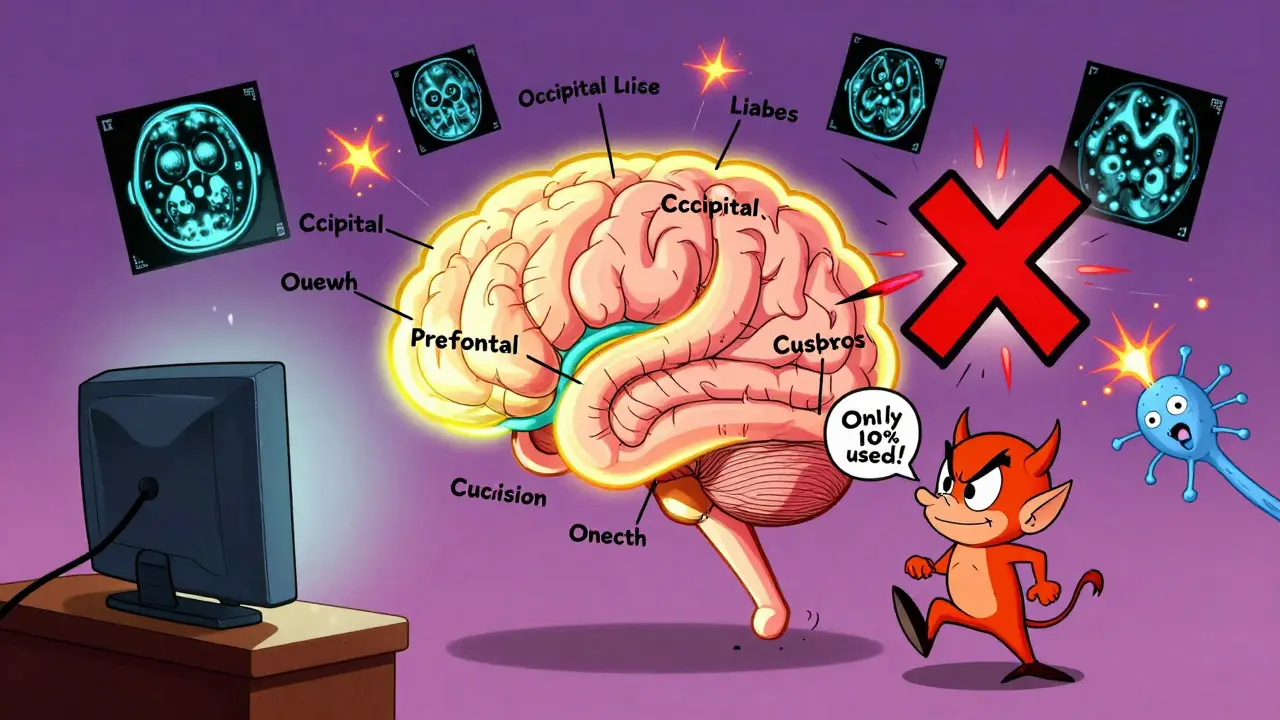
This myth has been around since the 1920s, thanks to a misinterpretation of psychologist William James’ work. It’s been repeated in movies, ads, and self-help books as proof that we’re all “unleashing hidden potential.” But modern neuroscience says otherwise. Functional MRI scans show activity across the entire brain-even during simple tasks like blinking or sipping coffee. Every region has a purpose. The cerebellum controls balance. The occipital lobe processes vision. The prefrontal cortex handles decision-making. There are no dormant zones. A 2022 study in the Journal of Cognitive Neuroscience confirmed that even at rest, the brain shows coordinated activity across all areas. You’re not wasting 90% of your mind-you’re using every part, just not all at once.
Myth: Sugar Makes Kids Hyperactive
It’s the classic birthday party excuse: “They ate too much candy-no wonder they’re running around like maniacs.” But over 23 double-blind, controlled studies, including a major 2021 meta-analysis in JAMA Pediatrics, have found no link between sugar and hyperactivity in children. Parents often report behavioral changes after sugar intake-but that’s likely because they expect it to happen. In studies where parents didn’t know whether their child consumed sugar or a placebo, they reported hyperactivity only when they thought their child had sugar. The real issue? The context. Birthday parties are exciting. Kids are surrounded by friends, music, and novelty. That’s what’s driving the energy-not the cake. Worse, this myth has been kept alive for decades by sugar industry lobbying, as documented in Archives of Internal Medicine in 2016. The truth? Sugar affects blood sugar levels, not behavior. And if your child is acting up after sweets, it’s probably because they’re tired, overstimulated, or bored-not because of glucose.
Myth: Chewing Gum Stays in Your Stomach for Seven Years
This one terrifies parents. “If your kid swallows gum, it’ll stick to their insides!” But here’s the reality: gum doesn’t digest. That’s true. But it also doesn’t stick. Your digestive system is built to move things along-even things that can’t be broken down. Chewing gum passes through your stomach, intestines, and out in your stool within two to four days. Dr. Ian Tullberg, a family medicine specialist at UCHealth, confirmed this in a 2022 interview: “It travels through your system like any other indigestible item-think corn kernels or seeds.” The only risk? Swallowing large amounts of gum in a short time, especially in very young children, which could cause a blockage. But one piece? No problem. You’re not giving your kid a permanent internal souvenir.
Myth: Superfoods Like Acai and Goji Berries Are Miracle Cures
Look at any health store or Instagram ad: “Superfood power!” “Anti-aging berries!” “Detox your body!” But the term “superfood” isn’t a scientific classification-it’s a marketing label. The European Food Information Council reviewed decades of research and found no evidence that goji berries, acai, kale, or chia seeds offer unique benefits beyond what you get from a balanced diet rich in fruits, vegetables, whole grains, and lean proteins. Yes, they’re nutritious. So are blueberries, spinach, lentils, and apples. You don’t need to pay $20 for a bag of dried acai to get antioxidants. You just need to eat a variety of colorful plants. The real danger? People think buying one “superfood” replaces the need for overall healthy eating. That’s like thinking taking one vitamin pill makes up for eating only chips and soda.
Why Do These Myths Stick Around?
It’s not because people are dumb. It’s because myths are simple, emotional, and often tied to cultural habits. They’re easier to remember than complex science. The brain prefers stories over statistics. And when a myth aligns with what we already believe-like “sugar gives kids energy”-it feels right, even if it’s wrong. Worse, some myths are actively pushed by industries. Sugar companies funded research to downplay sugar’s role in behavioral issues. Supplement companies profit from the idea that you need special “miracle” foods. Even well-meaning parents repeat myths because they heard them from their own parents.
How to Fight Back: The Truth Sandwich
Just saying “that’s wrong” doesn’t work. In fact, repeating the myth-even to debunk it-can make people remember it better. That’s called the “familiarity backfire effect.” The best way to correct misinformation is the “truth sandwich”: state the fact first, briefly mention the myth with clear labeling (“Some people think… but that’s not true”), then end by restating the truth. For example:
- Truth: Your brain is fully active-every part has a function.
- Myth: Some believe we only use 10% of our brain.
- Truth: Modern brain scans show activity across the entire brain, even during rest.
This method, backed by the American Association for the Advancement of Science (AAAS), improves retention by 47% compared to traditional debunking. It works because it anchors the correct information in the listener’s mind before and after the myth.
What You Can Do Today
You don’t need a science degree to help stop the spread of health myths. Here’s how:
- Check your sources. If someone says “studies show…” ask which ones. Look for peer-reviewed journals, not blog posts or influencers.
- Use trusted fact-checkers. Websites like Snopes, the WHO’s Myth Busters, or CDC’s Myth vs. Fact pages are reliable. They cite sources and update regularly.
- Ask questions. If a claim sounds too good to be true (“Lose 20 pounds in 3 days!”), it probably is. Healthy changes take time.
- Teach others gently. Instead of saying “You’re wrong,” say “I read something interesting about that-want to hear it?”
Health misinformation doesn’t just waste time-it can delay care, increase anxiety, and cost lives. The good news? Every time you replace a myth with a fact, you help someone make a better choice. And that’s not just smart-it’s powerful.
Is it true that drinking more water always improves your health?
No. Drinking more water than your body needs doesn’t give you extra health benefits. Your kidneys regulate fluid balance naturally. Overhydration can actually be dangerous, leading to low sodium levels (hyponatremia), especially in athletes or people with certain medical conditions. The key is listening to your body-thirst and urine color are better guides than arbitrary glass counts.
Can you really get sick from going outside with wet hair?
No. Colds and flu are caused by viruses, not cold temperatures or wet hair. You might feel chilly or uncomfortable, but that doesn’t lower your immune defenses enough to catch a virus. Studies have shown people exposed to cold environments don’t get sick more often than others-unless they’re also exposed to the virus. Wet hair won’t make you sick, but staying warm and washing your hands will.
Do detox diets actually remove toxins from your body?
Your liver and kidneys handle detoxification naturally. Detox diets-juice cleanses, laxatives, or special teas-don’t enhance this process. In fact, they can be harmful by causing nutrient deficiencies, dehydration, or electrolyte imbalances. There’s no scientific evidence that these diets remove “toxins” any better than your body already does. Eating whole foods, staying hydrated, and avoiding alcohol and processed foods supports your natural detox systems better than any commercial cleanse.
Is it dangerous to use aluminum cookware or antiperspirants?
No. Decades of research, including reviews by the FDA and the National Cancer Institute, have found no link between aluminum in cookware or antiperspirants and diseases like Alzheimer’s or breast cancer. Aluminum is present in many foods and water sources naturally. The amount absorbed through skin or cookware is tiny and safely filtered by the kidneys. Avoiding these products won’t reduce your risk of these conditions.
Do vaccines cause autism?
No. This myth started from a now-discredited 1998 study that was retracted due to fraud and ethical violations. Since then, over 25 large-scale studies involving millions of children have found no connection between vaccines and autism. Major health organizations-including the CDC, WHO, and American Academy of Pediatrics-confirm vaccines are safe and do not cause autism. The rise in autism diagnoses is due to better awareness and broader diagnostic criteria, not vaccines.
What’s Next?
Myth debunking isn’t a one-time fix-it’s an ongoing effort. As new misinformation emerges, so do new tools. Google’s “About This Result” feature now shows context for search results. The WHO’s Myth Busters page adds new corrections monthly. Fact-checking AI tools are getting smarter. But the most powerful tool is still you. When you question a myth, share the truth, and encourage others to do the same, you’re not just correcting a lie-you’re building a culture of critical thinking. And in healthcare, that’s the most effective medicine of all.


Amy Vickberg
January 16, 2026 AT 07:59It’s so refreshing to see someone lay out these myths with actual science behind them. I used to force myself to drink eight glasses a day until I started paying attention to my body-now I drink when I’m thirsty and eat more watermelon in summer. My urine is pale yellow, I’m not dizzy, and my skin isn’t cracking. Why do we listen to arbitrary numbers instead of our own biology?
Haley Graves
January 16, 2026 AT 13:55Exactly. And the sugar-hyperactivity myth? I’m a pediatric nurse. I’ve seen parents panic because their kid ate a cupcake at a party. Then we run the same test with a placebo-same behavior. The real issue is the chaos of the party, not the sugar. We need to stop blaming food and start teaching kids how to regulate excitement.
Gloria Montero Puertas
January 18, 2026 AT 08:10It’s astonishing-truly astonishing-that these myths persist in the 21st century. The 10% brain myth? A gross misrepresentation of neuroplasticity. The eight-glass rule? A marketing ploy disguised as medical advice. And the ‘superfood’ industry? A grotesque exploitation of human gullibility. If you’re still believing any of this, you’re not just misinformed-you’re complicit in the erosion of scientific literacy.
Frank Geurts
January 19, 2026 AT 10:54While I appreciate the effort to dispel misinformation, one must acknowledge the cultural context in which these myths arise. In many societies, hydration rituals, dietary superstitions, and folk remedies serve as social glue. To dismiss them outright without acknowledging their anthropological function may alienate those who need education most. A more nuanced approach-respectful, contextual, and community-led-is far more effective than clinical debunking.
Arjun Seth
January 20, 2026 AT 15:42These so-called myths are just the tip of the iceberg. Who really controls what we believe? Big Pharma, the sugar lobby, the supplement industry-they all profit from keeping us confused. You think your kidneys are detoxing? They’re just cleaning up the mess left by processed foods they told you were ‘healthy.’ Wake up. The system is rigged.
Mike Berrange
January 22, 2026 AT 07:04You mention the ‘truth sandwich’ method. But you didn’t cite the original source. Was it from the AAAS? Or was it from a 2017 paper by Lewandowsky? Also, you say ‘over 23 studies’ on sugar and hyperactivity-but you didn’t list them. That’s sloppy. If you’re going to debunk myths, at least do it with proper citations. Otherwise, you’re just another person repeating a myth with footnotes.
Dan Mack
January 24, 2026 AT 05:59They’re all lies. The water thing? The brain thing? The gum thing? All controlled by the same shadowy group that also says vaccines are safe. Why do you think they push the ‘urine color’ thing? So you’ll think you’re fine while your kidneys are shutting down. They don’t want you to know the truth. The real danger isn’t the myth-it’s the people who profit from you believing the lie.
Nishant Garg
January 25, 2026 AT 06:49In India, we have our own myths-like drinking warm water with lemon every morning cures everything. But here’s the thing: culture isn’t the enemy. The enemy is when tradition becomes dogma without curiosity. I grew up believing in ‘hot water cures,’ but then I read a study on hydration and realized my grandmother wasn’t wrong-she just didn’t know the science. So I keep the ritual, but now I understand why it works. That’s the bridge: honor the practice, but update the understanding.
Jan Hess
January 26, 2026 AT 07:47YES. This is the kind of post that makes me want to share it with my whole family. I’ve been telling my mom for years that gum doesn’t stay in your stomach for seven years. She still thinks it does. Now I can just send her this. Thank you for making science feel like a conversation, not a lecture. Keep it coming!
Tom Doan
January 27, 2026 AT 10:23How curious. You meticulously dismantle each myth with peer-reviewed evidence-yet you conclude with a call to ‘teach others gently.’ Isn’t that a contradiction? If the truth is demonstrably superior, why soften it with politeness? Perhaps the real myth isn’t in the science-but in the assumption that people will change their minds if you’re nice enough.