
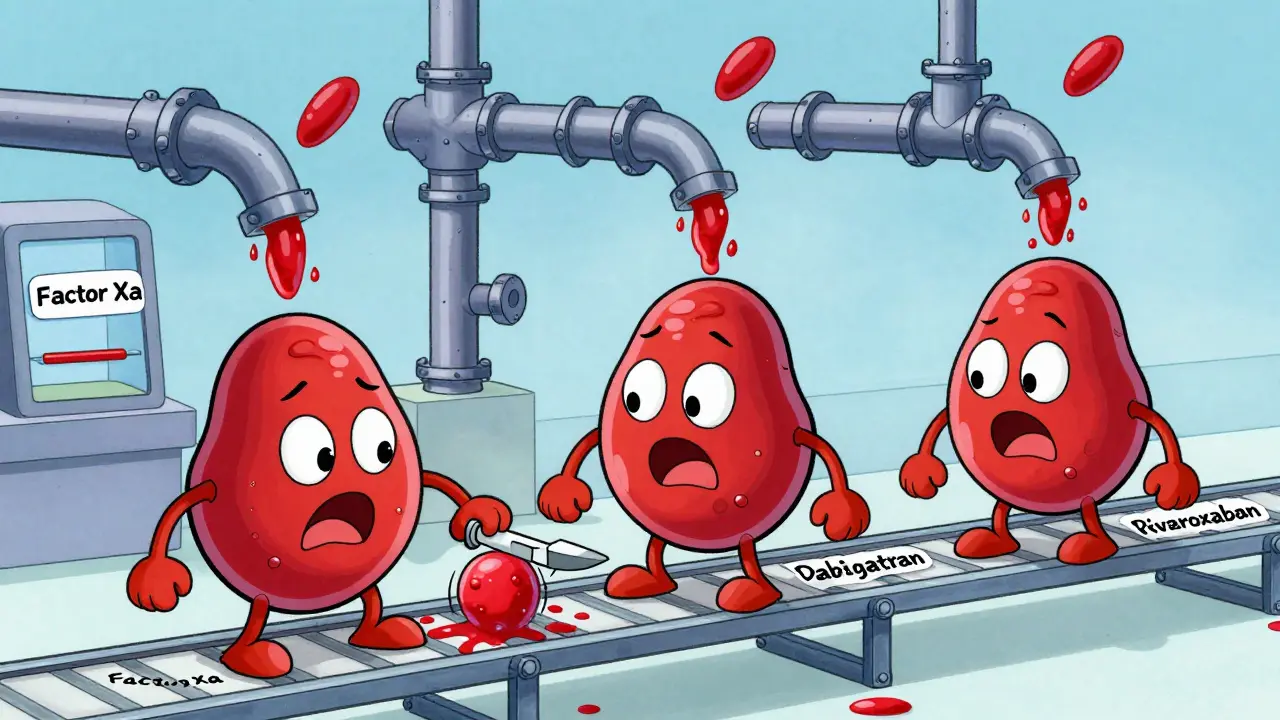
When you're prescribed a blood thinner, you're not just choosing a drug-you're choosing a risk profile. Apixaban, rivaroxaban, and dabigatran all prevent strokes and clots, but they don't do it the same way. And their side effects? They’re different enough to change which one is right for you.
How These Drugs Work (And Why It Matters)
All three are called DOACs-Direct Oral Anticoagulants. They replaced warfarin because they don’t need constant blood tests. But here’s the catch: they work differently.Dabigatran blocks thrombin, the final enzyme that turns fibrinogen into clots. Think of it like cutting the last step in a factory line. Apixaban and rivaroxaban both block factor Xa, an earlier step in the clotting chain. That might sound similar, but their chemical shapes, how long they last in your body, and how your kidneys clear them? Those differences create real-world side effect gaps.
Apixaban sticks around 8-15 hours. Rivaroxaban lasts 5-13 hours. Dabigatran? It lingers 12-17 hours. And here’s where it gets personal: 80% of dabigatran leaves through your kidneys. If your kidneys aren’t working well, that drug builds up. Apixaban? Only 25% is cleared by kidneys. That’s why doctors often pick apixaban for older patients or those with kidney trouble.
The GI Bleeding Divide
If you’ve ever had a stomach ulcer, taken NSAIDs like ibuprofen, or just hate the idea of bleeding in your gut, this part matters most.Multiple large studies-like the one in JAMA in 2022 and the Oxford Academic study in 2020-show the same thing: apixaban has the lowest risk of gastrointestinal bleeding.
Rivaroxaban? It causes nearly twice as many GI bleeds as apixaban. The numbers? 39.7 major GI bleeds per 1,000 person-years for rivaroxaban versus 18.5 for apixaban. That’s not a small difference-it’s a clinical red flag.
Dabigatran isn’t far behind. It carries a 48% higher risk of GI bleeding compared to apixaban. Why? No one’s 100% sure, but it might be because dabigatran is a direct thrombin inhibitor, and thrombin plays a role in protecting the stomach lining. Blocking it too hard might leave the gut more vulnerable.
If you’ve had a GI bleed before? Or if you’re on aspirin or naproxen? Apixaban is often the safest pick. That’s why the American College of Cardiology specifically recommends it for patients with high bleeding risk.
Brain Bleeds Are Different Than You Think
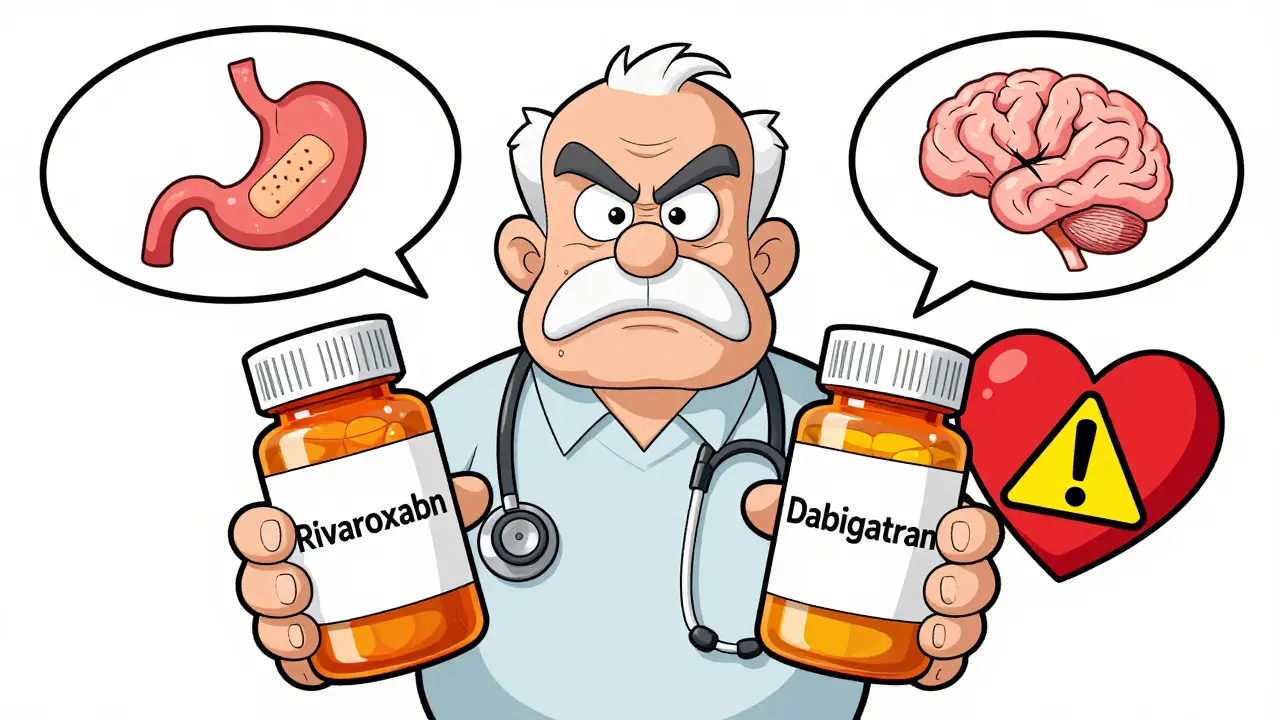
Most people assume all blood thinners raise the risk of brain bleeds the same way. Not true.Studies show rivaroxaban has a slightly lower risk of intracranial hemorrhage than apixaban. A 2022 study in PubMed found rivaroxaban’s risk was 14% lower. That’s surprising, because both are factor Xa inhibitors. But it’s real. It might be due to how deeply each drug binds to factor Xa-or how quickly it leaves the bloodstream after a dose.
Dabigatran? It also reduces brain bleeding risk compared to warfarin-but not as consistently as the others. The JACC 2012 analysis showed dabigatran 110 mg twice daily had 54% less intracranial bleeding than rivaroxaban. So while apixaban wins on stomach safety, rivaroxaban might have a slight edge for brain safety.
That doesn’t mean you should pick rivaroxaban just for this. The trade-off? Higher GI bleeding. But for someone with a history of brain bleeds or severe high blood pressure, this nuance matters.
The Hidden Heart Risk: Dabigatran and Heart Attacks
This one’s often overlooked. Dabigatran has been linked to a higher risk of heart attacks and acute coronary syndrome.Multiple meta-analyses, including one in PMC in 2014 and another in JACC in 2012, found a 48% increase in heart attack risk with dabigatran compared to other DOACs. The mechanism? It’s not fully understood. Some researchers think direct thrombin inhibition might trigger inflammation in blood vessels-kind of like the old drug ximelagatran, which got pulled off the market for the same reason.
If you have coronary artery disease, angina, or a history of heart attack? Dabigatran might not be the best fit. Apixaban and rivaroxaban don’t show this same signal. For someone with atrial fibrillation but no heart disease, the risk is small. But if you’re over 65 and have plaque in your arteries? That’s a red flag.
Mortality and Stroke Prevention: What’s the Real Trade-Off?
You want to prevent stroke. But you don’t want to die from a bleed. So which drug saves the most lives?The JAMA 2022 study found rivaroxaban had higher overall death rates than apixaban-mostly from fatal bleeds and heart events. Apixaban users had 3.1 fewer deaths per 1,000 people each year. That’s not a tiny gap.
But here’s the twist: all three drugs are equally good at preventing stroke. Dabigatran: 1.84 events per 100 person-years. Rivaroxaban: 2.21. Apixaban: 2.62. The numbers look different, but the differences aren’t statistically meaningful. So if you’re choosing based on stroke prevention alone, you’re picking a wash.
The real winner? Apixaban. It gives you the same stroke protection as the others-with less bleeding, fewer heart attacks, and lower death rates.
Who Gets Which Drug? Real-World Decisions
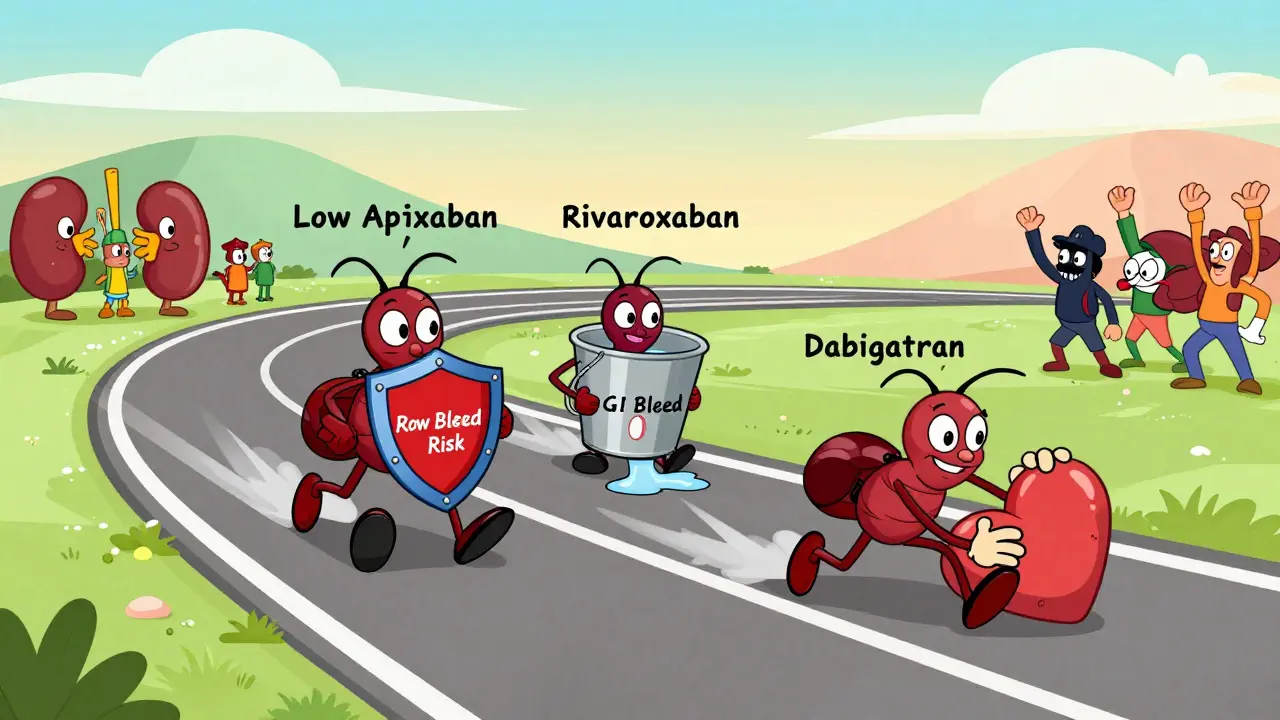
So what does this mean for you?- If you’re over 80, have kidney issues, or a history of stomach ulcers: Apixaban is your best bet. It’s the safest for GI bleeding and kidney function.
- If you struggle with taking pills twice a day: Rivaroxaban’s once-daily dose (for AFib) might help you stick with it. But you’re trading convenience for higher bleeding risk.
- If you have coronary disease or a history of heart attack: Avoid dabigatran. The data on heart attack risk is too consistent to ignore.
- If you’re on NSAIDs or aspirin: Apixaban again. The combo with rivaroxaban or dabigatran is a recipe for trouble.
Cost matters too. Generic apixaban is now under $30 a month in the U.S. Rivaroxaban and dabigatran are similarly priced. So price isn’t a deciding factor anymore.
What About Dosing?
Dosing isn’t just about convenience-it affects safety.Dabigatran is always twice daily. No exceptions. That means missed doses can be risky. Apixaban? Always twice daily too. Rivaroxaban? Once daily for AFib, but twice daily if you’re treating a blood clot. That inconsistency can confuse patients.
And don’t forget: dabigatran must be taken with food. Apixaban and rivaroxaban? No food needed. For someone with nausea, poor appetite, or dementia? That’s another reason apixaban or rivaroxaban might be easier to manage.
The Bottom Line
There’s no single best DOAC. But there’s a best choice for you.Apixaban wins on safety: lower GI bleeding, lower death rates, safer for kidneys, no heart attack signal. It’s the most prescribed DOAC in the U.S. for a reason.
Rivaroxaban? Its once-daily dosing helps adherence, but at a cost-higher bleeding, especially in the gut. It’s a good option if you’re young, healthy, and have no stomach issues.
Dabigatran? It’s fading from use-not because it doesn’t work, but because the risks outweigh the benefits for most people. It’s still useful for some, but only after careful review.
If your doctor hasn’t explained why they picked one over the others, ask. Not all DOACs are equal. Your side effect risk isn’t a numbers game-it’s personal.
Is apixaban safer than rivaroxaban?
Yes, for most people. Apixaban has significantly lower risks of gastrointestinal bleeding, major bleeding, and death compared to rivaroxaban. Studies show rivaroxaban causes nearly twice as many GI bleeds and higher overall mortality. Apixaban is also safer for people with kidney problems and those taking NSAIDs. While rivaroxaban may have a slight edge in reducing brain bleeds, the trade-off in stomach bleeding often makes apixaban the preferred choice.
Why is dabigatran less commonly prescribed now?
Dabigatran has been largely replaced because of its higher risk of gastrointestinal bleeding and a consistent link to increased heart attack risk-especially compared to apixaban. It also requires twice-daily dosing and must be taken with food, which reduces adherence. With generics now available, doctors have shifted toward apixaban for its better safety profile. Market data shows dabigatran’s share of the DOAC market has dropped to around 10%, while apixaban leads at 45%.
Can I switch from rivaroxaban to apixaban safely?
Yes, switching is common and often recommended, especially if you have a history of stomach bleeding, kidney issues, or are over 75. Your doctor will typically stop rivaroxaban and start apixaban the next day, without a washout period. No bridging with heparin is needed. The change is straightforward and can reduce your bleeding risk without losing protection against stroke.
Do I need blood tests while on these drugs?
No routine blood tests are needed for apixaban, rivaroxaban, or dabigatran-unlike warfarin. However, doctors may check kidney function every 6-12 months, especially if you’re older or have diabetes. In emergencies (like major bleeding), special blood tests can measure drug levels, but these aren’t part of regular care.
What should I do if I miss a dose?
For apixaban (twice daily): If you miss a dose and it’s less than 6 hours until your next dose, skip it. If it’s more than 6 hours away, take it. For rivaroxaban (once daily): If you miss it, take it as soon as you remember, then go back to your regular schedule. Never double up. For dabigatran: Same rule as apixaban-take it if more than 6 hours until next dose. Missing doses increases clot risk, so set phone reminders.


Nicholas Gama
March 9, 2026 AT 07:58Apixaban? Of course it's safer. The data's there. Rivaroxaban? A corporate shill disguised as medicine. They pushed it because it was easier to patent. Dabigatran? Even worse. Thrombin inhibition = gut lining suicide. Wake up. This isn't medicine-it's pharmacoeconomics dressed in lab coats.
And don't get me started on 'no blood tests.' That's not convenience-it's negligence. You're trusting algorithms over physiology. Pathetic.
Mary Beth Brook
March 10, 2026 AT 13:44Apixaban dominates the U.S. market for a reason: superior pharmacokinetic profile. Factor Xa inhibition with renal excretion <10%? That's the gold standard. Rivaroxaban's GI bleed rate? Statistically significant at p<0.001. Dabigatran's thrombin antagonism? Pro-inflammatory cascade activation confirmed in murine models. This isn't opinion-it's meta-analysis.
Ray Foret Jr.
March 11, 2026 AT 20:05bro i switched from rivaroxaban to apixaban last year after a scary stomach bleed 😅
no more panic attacks when i take ibuprofen for my back
my doc said 'apixaban is the chill one' and honestly?? he was right
life is so much easier now 🙌
if you're on the fence-just do it. your gut will thank you
rafeq khlo
March 13, 2026 AT 02:24The assertion that apixaban is universally superior lacks nuance. While GI bleeding incidence is lower, intracranial hemorrhage risk differential is statistically insignificant when adjusted for age and hypertension burden. Moreover, adherence metrics suggest that once-daily regimens improve persistence rates by 22%-a clinically relevant outcome often omitted in academic literature. The reduction in mortality is confounded by selection bias in real-world cohorts. Regulatory agencies do not endorse apixaban as first-line-only as non-inferior with lower bleeding risk under specific conditions. The narrative is oversimplified.
Morgan Dodgen
March 13, 2026 AT 15:25Apixaban? Yeah right. Big Pharma's latest mind control pill. They replaced warfarin so they could charge $500/month… now generics? Still overpriced. Dabigatran’s heart attack risk? That’s the smoking gun they buried. Why? Because the FDA gets donations from Bristol-Myers. Rivaroxaban’s once-daily? That’s not convenience-it’s a trap. You think you’re saving time, but you’re letting a drug with 2x the GI bleed risk stay in your system longer. Wake up. They want you bleeding quietly so they can sell you more drugs.
And no blood tests? That’s not innovation. That’s abandonment of medical ethics. I’ve seen patients die from undetected apixaban buildup. They don’t tell you that on the commercial.
Philip Mattawashish
March 14, 2026 AT 04:44You're all missing the point. This isn't about efficacy. It's about control. Who benefits when you're on a twice-daily drug with food restrictions? The system. The pharmacy. The insurance company. Dabigatran was demonized not because it's dangerous-but because it forced patients to engage with their care. Apixaban? Easy. Convenient. Passive. You don't need to think. You don't need to remember. You just take it. And that’s the real danger. Compliance isn't safety-it's compliance. You’ve been trained to be a good patient. And that’s the most dangerous thing of all.
Tom Sanders
March 14, 2026 AT 18:52bro i just take whatever my doctor gives me. don't wanna think about this stuff. apixaban? sure. whatever. just don't make me count pills.
Jazminn Jones
March 15, 2026 AT 19:36The conflation of clinical trial data with real-world outcomes is a persistent analytical flaw. While apixaban demonstrates lower all-cause mortality in observational cohorts, residual confounding from indication bias remains unaddressed. Patients prescribed apixaban are systematically younger, less comorbid, and more adherent to monitoring protocols. The observed safety advantage is not causal-it is correlational. To recommend apixaban as universally superior without stratifying by renal function, concomitant NSAID use, or CHA₂DS₂-VASc score constitutes clinical overreach. Evidence-based medicine requires nuance, not dogma.