
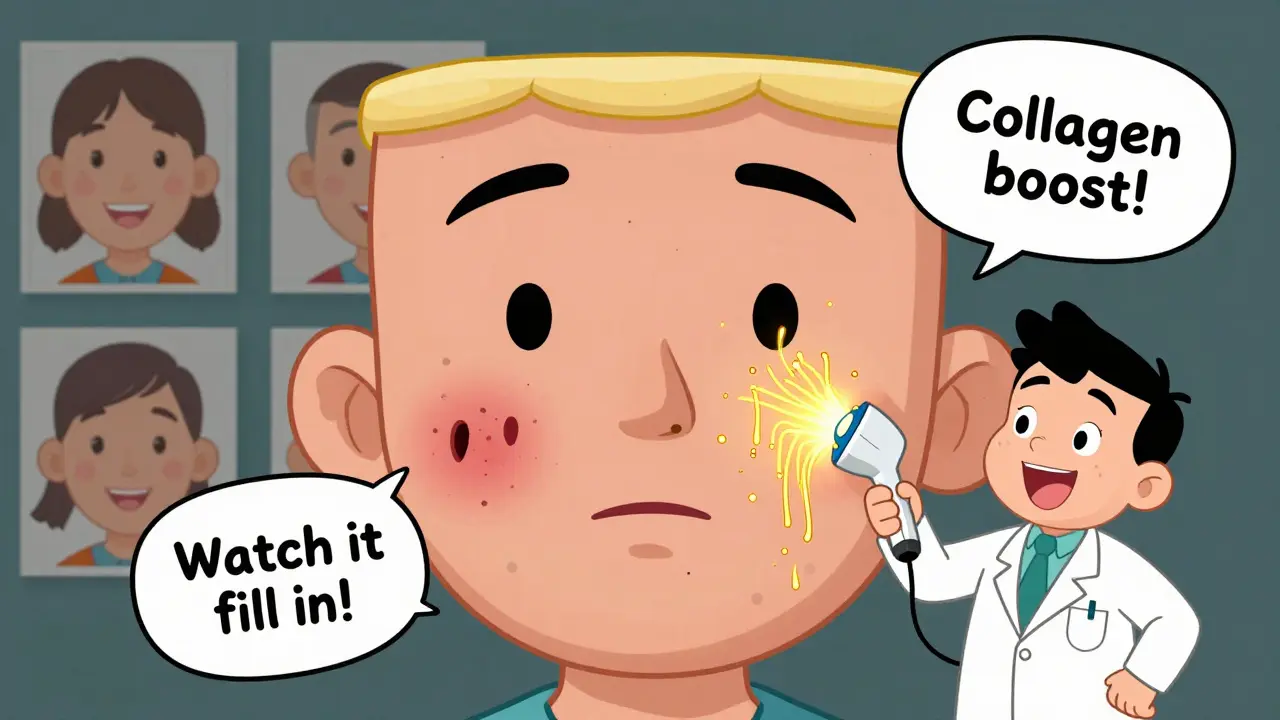
Acne scars don’t just fade with time. If you’ve had cystic acne or deep breakouts, you know that even after the pimples are gone, the damage lingers-pits, ridges, and uneven texture that make your skin feel like it’s been through a war. The good news? You’re not stuck with them. Today’s treatments go far beyond creams and concealers. Acne scars can be significantly improved, and the best results come from combining the right procedures with smart skincare. This isn’t magic. It’s science. And it’s working for thousands of people right now.
Why Acne Scars Don’t Heal on Their Own
Not all acne leaves scars, but about 95% of people who’ve had moderate to severe acne will develop some kind of scarring, according to the American Academy of Dermatology. These aren’t just marks-they’re structural changes in your skin. When a deep pimple inflames the follicle, it damages the tissue beneath. As your body tries to repair it, collagen production goes haywire. Too little collagen? You get depressed scars. Too much? You get raised ones. Most acne scars are atrophic-sunken-because the skin can’t rebuild what was lost. There are three main types:- Rolling scars: Wide, shallow depressions that look like waves under the skin.
- Boxcar scars: Sharp edges, like small craters or chickenpox scars.
- Ice pick scars: Narrow, deep holes that look like they were punched in.
Microneedling: The Gentle Powerhouse
Microneedling isn’t new, but it’s gotten a serious upgrade. Traditional microneedling uses tiny needles to create controlled micro-injuries in the skin. Your body responds by ramping up collagen and elastin-exactly what you need to fill in those scars. But now, the game-changer is RF microneedling, like Morpheus8. These devices deliver radiofrequency energy deep into the skin through insulated needles, heating the tissue to stimulate remodeling from the inside out. Here’s how it stacks up:- Needle depth: 1.5mm to 2.5mm for optimal scar penetration
- Punctures per second: 100-200 (automated devices like Dermapen)
- Energy levels: 1-12W (adjustable for skin type and scar depth)
Laser Treatments: Precision and Power
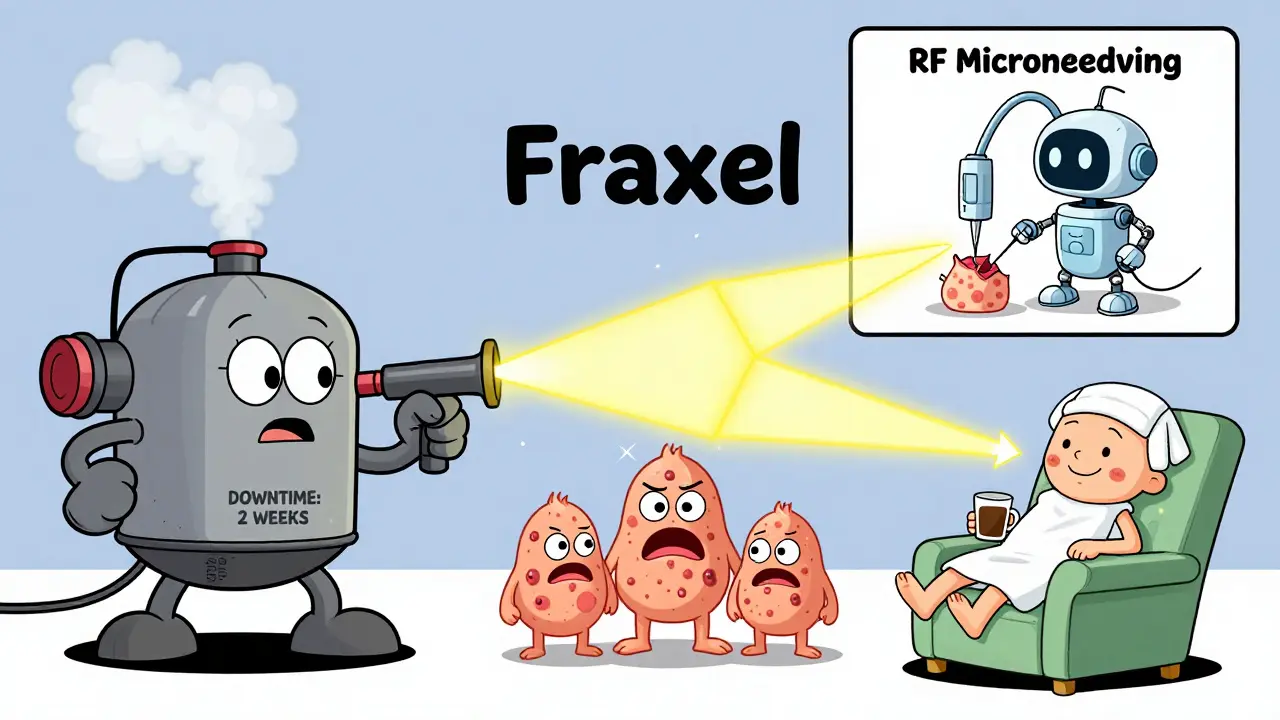
Lasers have been the gold standard for acne scars since the mid-2000s. But not all lasers are the same. Here’s the breakdown:- Fractional CO2 (10,600 nm): Ablative. Removes thin layers of skin. Best for moderate to severe scarring. One session can show big results, but downtime is 7-14 days.
- Fraxel (1,540 nm erbium-doped glass): Non-ablative. Targets deeper layers without removing skin. Requires 4-6 sessions, but recovery is just 3-5 days. Works well for all scar types.
- Er:YAG (2940 nm): Superficial resurfacing. Great for texture and pigment. Less aggressive than CO2, so better for sensitive or darker skin tones.
Which Should You Choose? It Depends
There’s no one-size-fits-all. Your best option depends on your scar type, skin tone, and tolerance for downtime.- Dark skin tones (Fitzpatrick IV-VI): RF microneedling is safer. Lasers carry a higher risk of hyperpigmentation-up to 20% versus 5-8% with microneedling.
- Deep ice pick scars: Neither alone does enough. Consider punch excision or TCA cross first, then follow up with lasers or microneedling.
- Rolling scars: Both lasers and RF microneedling work well. CO2 laser may give faster, more dramatic results.
- Boxcar scars: Fraxel or Er:YAG lasers show strong results with less downtime than CO2.
- Low downtime priority: Go with RF microneedling. You can get 3 sessions in 3 months and still look presentable.
- Severe scarring: CO2 laser or a combination of RF microneedling + laser.
Topical Strategies: The Secret Weapon
You can’t skip skincare. Procedures create the opportunity-but topical treatments lock in the results.- Tretinoin 0.05%: Use nightly for at least 12 weeks before any procedure. A 2023 study found it increases treatment efficacy by 22%. It thins the top layer of skin and boosts collagen.
- Silicone gel: Apply daily after treatments. Reduces hyperpigmentation risk by 35% and softens scar tissue.
- AlphaRet by Skinbetter Science: A new 2023 formula combining retinaldehyde and growth factors. In independent testing, it improved scar appearance by 30% in 12 weeks.
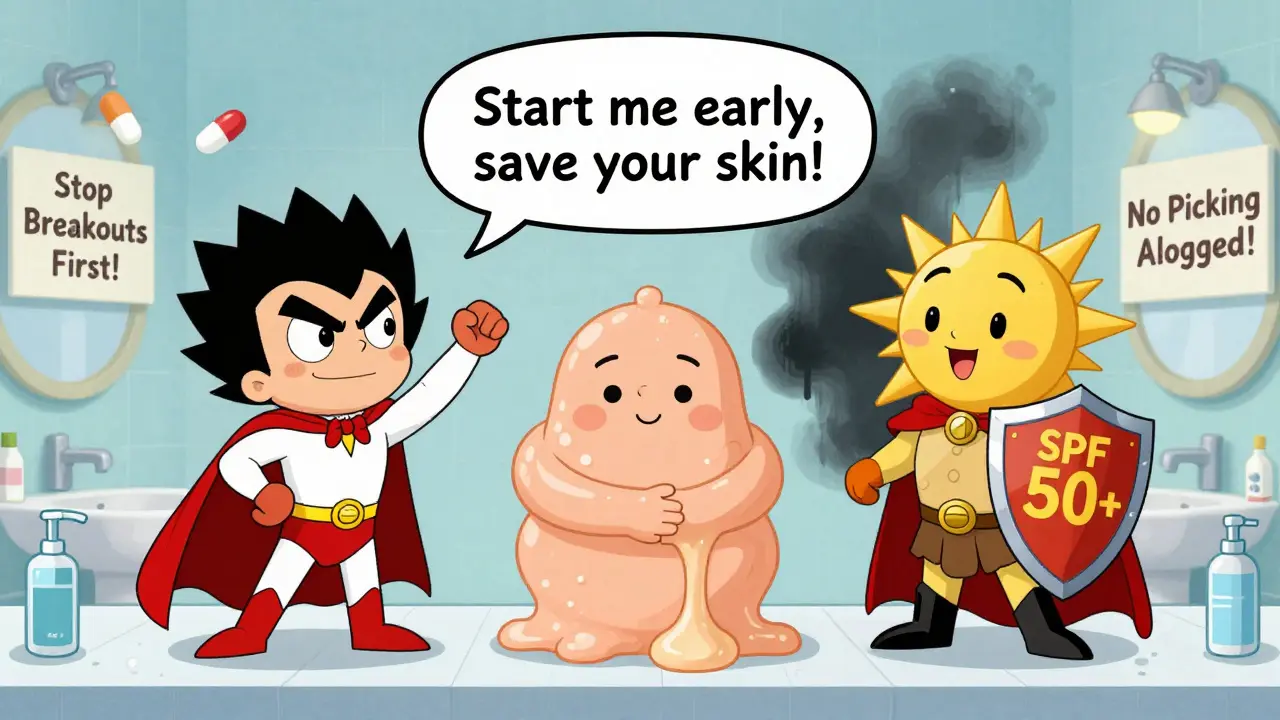
- SPF 50+ daily: Non-negotiable. Sun exposure darkens scars and slows healing. Wear it even on cloudy days.
What to Expect After Treatment
Recovery isn’t glamorous, but it’s worth it.- After microneedling: Redness like a sunburn. Peeling starts around day 2. Avoid makeup for 24 hours. Use gentle cleanser and moisturizer.
- After laser: Crusting, oozing, and swelling for 3-7 days. Use occlusive ointments (like petroleum jelly) for 5-7 days. No picking. Ever.
- Both: No sun exposure for 8-12 weeks. No swimming, saunas, or heavy sweating for 7 days. Avoid retinoids and AHAs/BHAs for 1-2 weeks post-treatment.
Cost, Providers, and Realistic Expectations
Prices vary by region and provider skill. In Brisbane, expect:- RF microneedling: $600-$900 per session (3-6 sessions needed)
- Fractional CO2 laser: $1,200-$2,000 per session (1-3 sessions)
- Fraxel or Er:YAG: $800-$1,400 per session (4-6 sessions)
What’s Next? The Future of Scar Treatment
AI is starting to enter the room. Companies like Canfield Imaging are developing 3D scar mapping tools that analyze scar depth and texture with 40% more precision than the human eye. This means treatments can be customized down to the millimeter. New devices are coming too. The FDA just cleared the ProFractional-XC laser in May 2023-it combines two wavelengths to deliver deep remodeling with only 5 days of downtime. And research is exploring picosecond lasers to target the dark pigmentation often left behind by scars. But the real breakthrough? Early intervention. If you treat acne aggressively and start tretinoin right after clearing it, you can prevent scarring before it starts. That’s the future: not fixing scars, but stopping them from forming.Can microneedling get rid of deep ice pick scars?
Microneedling alone won’t fully erase deep ice pick scars. These narrow, jagged pits require more aggressive methods like TCA cross (chemical peeling into the scar) or punch excision (surgically removing the scar and stitching the skin). Microneedling can help smooth the surrounding area and improve texture, but for the deepest pits, you’ll need a combo approach. Start with a dermatologist who can assess which technique is right for your specific scars.
Is laser treatment safe for darker skin tones?
Traditional ablative lasers like CO2 carry a higher risk of hyperpigmentation in darker skin tones (Fitzpatrick IV-VI). But non-ablative lasers like Fraxel or Er:YAG are much safer. RF microneedling is often the top recommendation for these skin types-it delivers heat deep into the skin without affecting the surface, so it’s less likely to trigger dark spots. Always choose a provider experienced with diverse skin tones and ask about their success rates with patients similar to you.
How long before I see results from microneedling or lasers?
You’ll notice some improvement after the first session-usually less redness and smoother texture. But true collagen remodeling takes time. Most people see clear changes after 2-3 sessions, with full results appearing between 6 and 12 months. That’s because your body slowly rebuilds the structure beneath the skin. Patience is key. Rushing into more treatments too soon can cause more harm than good.
Do I need to stop using retinoids before treatment?
Yes. Stop using retinoids (like tretinoin, adapalene) and AHAs/BHAs (glycolic, salicylic acid) at least 5-7 days before microneedling or laser treatments. These products make your skin more sensitive and increase the risk of irritation or uneven healing. After treatment, wait 1-2 weeks before restarting them. Your provider will give you a specific timeline based on the procedure.
Can I combine microneedling and laser treatments?
Yes-and it’s often the best strategy. Many dermatologists now recommend starting with 3-4 sessions of RF microneedling to remodel the deeper scar tissue, then following up with 1-2 sessions of a non-ablative laser like Fraxel to refine the surface texture. This combo reduces downtime, lowers risks, and delivers better results than either alone. A 2023 study from Creo Clinic showed 78% average scar reduction using this exact sequence.
Are at-home microneedling devices effective for acne scars?
At-home rollers (under 0.5mm depth) are not strong enough to treat acne scars. They may improve product absorption and skin texture, but they can’t stimulate the deep collagen remodeling needed for scars. Professional devices use needles up to 3mm and deliver controlled energy. If you want real results, skip the $30 gadget and see a dermatologist. The risk of infection or scarring from improper home use isn’t worth it.



Brett Pouser
February 9, 2026 AT 11:26Simon Critchley
February 9, 2026 AT 18:00Karianne Jackson
February 10, 2026 AT 23:50Chelsea Cook
February 11, 2026 AT 05:24MANI V
February 11, 2026 AT 14:34Tasha Lake
February 12, 2026 AT 04:21Sam Dickison
February 13, 2026 AT 03:20Jacob den Hollander
February 14, 2026 AT 15:17John Sonnenberg
February 15, 2026 AT 15:55Joshua Smith
February 17, 2026 AT 06:45Jessica Klaar
February 18, 2026 AT 21:28PAUL MCQUEEN
February 19, 2026 AT 16:28glenn mendoza
February 21, 2026 AT 01:19Tori Thenazi
February 22, 2026 AT 01:00