Patient Scenario
The goal isn't to tell a patient which drug to take, but to provide the data and a structured process so they can decide what fits their life. Research shows that when patients are truly involved in these decisions, they score significantly higher on involvement scales-about 22 points higher than those receiving standard care. This isn't just about feeling heard; it's about safety. An informed patient is a patient who adheres to their regimen and spots errors before they become emergencies.
The Science Behind the Tools
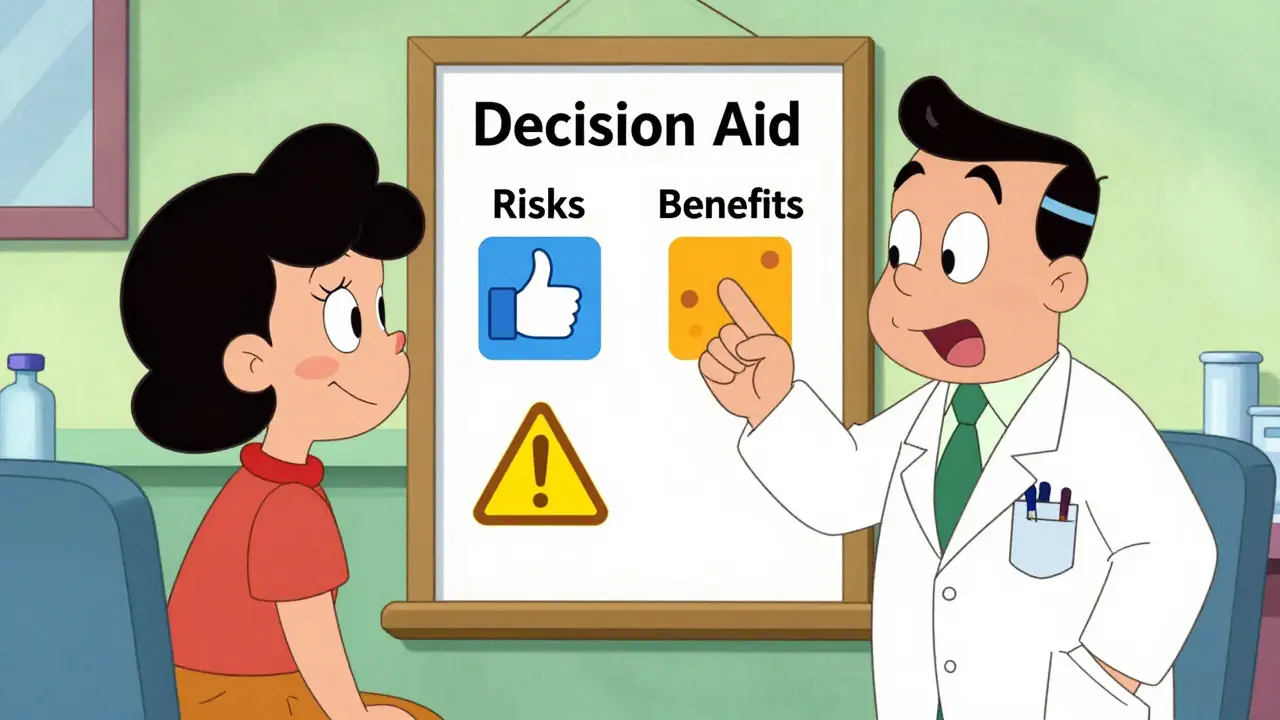
Not every brochure is a decision aid. To be effective, a tool must follow a rigorous set of rules. The International Patient Decision Aids Standards (or IPDAS) Collaboration provides the gold standard for this. To be IPDAS-certified, a tool must provide balanced information, present the probabilities of outcomes, and actually help the patient clarify their own personal values.
When we look at the data, the impact is clear. A massive review of 86 randomized controlled trials found that people using these aids scored over 13 points higher on knowledge tests than those who just talked to their doctor. In practical terms, this means patients actually understand the 10-year risk of a heart attack or the likelihood of a specific side effect, rather than relying on vague terms like "low risk" or "common side effects." For instance, a patient might discover their actual 10-year cardiovascular risk is 7.2%-a concrete number that helps them decide if a statin is necessary, rather than just guessing based on a doctor's general warning.
How Decision Aids Directly Improve Medication Safety
Medication safety isn't just about the right dose; it's about the right drug for the right person. Shared Decision-Making (or SDM) is the process that PDAs enable. When a patient understands the "why" behind a medication, the safety profile improves in several ways:
- Higher Adherence: In diabetes care, using decision aids has been linked to a 17.3% increase in medication adherence over six months. Patients who choose their medication are more likely to take it.
- Reduced Decisional Conflict: PDAs reduce conflict scores by nearly 9 points. This means fewer patients second-guessing their treatment at home, which often leads to dangerous self-adjustments of dosages.
- Better Risk Perception: Users are more likely to have an accurate understanding of risks, meaning they know exactly what red flags to watch for and when to contact their provider.
Take the Mayo Clinic's approach to diabetes. By integrating these tools into their care pathway, they saw medication adherence jump from 58% to 75%. That is a massive leap in patient safety and long-term health outcomes.
| Metric | Standard Care (Verbal/Brochure) | Patient Decision Aids (PDAs) |
|---|---|---|
| Knowledge Gain | Baseline | +13.28 points (average) |
| Decisional Conflict | Higher | -8.7 points (lower conflict) |
| Patient Involvement | Passive | +22.09 points on OPTION scale |
| Adherence (Diabetes) | Lower | ~17.3% increase at 6 months |
The Shift to Digital and Integrated Systems
We've moved far beyond paper pamphlets. Today, the most effective aids are digital and integrated. About 78% of modern aids now include interactive risk calculators, allowing patients to plug in their own data and see real-time probabilities. To make this work in a busy clinic, these tools are increasingly using FHIR APIs to connect directly with electronic health records (EHRs). This means the doctor doesn't have to spend ten minutes typing in data; the tool already knows the patient's history.
For a clinician, the biggest hurdle is time. A typical consultation might only be 15 minutes, and a PDA can add 3 to 8 minutes to that visit. To solve this, many high-performing clinics now send the decision aid to the patient *before* the appointment. This allows the patient to explore the options and clarify their values at home, turning the actual office visit into a focused discussion about a final choice rather than a lecture on basic facts.
Real-World Trade-offs and Limitations
It's not a magic bullet. One of the biggest challenges is health literacy. If a tool is too complex, it can lead to information overload, especially for elderly patients. Research indicates that about 31% of patients in some trials felt overwhelmed by too much data. To fix this, the best clinics use the "teach-back" method, where the provider asks the patient to explain the decision back to them in their own words.
There is also a gap in "hard" clinical outcomes. While we know patients feel better, know more, and stick to their meds more often, some experts, like Dr. Michael Barry, point out that we still need more definitive evidence that this leads to fewer hospitalizations or lower mortality rates. However, the logic is sound: better adherence and fewer errors almost always lead to better clinical results.

What's Next for Medication Safety?
The landscape is changing fast. We are seeing a move toward the Personalized Medication Decision Support System, which uses AI and EHR data to tailor options specifically to a patient's genetic and clinical profile. By 2027, it is predicted that 75% of high-stakes medication decisions will involve these validated aids.
Moreover, the financial incentives are shifting. The Centers for Medicare & Medicaid Services (or CMS) has already begun including shared decision-making as a quality metric in Medicare Advantage plans. This means that providing these tools is no longer just "nice to have"-it's becoming a requirement for high-quality, reimbursed care.
What exactly is a patient decision aid?
A patient decision aid (PDA) is a structured tool-digital or paper-based-that provides balanced, evidence-based information about different treatment options. Unlike a brochure that simply describes a drug, a PDA helps patients compare the benefits and risks of multiple options (including doing nothing) and helps them align that information with their own personal values and preferences.
Do these tools actually make medications safer?
Yes, primarily by increasing medication adherence and reducing errors. When patients participate in the decision process, they are more likely to understand the purpose of the drug and its risks, making them more likely to take the medication correctly and report side effects early. For example, diabetes medication adherence has seen improvements of around 17.3% when these aids are used.
How long does it take to implement these in a clinic?
For clinicians, the initial learning curve is relatively short, typically requiring 2-3 hours of training and a few supervised uses. However, the actual application adds about 3-8 minutes per patient visit. To manage this, many providers distribute the aids via patient portals before the appointment.
Where can doctors find validated decision aids?
The Ottawa Hospital Research Institute's Decision Aids Library is one of the most comprehensive resources, offering over 100 condition-specific tools. It is highly recommended to use tools that are validated against the IPDAS (International Patient Decision Aids Standards) criteria to ensure the information is balanced and unbiased.
Are there any downsides to using PDAs?
The main drawbacks are the time investment during the clinical visit and the potential for "information overload," particularly for patients with low health literacy or the elderly. These risks can be mitigated by using simpler language, interactive digital elements, and the "teach-back" method during the consultation.
Next Steps for Implementation
If you are a healthcare provider looking to integrate these tools, start by identifying "preference-sensitive" decisions in your practice-areas where there isn't one single right answer, but rather a choice between a few viable options (like choosing between different types of blood pressure meds). Select an IPDAS-certified tool and trial it with a small group of patients.
For patients, the next step is simple: ask your doctor if a decision aid exists for your specific condition. If they don't have one, mentioning the Ottawa Hospital Research Institute library can be a great way to start a conversation about shared decision-making. The goal is to move toward a system where you aren't just told what to take, but are guided to the choice that best fits your health and your life.