
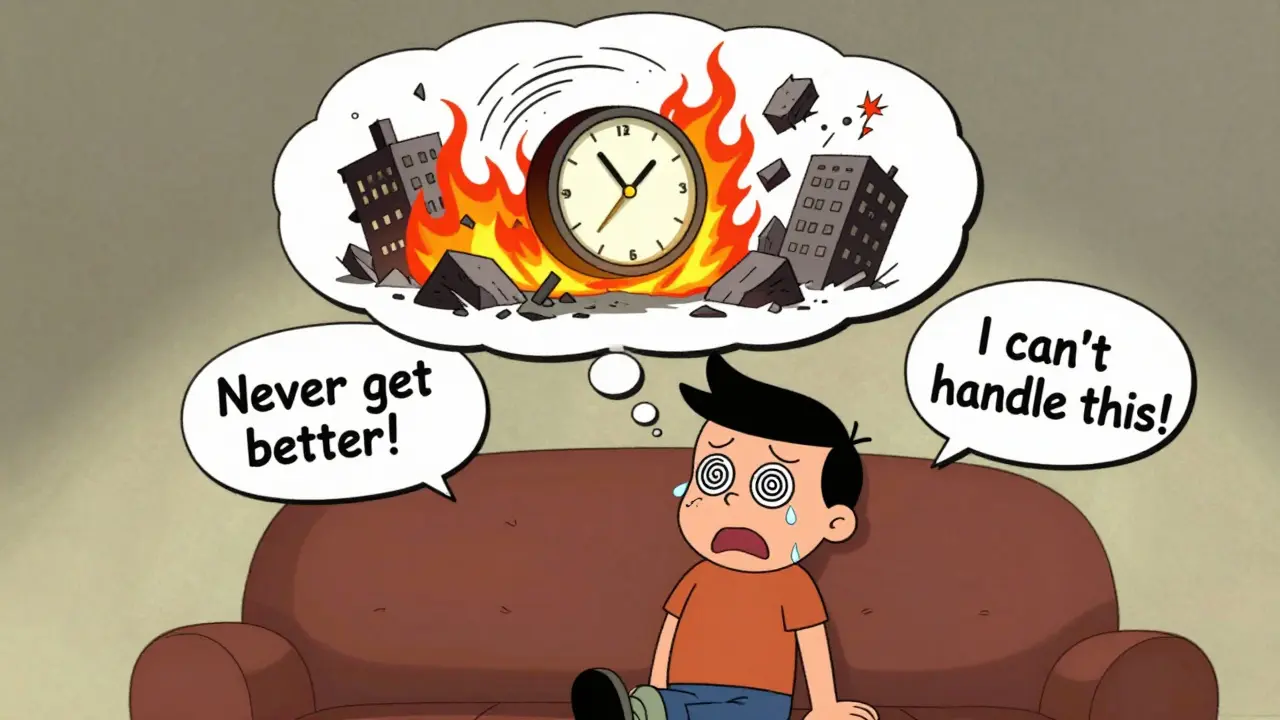
When pain sticks around, it doesn’t just hurt your body-it starts to hijack your mind. You might find yourself thinking, “This will never get better,” or “I can’t handle this anymore,” even before the pain gets worse. That’s not just being negative. It’s pain catastrophizing-a real psychological pattern that makes pain feel worse, last longer, and steal your ability to live normally.
Think of it like this: your brain turns a sharp twinge into a disaster movie. Your body says, “Ouch.” Your mind replies, “This is the end of everything.” And suddenly, you’re stuck-not just with pain, but with fear, anxiety, and avoidance. The good news? You don’t have to stay stuck. Cognitive Behavioral Therapy, or CBT, gives you real tools to break that cycle. Not with pills. Not with surgery. With your own thinking.
What Exactly Is Pain Catastrophizing?
Pain catastrophizing isn’t just “being dramatic.” It’s a measurable, well-studied response backed by decades of research. Experts define it as an exaggerated negative mental set brought on by actual or even imagined pain. It’s not about being weak-it’s about how your brain processes threat.
The Pain Catastrophizing Scale (PCS), developed in the 1990s, breaks it down into three clear parts:
- Rumination: You can’t stop thinking about the pain. It loops in your head like a broken record: “Why won’t it stop? What if it gets worse?”
- Magnification: You blow the danger out of proportion. A small ache becomes “I’m going to be paralyzed.” A flare-up becomes “I’ll never work again.”
- Helplessness: You feel like there’s nothing you can do. No control. No hope. Just suffering.
People with chronic pain who score above 30 on the PCS are in the clinical range. That means their thinking is actively making their pain worse. Studies show this pattern predicts poor outcomes better than almost any other psychological factor. It’s not just in your head-it changes how your brain processes pain signals.
How CBT Breaks the Cycle
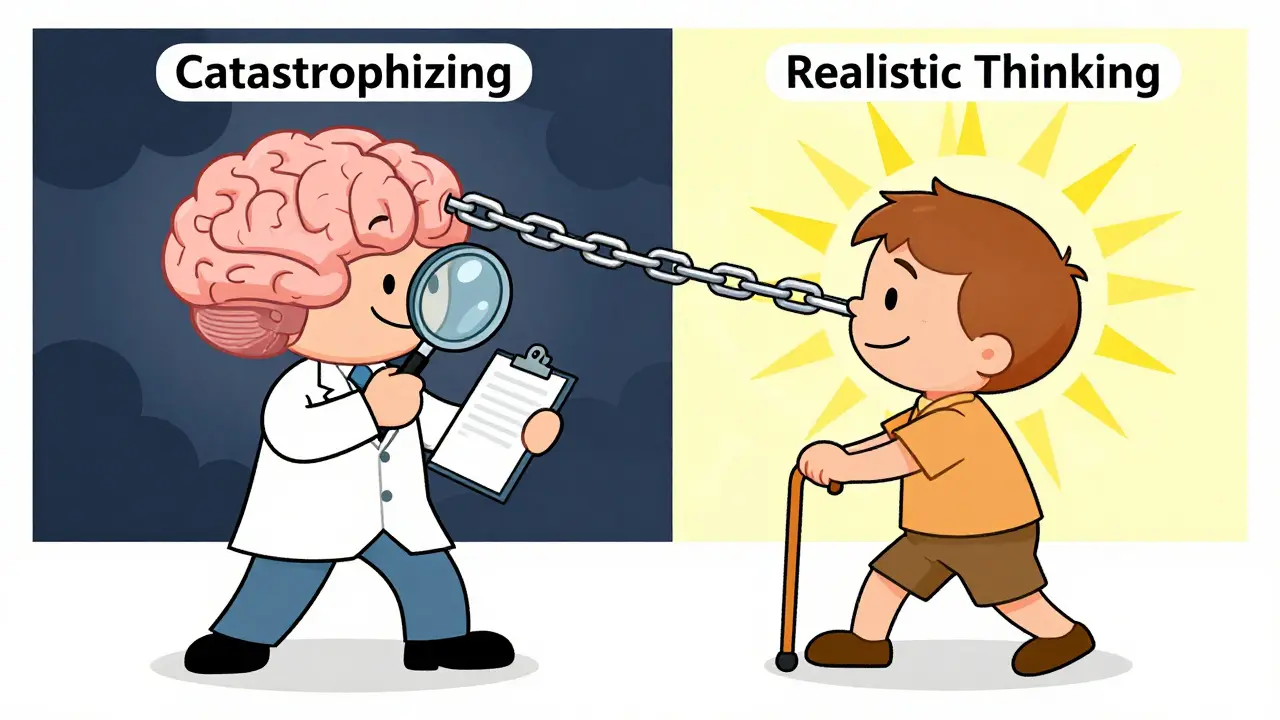
CBT doesn’t try to make the pain disappear. It changes how you relate to it. The goal isn’t to think positively. It’s to think accurately.
Here’s how it works in practice:
- Self-monitoring: You start tracking your thoughts, feelings, and behaviors when pain flares. Not just “I hurt,” but “When I tried to lift my groceries, I thought, ‘I’ll never be able to carry anything again,’ and I dropped everything and sat down.”
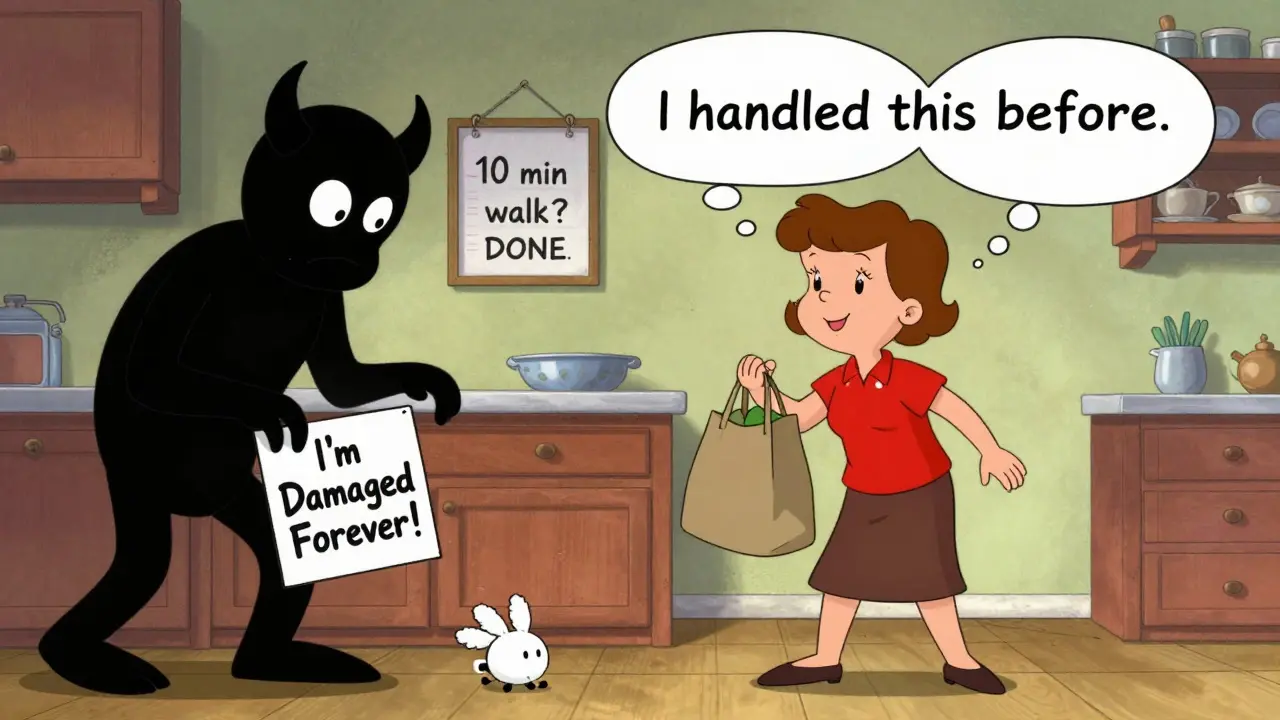
- Cognitive restructuring: You learn to spot the catastrophic thought, pause, and ask: “Is this thought helpful? Is it true? What’s a more realistic version?” Instead of “This pain means I’m damaged forever,” you shift to “This pain is intense right now, but it’s temporary. I’ve handled this before.”
- Behavioral activation: You stop avoiding things because you fear pain. Slowly, you return to activities-even small ones-like walking around the block or cooking a meal. This proves to your brain that pain doesn’t mean danger.
Neuroscience backs this up. Brain scans show that when people catastrophize, areas linked to fear and emotional processing light up more intensely. CBT helps calm those regions. It doesn’t numb the pain-it rewires your reaction to it.
What CBT Looks Like in Real Life
A 45-year-old woman with fibromyalgia started CBT with a PCS score of 42-deep in the clinical range. She avoided leaving the house, feared touch, and cried every morning thinking about the day ahead.
Over 12 weeks:
- She kept a daily journal of thoughts during pain flares.
- She learned to label thoughts as “catastrophic” or “realistic.”
- She replaced “I can’t do anything” with “I can do 10 minutes, then rest.”
- She started walking 5 minutes a day-even on high-pain days.
By week 12, her PCS score dropped to 18. Her pain intensity fell by half. She went back to part-time work. Not because the pain vanished-but because her mind stopped turning it into a catastrophe.
Another example: a veteran with lower back pain used VA’s CBT program. He used to lie in bed for hours, terrified of moving. After learning to separate physical sensation from catastrophic thoughts (“If I stand up, I’ll ruin my spine”), he began doing light stretches. Within months, he returned to gardening-something he hadn’t done in five years.
What Doesn’t Work
CBT isn’t magic. It doesn’t work for everyone-and it’s not a quick fix.
Some people struggle because:
- They expect instant relief. CBT takes time. Most people need 3-4 weeks just to recognize their catastrophic thoughts. Real change takes 8-12 weeks.
- Their pain is too high. When pain hits an 8 or 9 out of 10, the mental energy to do CBT exercises vanishes. That’s normal. The trick? Practice when pain is low. Build the skill so it’s there when you need it.
- They don’t have support. Studies show patients in VA clinics (with structured programs) report 92% satisfaction. Community clinics? Only 76%. The quality of the therapist matters.
Dropout rates are around 22%. People quit because they don’t see results fast enough. But here’s the truth: if you’re still thinking “This will never get better,” you’re not failing-you’re just halfway there.
CBT vs. Other Approaches
There are other therapies for chronic pain. But when it comes to pain catastrophizing specifically, CBT stands out.
Acceptance and Commitment Therapy (ACT) helps people make peace with pain. It’s useful-but studies show CBT reduces catastrophizing more effectively. A 2023 review found CBT’s effect size was nearly double that of other treatments when targeting catastrophizing directly.
Combining CBT with gentle movement (like walking or yoga) boosts results even more. One study showed a 1.0 effect size-meaning patients improved more than 84% of those in control groups.
Medications? They help with pain intensity, but they don’t touch the thought patterns. That’s why CBT is now included in 89% of U.S. multidisciplinary pain programs.
Getting Started
You don’t need to be a therapist to start using these tools. Here’s how to begin:
- Take the PCS: Search for the 13-item Pain Catastrophizing Scale online. It’s free. Answer honestly. If your score is 30+, CBT is likely to help.
- Track one day: Write down every time you have a pain flare. Note: What did you think? What did you feel? What did you do?
- Challenge one thought: Pick the worst thought from that day. Ask: “Is this 100% true? What’s another way to see it?”
- Move a little: Do one small activity you’ve been avoiding. Even if you think, “I’ll regret it.” Do it anyway.
Apps like Curable and PainScale offer guided CBT exercises designed for pain catastrophizing. They’re not replacements for therapy-but they’re powerful tools if you can’t find a specialist.
Why This Matters Now
The global chronic pain market is growing fast. But the real shift isn’t in pills or devices-it’s in how we treat the mind’s role in pain. Since 2020, the U.S. Veterans Health Administration has required all chronic pain patients to be screened for catastrophizing. By 2025, 75% of pain clinics will do the same.
Why? Because pain isn’t just a signal. It’s a story. And when the story is full of fear and doom, the body believes it. CBT helps you rewrite that story-one thought at a time.
Can CBT really reduce physical pain, or just how I feel about it?
CBT doesn’t remove the physical sensation of pain, but it reduces how much your brain amplifies it. Studies show people who complete CBT for pain catastrophizing often report 30-50% reductions in pain intensity-not because their injury changed, but because their brain stopped interpreting pain as a threat. The body responds to the mind’s signal. If the mind says, “This is dangerous,” the body tightens up, releases stress hormones, and feels more pain. CBT breaks that loop.
Do I need a therapist to do CBT for pain catastrophizing?
You don’t need a therapist, but you’ll have better results with one. A trained therapist helps you spot blind spots in your thinking and guides you through tough emotional moments. That said, high-quality apps and workbooks (like those from the VA or Stanford) can be very effective if you’re consistent. Many people start with self-guided tools and then seek a therapist if they get stuck.
What if I’m too overwhelmed to do CBT exercises?
That’s common-and normal. When pain is at its worst, your brain is in survival mode. You won’t be able to think clearly. That’s why CBT works best when practiced during low-pain moments. Think of it like training for a marathon: you don’t run when you’re injured. You build strength on good days so you’re ready when pain flares. Start with one minute a day. Just one. Write one thought. That’s enough.
Is pain catastrophizing the same as depression?
They’re related, but not the same. Depression is a broad mood disorder. Pain catastrophizing is a specific thinking pattern focused on pain. Many people with chronic pain have both, but you can have high catastrophizing without depression-and vice versa. CBT targets the thought patterns around pain, not general sadness. If you’re also depressed, treating both at once gives the best results.
How long does CBT take to work for pain catastrophizing?
Most people start noticing shifts in 3-4 weeks, especially in how often they get stuck in catastrophic thoughts. But real, lasting change takes 8-12 weeks of consistent practice. Think of it like learning a new language. You won’t speak fluently after one lesson. But after months of daily practice, it becomes automatic. The same goes for rewiring your pain response.
Final Thought
Pain is hard. But your thoughts about pain? They’re not facts. They’re habits. And habits can change. You don’t need to be brave. You just need to be curious. Ask yourself: “Is this thought helping me, or trapping me?” That simple question is the first step out of the spiral.




Korn Deno
March 23, 2026 AT 18:41Grace Kusta Nasralla
March 25, 2026 AT 13:29Pat Fur
March 27, 2026 AT 02:17Natasha Rodríguez Lara
March 27, 2026 AT 16:48Aaron Sims
March 28, 2026 AT 16:46Stephen Alabi
March 29, 2026 AT 13:54Aaron Sims
March 30, 2026 AT 10:35Anil Arekar
April 1, 2026 AT 06:39Agbogla Bischof
April 2, 2026 AT 09:24Elaine Parra
April 2, 2026 AT 22:23Linda Foster
April 4, 2026 AT 17:54James Moreau
April 6, 2026 AT 08:30Amber Gray
April 6, 2026 AT 10:50Chris Crosson
April 8, 2026 AT 09:29